



Image: METAL
Summary
- On October 12, Z.ai unveiled GLM-Legal, a legal-specialist model built on GLM-5.3-Flash and designed, the company said, for contract review, evidence analysis and compliance research.
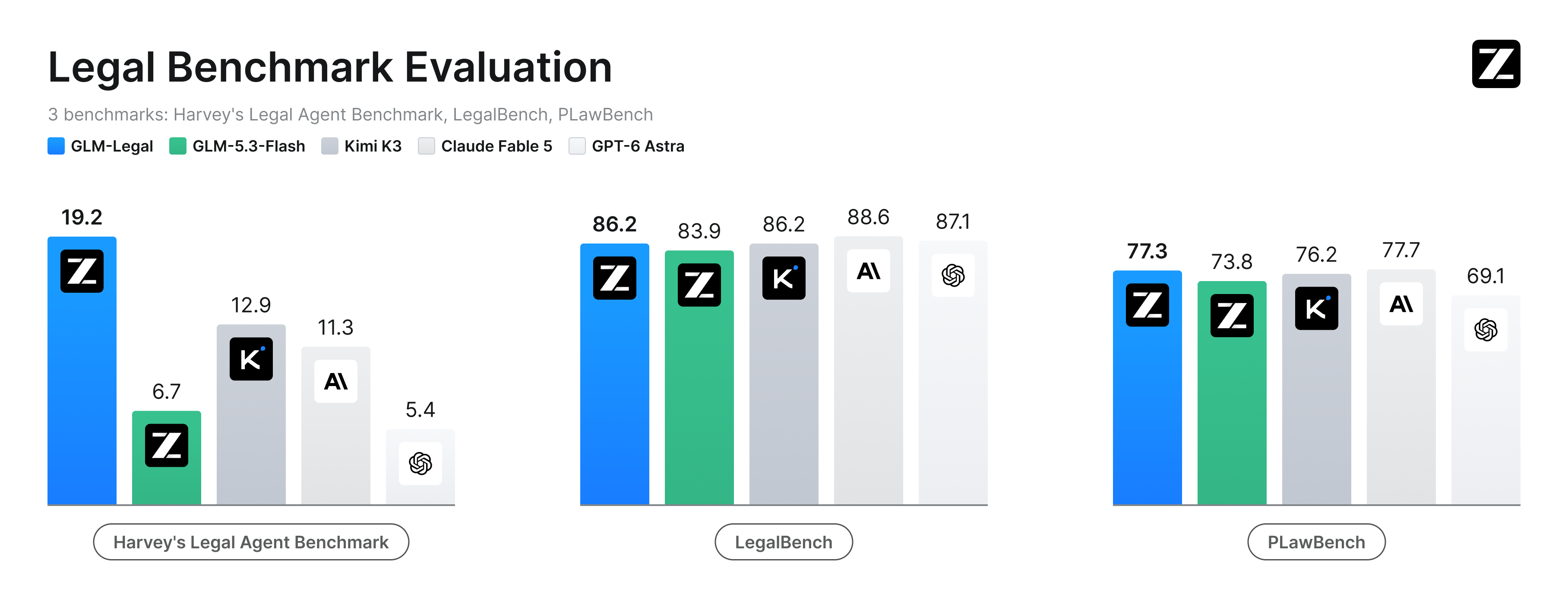
- Its all-pass rate on Harvey LAB was 19.2%, ahead of Kimi K3 (12.9%) and Claude Fable 5 (11.3%), while its LegalBench score of 86.2% and PLawBench score of 77.3% put it close to top closed-source models.
- Independent evaluator Vals ranked it 7th of 79 models on Harvey LAB and 14th of 150 on LegalBench; the model is taking API beta applications and is coming to AutoClaw soon.
Chinese AI lab Z.ai on October 12 unveiled GLM-Legal, a legal-specialist model trained for legal work. It is built on the lightweight base model GLM-5.3-Flash, and Z.ai said it was designed for real legal workflows such as contract review, evidence analysis and compliance research. On the legal agent benchmark Harvey LAB, the share of tasks that passed every grading criterion in one go was 19.2%, 12.5 percentage points higher than the base model. The company claimed it also matched top closed-source models on the legal reasoning benchmark LegalBench and the Chinese legal practice benchmark PLawBench.
In its technical blog, Z.ai began by explaining why it chose legal practice. "Legal practice demands an unbroken chain between facts, statutory doctrine, analytical reasoning, and client-ready work product," the company wrote. In other words, a model has to extract the core issues from source documents, build defensible arguments and follow the exact format a task requires, all at the same time. The company said satisfying all of these constraints is the true test for a domain-specific model.
The biggest gap showed up on Harvey LAB. The benchmark sets law firm tasks across 24 practice areas and counts a task as failed if any single grading criterion is missed. In a chart published by Z.ai, GLM-Legal scored 19.2%, Kimi K3 12.9%, Claude Fable 5 11.3%, GLM-5.3-Flash 6.7% and GPT-6 Astra 5.4%. On LegalBench, GLM-Legal and Kimi K3 tied at 86.2%, while Claude Fable 5 led at 88.6% and GPT-6 Astra at 87.1%. On PLawBench, GLM-Legal's 77.3% trailed Claude Fable 5's 77.7% by 0.4 percentage points and beat GPT-6 Astra's 69.1%.
These figures do not rest on the company's own measurements alone. According to Z.ai, the Harvey LAB and LegalBench results were independently evaluated by AI evaluation firm Vals. The Vals evaluation page that METAL reviewed ranked GLM-Legal 7th of 79 models on Harvey LAB (19.17%) and noted it had the lowest cost per test among the top 10 models. On LegalBench it ranked 14th of 150 (86.24%), the best score a GLM model has posted on that benchmark, and on the legal research benchmark Legal Research Bench it ranked 24th of 78 (41.83%). That also means six more models sit above it on Harvey LAB beyond the four rivals in the company's chart.
Training came in two stages. In mid-training, Z.ai expanded the volume of high-quality legal corpora so the model could learn legal concepts, statutory rules and interpretive frameworks. In post-training, it ran reinforcement learning across tens of thousands of realistic legal environments to teach the model to plan analysis, advance workflows and produce deliverables. Z.ai said it refined the model together with the harness, the runtime framework that manages task context, connects tools and routes execution feedback. Edge cases surfaced in training point to bottlenecks in the harness, and the refined harness in turn teaches the model the constraints of real work.
Practitioner feedback becomes a loss signal. The company listed four review criteria: whether all critical issues and edge cases are addressed, whether arguments are well substantiated and citations legally sound, whether the deliverable strictly follows the matter brief, and whether downstream teams can use it immediately without rework. When missed facts, shallow analysis or format deviations appear, the company said it inspects the entire pipeline to isolate whether raw model intelligence, context staging or workflow logic is to blame.
Three demonstrations in the blog put the model side by side with its base. In reviewing a software services contract for a client switching providers, GLM-5.3-Flash only advised shortening the notice period, while GLM-Legal wrote that convenience-termination notice should drop from 60 to 30 days and that the 30-day cure period should be removed for breaches of IP, confidentiality or data-security obligations so the client could terminate immediately. It also added up to 90 days of transition assistance. In a dispute demonstration analyzing 40 documents, it tied the September 30 report's "60% COMPLETE" label to internal records showing roughly 41% progress and to the CEO's instruction to suppress the risk and keep invoicing. In a demonstration for a simultaneous launch in Singapore, Malaysia and Indonesia, it produced a pre-launch checklist citing each country's data protection law provisions.
Seen through a tech lawyer's lens, what weighs more than the headline number is the flip side of a 19.2% pass rate. Even for the leading model, roughly four of every five tasks miss at least one grading criterion. Z.ai itself left a line in the evidence demonstration advising users to reconcile the completion measures and test the remaining claim elements before drawing a final conclusion, and it stressed that the model keeps facts and inferences distinct. Responsibility for legal work product stays with the person who signs it. A near threefold jump in pass rate over the base model changes the starting point for drafting, but it is no reason to cut the review stage.
METAL has reported that the anonymous model Ox Alpha turned out to be GLM-5.3-Flash, and also covered OpenAI's case study on legal AI company Harvey adopting GPT-6 Astra. This release shows that lightweight base model going head to head with large closed-source models in the narrow field of law. "GLM-Legal matches frontier models on mainstream legal benchmarks," Z.ai said in its X post, which had 367,400 views at the time of collection.
GLM-Legal is still in beta. Z.ai is accepting API access applications from law firms, legal tech companies, in-house legal teams and independent practitioners, and said the model will soon be available in AutoClaw, its desktop agent platform. A feature that inserts contract edits into a Word document as tracked changes and comments has been previewed. The company did not disclose a launch date or the range of supported languages. More than how fast specialist models catch up with general-purpose scores, the next question is how far practitioners will trust that output enough to sign it.



Comments