



Summary
- Meta unveiled Muse Wonder and Muse Wonder Full on October 12. Muse Wonder is offered through the Meta Model API and Muse Code, while Muse Wonder Full is available only to Muse Code subscribers.
- On Meta's benchmark table, Muse Wonder Full ranked first with 59.1 on the Personal Superintelligence Index and 13.1 on Harvey LAB-AA, but scored 56 on the Artificial Analysis Index, behind Claude Opus 5.5 at 58.
- Meta highlighted Active Memory, which remembers across conversations, and Muse Wonder posted the highest MemoryBench score at 85.6. It will soon come to the personal agent Muse, starting with subscribers.
Meta on October 12 unveiled Muse Wonder and Muse Wonder Full, its first frontier models. In its announcement, Meta introduced the two as the most capable models it has released so far and said they deliver state-of-the-art performance on agentic tasks that handle personal and professional work on a user's behalf. Muse Wonder is available from launch day through the Meta Model API and the coding tool Muse Code, while Muse Wonder Full opened only to Muse Code subscribers. Both models have a context window of 1 million tokens.
The launch is the first report card on Meta's AI reorganization. Meta said it began overhauling its AI business 14 months ago and has moved from rebuilding its foundations to pushing the frontier. According to reports, these are the first frontier-class models since Scale AI founder Alexandr Wang restructured Meta's AI organization in August last year, and in the meantime Meta had released only the lightweight Muse Spark model and the personal agent Muse. "Together, they mark the next step on our scaling ladder and a major leap toward personal superintelligence," Meta wrote on its research blog. According to reports, training took place at gigawatt scale at the Prometheus data center in central Ohio, which came online this year.
Meta is not aiming only at coding. The announcement cited tasks such as handling an insurance claim, understanding a lease and making sense of personal finances, and said the two models cover expert domains such as law, finance and health alongside frontier-level coding. Meta's developer page says Muse Wonder plans long tasks, delegates parts of them to sub-agents, calls tools in parallel and recovers from errors on its own to carry out multi-step work that runs for hours without interruption. It also includes computer use, seeing and directly operating browser, desktop and mobile app screens. According to reports, both models accept text, images, video and audio as input.
The benchmark table on Meta's developer page, which METAL reviewed, compares the two models side by side with Claude Fable 5.1, GPT-6 Astra and Claude Opus 5.5 across 14 items. The scores in the table are figures Meta published. On the Personal Superintelligence Index, an internal Meta composite of personal and knowledge work, Muse Wonder Full scored 59.1, ahead of Claude Opus 5.5 (55.2), GPT-6 Astra (54.5) and Claude Fable 5.1 (49.9). On the legal agent task Harvey LAB-AA it scored 13.1, the highest among the models compared, while Claude Opus 5.5 scored 4.2. It also ranked first with 59.1 on the financial analysis task Vals Finance Agent V2 and 45.4 on the business automation task AutomationBench-AA.
It did not win every item. In the same table, Claude Opus 5.5 scored highest on the health queries test HealthBench Pro (65.6), the professional tool use test JobBench (75.4), the terminal coding test Terminal-Bench 4.0-AA (59.6) and ProgramBench (70.5), which builds programs from scratch, and it also topped Muse Wonder Full (56) on the external Artificial Analysis Index with 58. In coding, what Meta emphasized was long-horizon work. Muse Wonder Full beat every comparison model with 79.0 on the long-horizon coding task DeepSWE 1.1 and 57.5 on the ultra-long-horizon engineering task SWE-Marathon, and Meta said these results were also confirmed in independent third-party runs.
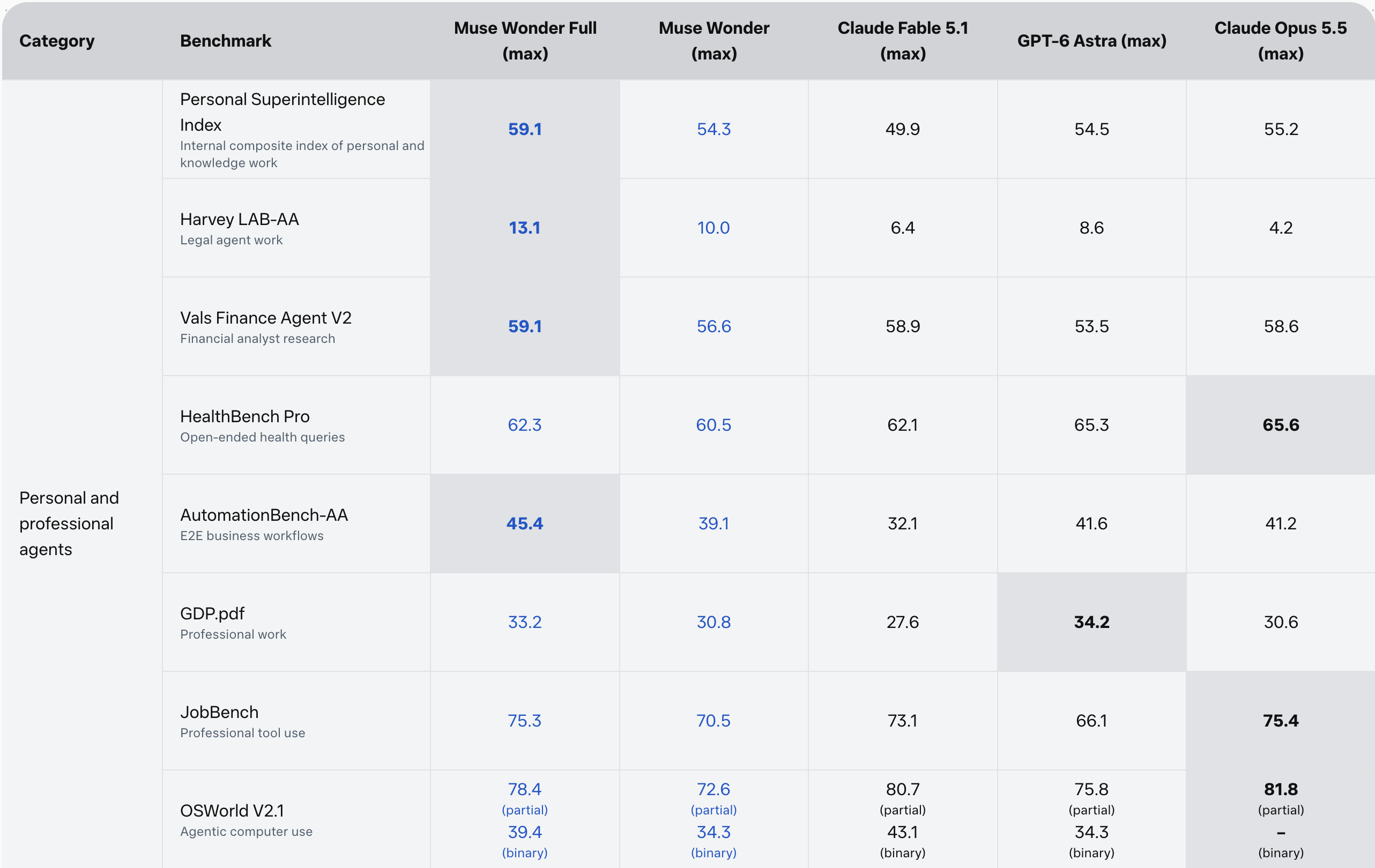
Memory is where Meta put the most effort. Meta named the ability to remember what matters to a user across conversations and bring it back when needed Active Memory, and the ability to try other approaches when a task gets stuck, recover from errors and ask for confirmation before acting on anything important Active Focus. On MemoryBench, which measures remembering context, Muse Wonder scored 85.6, the highest of the five models in the table. "We put a tremendous amount of effort into making sure that our model can remember what's important to you over days, weeks, months and beyond," Meta research scientist Kavya Kopparapu said in the launch video.
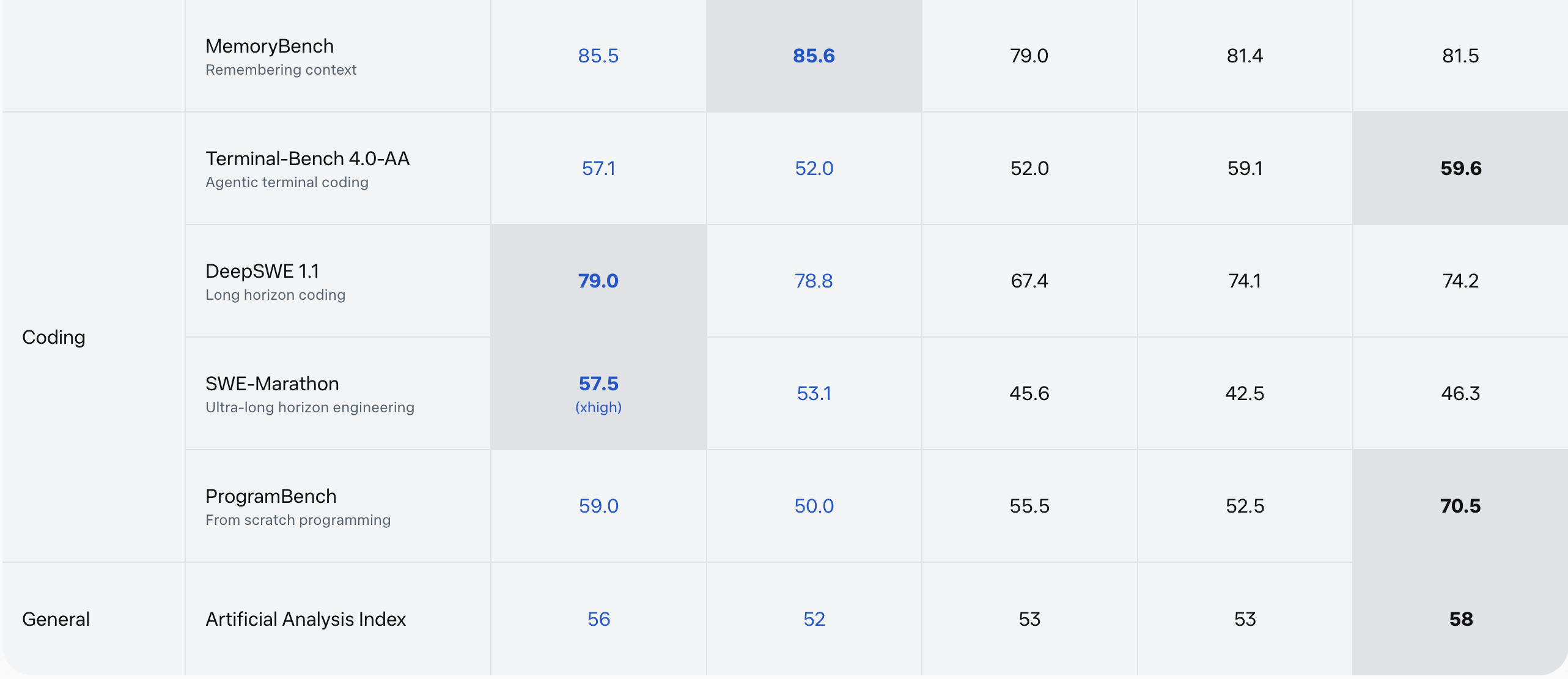
External measurements paint a similar picture. According to reports, on the Artificial Analysis Intelligence Index Muse Wonder Full scored 56 and Muse Wonder 52, well up from 48 for the predecessor Muse Spark 1.3, and the Terminal-Bench 4.0 score jumped from 33% to 57%. On ProofBench, a private benchmark of mathematical proofs, it solved 94 of 100 problems, far above the predecessor's 58. Factual knowledge was singled out as a weak spot. On the AA-Omniscience knowledge test, Muse Wonder Full scored 30, short of Claude Opus 5.5 at 46, GPT-6 Astra at 43 and Gemini 4 Argon at 42. Its hallucination rate, however, fell from the predecessor's 33% to 23%. METAL has reported that Meta released Muse Spark 1.3 with an emphasis on coding benchmarks, and this time Meta has effectively stacked a large-model tier on top of that lightweight model.
Safety measures came with the launch. Meta said that because a personal agent works across messages, calendars and documents, it trained both models to avoid sharing private information without permission and to turn down requests to assist in actually harmful acts. It left intact the ability of security teams to find flaws in their own code. Meta added that it trains, evaluates and releases its most capable models in line with the standards of the Meta Superintelligence Scaling Framework, and that a full report with additional safety evaluations will be released soon.
The next stage is the personal agent Muse. Meta said Muse Wonder will soon power more of Muse, rolling out first to subscribers. METAL has reported that Meta launched the personal agent Muse running on a secure virtual machine. Meta called this launch "a major step toward personal superintelligence for everyone." Most of the figures in the table are Meta's own measurements, and the full safety report has not yet been released. How much a model that remembers a user's messages and calendar for months actually changes the Muse experience will be the first test of these numbers.
Sources
- Meta — Introducing Muse Wonder and Muse Wonder Full: Frontier Models for Agents →
- Meta — Muse Wonder | Meta for Developers →
- TechCrunch — Meta releases its first frontier model, Muse Wonder →
- The Decoder — Meta's new frontier model Muse Wonder Full breaks into the AI top tier →
- X — We're excited to introduce the Muse Wonder series (@AIatMeta) →



Comments