


Image: METAL
Summary
- Crusoe announced on July 21 that it will deploy 5 gigawatts of ON.energy's AI UPS across multiple hyperscale campuses, with commissioning starting in 2026 and extending into 2027.
- Power demand at AI training facilities can swing hundreds to thousands of times a day, and in July nearly 4 gigawatts of data center load in Virginia disconnected from the grid at once.
- The AI UPS has been tested at the National Laboratory of the Rockies and validated against ERCOT's large-load requirements, but data centers must be designed for it from the start.
A new kind of uninterruptible power supply (UPS) that places lithium-ion batteries between AI data centers and the power grid is preparing for commercial deployment. It is the AI UPS from U.S. startup ON.energy. AI infrastructure company Crusoe announced on July 21 that it will deploy 5 gigawatts of AI UPS with ON.energy across multiple hyperscale campuses, with commissioning starting in 2026 and extending into 2027. According to reporting, the order is ON.energy's first test of the centralized UPS at commercial scale.
The problem starts with how AI data centers use power. According to Crusoe's announcement, thousands of GPUs ramp up and down in synchronized bursts during training, and demand at a large AI training facility can switch between high and low hundreds to thousands of times a day. If unmanaged, those swings can propagate through the point of interconnection into the transmission system. Shahil Shah, chief engineer at the National Laboratory of the Rockies, formerly the National Renewable Energy Laboratory, said demand can jump "from 5% to 100% in a few milliseconds," adding, "You're hammering the grid if you do that."
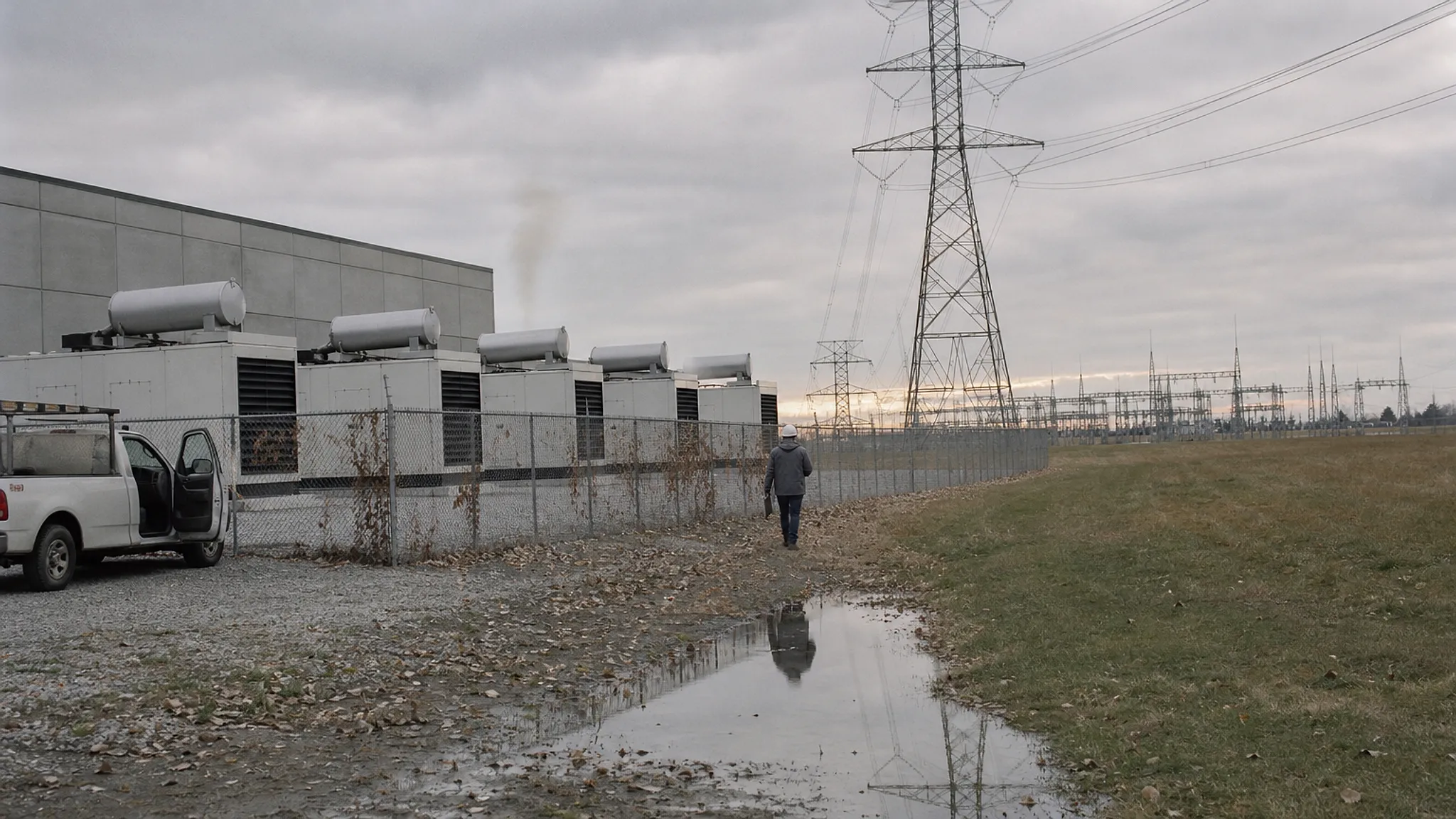
There is also risk in the other direction. Data centers are sensitive to power quality and can drop off the grid in an instant, switching to their own UPS and backup generators. At that moment, a huge block of demand suddenly vanishes from the system. According to reporting, grid operator PJM Interconnection has recorded several multi-gigawatt drop-offs in recent years, including one in July in which nearly 4 gigawatts of data center load in Virginia disconnected at once. The North American Electric Reliability Corp. (NERC) has moved to set new requirements for large "computational loads," and Texas regulators introduced similar requirements this year. "Many power system operators are coming up with requirements to make sure that the data center loads — the large loads — don't negatively impact the reliability of the grid," Shah said.
Conventional data center UPS systems cannot do this job. Most are banks of old-fashioned lead-acid batteries that sit beside servers and do nothing useful except when utility power flickers or fails, much like diesel backup generators. The AI UPS sits at medium voltage between the grid and the data center. "The grid sees a battery that's always charging, and the load sees a battery that's always outputting perfect quality power," said Alan Cooper, co-founder and CEO of ON.energy. "In an oversimplified way, it smashes together BESS and UPS into a single asset." The company says its patented double-conversion design fully decouples the load from the power source electrically. ON.energy holds U.S. Patent 12,614,920 for this medium-voltage double-conversion UPS architecture, with a priority date of September 2, 2022.
Validation came first at the lab. On January 15, ON.energy announced it had completed construction of the AI UPS at the National Laboratory of the Rockies' Flatirons Campus near Boulder, Colorado. The lab simulated the power profile of an AI data center with fast-moving GPU spikes, along with grid-connected and off-grid conditions, to test the system. "The teams have gone from first contact through contracting and construction in less than six months," said Andrew Hudgins, the lab's ARIES program manager. Shah runs the grid simulator lab that tested the AI UPS at multi-megawatt configurations and is also testing a similar battery system from Prevalon Energy and others he cannot yet name.
According to Crusoe's July 21 announcement, which METAL reviewed, the AI UPS has been validated against ERCOT's large-load interconnection requirements, including NOGRR 282 and low-voltage ride-through (LLVRT) protocols. The announcement says the system stores enough energy to power an entire campus for extended durations, significantly reducing grid variability during peak hours. "This technology protects our infrastructure, it protects our generation assets, and it aligns with where grid requirements are heading," said Chris Dolan, Crusoe's chief data center officer.
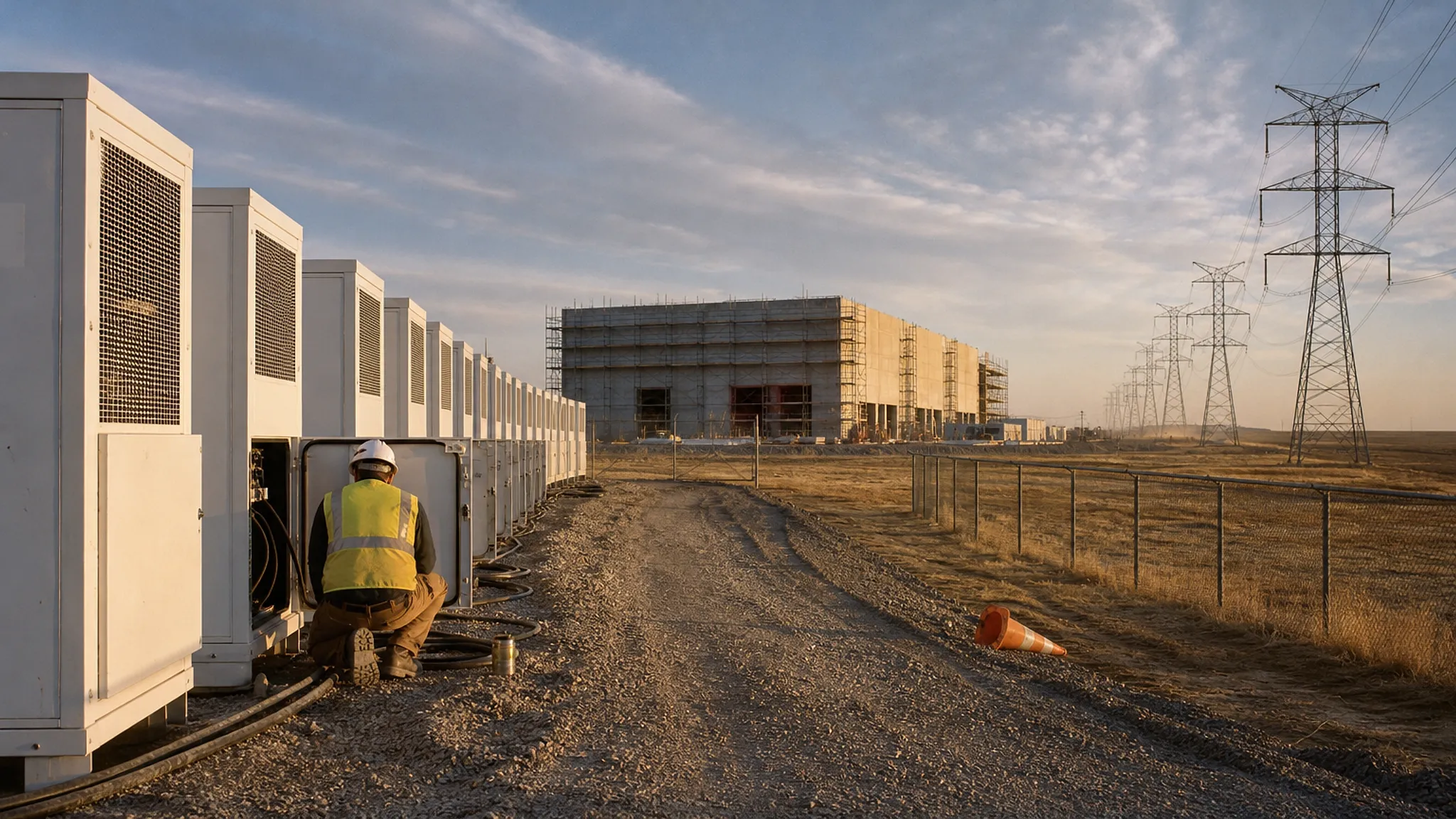
Adoption comes with conditions. According to Cooper, data centers must be designed from the start to use the AI UPS. In aerial photos of a Crusoe campus under construction that he showed, the central building in the first phase will house traditional UPS systems, while land beside the most recent building has been set aside for AI UPS batteries. According to reporting, data center developers still see fossil fuels as more reliable for round-the-clock power and are wary of adding batteries without a clear payback.
From a journalist's vantage point, the device matters for whether data centers can shift from a pure burden on the grid to a resource that can be dispatched. Data center operators face pressure over passing the costs of grid expansion and new power plants on to electricity customers. A battery that has already paid its way as a UPS and grid-stabilization tool makes it easier to justify using it to shave peak demand or store surplus solar and wind power. METAL has previously reported that U.S. data center land purchases reached $6 billion in the first half as power access became the key driver of land prices. "The main thing is, you have a battery on site that's multi-hour duration, and you're able to curtail the data center from the grid whenever you need," Cooper said. "It's kind of a natural way to get data center flexibility."

Comments