



Image: METAL
Summary
- An international team of scientists reported that 7 of 16 climate indicators are at record extremes.
- The rate of global warming has risen from 0.05 to 0.36 degrees Celsius per decade, and at this pace warming could reach 2 degrees before 2050.
- Renewable power overtook coal for the first time in 2025, but rising energy demand pushed fossil fuel use and emissions to record highs as well.
An international team of scientists published the 2026 state of the climate report in the journal BioScience on October 14. William Ripple, a professor at Oregon State University, is the lead author, and climate scientists including Michael Mann and Johan Rockström joined as co-authors. Of the 16 climate indicators the team tracks, 7, or 44%, have reached their most extreme values on record. The researchers wrote at the opening of the report that "this is no longer a warning for the future; it is a diagnosis of the present."
The record-breaking indicators start with greenhouse gases. In May 2026 the atmospheric concentration of carbon dioxide exceeded 428 ppm, about 50% above pre-industrial levels. Methane and nitrous oxide also reached record highs on a year-to-date average basis. The report said most of this rise comes from burning fossil fuels. It also cited the Intergovernmental Panel on Climate Change (IPCC) assessment that carbon dioxide levels are the highest in 2 million years.
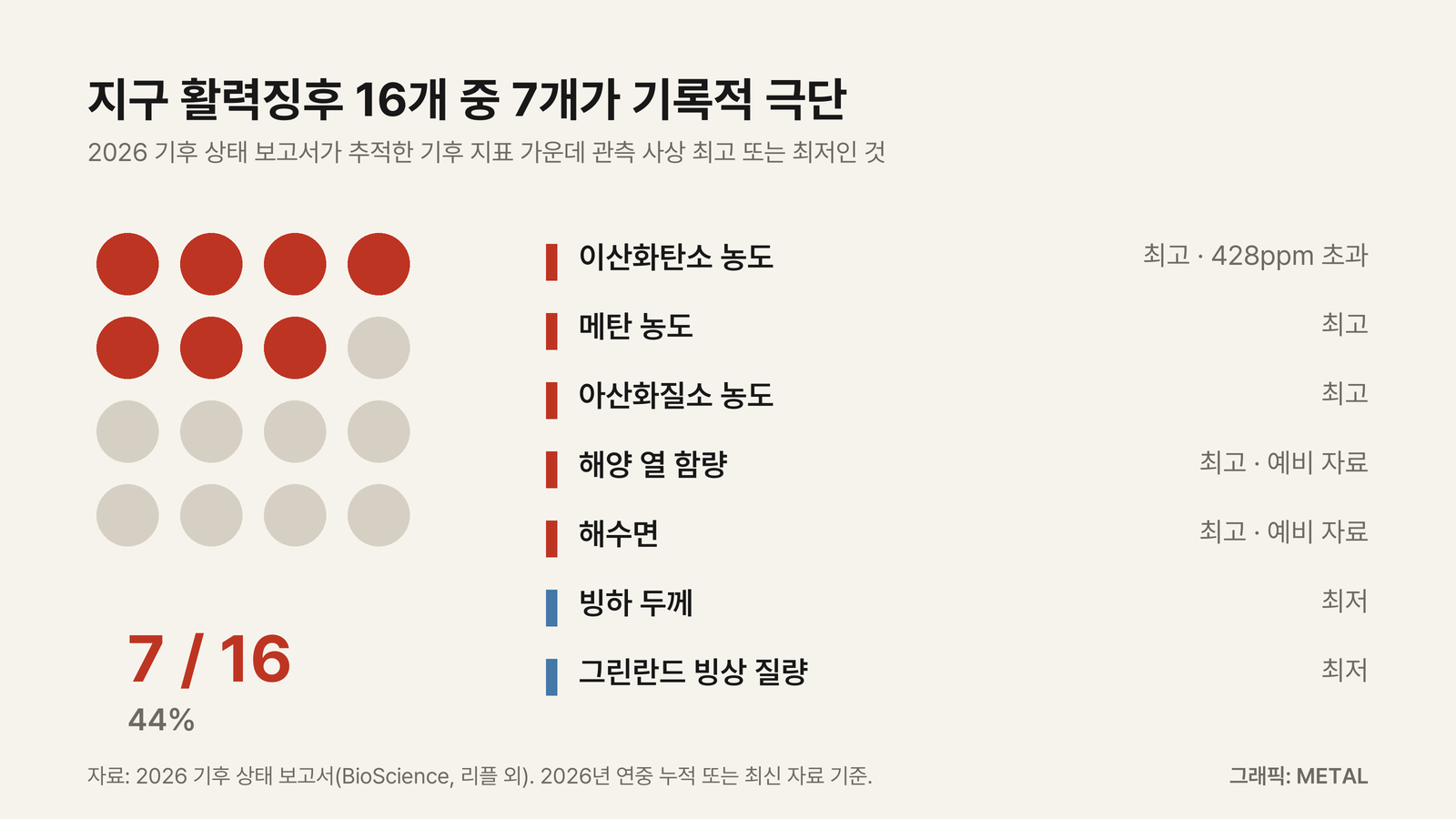
Ice and ocean indicators point the same way. Glacier thickness and Greenland ice sheet mass fell to record lows, while minimum Arctic sea ice extent and Antarctic ice mass change came close to record lows. Ocean heat content and sea level, by contrast, are at record highs based on preliminary data. According to research cited in the report, thermal expansion, the swelling of seawater as it warms, explains about 56% of sea level rise in recent decades. More frequent marine heatwaves are leading to coral bleaching and disruption of marine ecosystems.
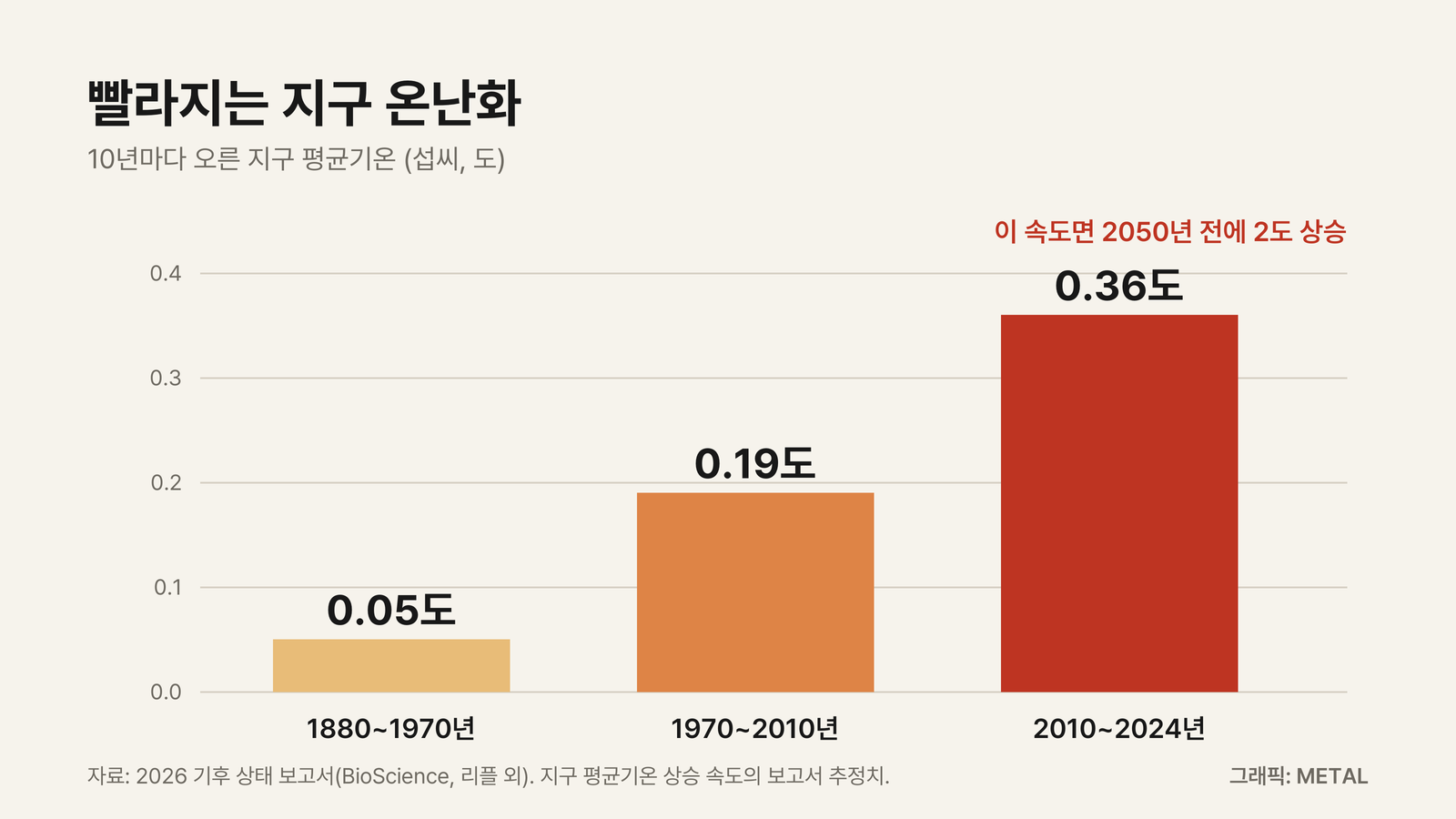
The number the researchers weighed most heavily is the speed of warming. According to the report's analysis, the rise in global temperature grew from about 0.05 degrees Celsius per decade in 1880 to 1970, to about 0.19 degrees in 1970 to 2010, and to about 0.36 degrees in 2010 to 2024. The researchers judged that at the current pace, warming of 2 degrees above pre-industrial levels could arrive before 2050. One candidate cause is the decline of aerosol pollutants that had masked part of greenhouse gas warming. The report also includes analysis finding the 2023 to 2024 temperature spike within the range of state-of-the-art climate models, so interpretations of how much warming has accelerated differ.
El Niño adds to this. The report expects a very strong El Niño beginning in early autumn 2026 to cause substantial additional warming, putting this year on track to be one of the hottest on record. July 2026 was already the hottest month for the contiguous United States since records began in 1895, and global ocean temperatures that month reached a record for July. According to reports, Ripple said El Niño is a natural phenomenon but is now occurring on a much warmer planet.
The cost of extreme weather showed up in death tolls. Hurricane Melissa in October 2025 killed 95 people, mainly in Jamaica and Haiti, and caused more than 12.2 billion dollars in damage. In November of that year, flooding in Sumatra, Indonesia, killed 708 people, and record rainfall in south-central Vietnam killed 90. Excess deaths from the June 2026 European heatwave are about 14,000 by a preliminary estimate. The researchers presented attribution studies indicating that these events were at least partly caused by climate change.
Tipping point warnings centered on the Amazon. According to analysis cited in the report, the Amazon rainforest can withstand warming alone up to 3 to 5 degrees. When warming and deforestation act together, however, it could cross an irreversible threshold at 1.5 to 1.9 degrees. The report also includes an estimate that greenhouse gases released from nature by warming, such as from permafrost, wetlands and wildfires, could increase human-caused warming since 2020 by 20 to 30% by 2100. Global tree cover lost to fire in 2025 was 10.8 million hectares, the third-highest on record.
Energy indicators point in two directions at once. Solar and wind consumption rose about 18% in 2025, and renewable power generation overtook coal for the first time in more than a century of coal-dominated electricity. In the same year fossil fuel consumption also rose 0.9%, with oil, coal and gas all at record highs, and energy-related carbon dioxide emissions exceeded 41 billion tonnes for the first time. In household terms, a new source of income grew quickly, but spending grew even faster, so the debt did not shrink. The report concluded that ever-rising energy demand kept the expansion of renewables from displacing fossil fuels.
This diagnosis, that emissions do not fall when demand grows faster than the supply transition, also bears on the debate over data center electricity. METAL has reported on a United Nations University report projecting global data center electricity use of 945 terawatt-hours in 2030. The text of the new report, which METAL reviewed, does not address AI directly. Instead it cites an International Energy Agency (IEA) projection that global primary energy demand will grow by about 2%, pointing to how rising demand offsets the gains of the transition.
The researchers argued that cutting emissions alone is not enough. Global climate adaptation finance was about 64 billion dollars in 2024. That falls far short of the 310 to 365 billion dollars needed every year by 2035 for developing countries alone. The report lists adaptation measures that can be deployed quickly by type of threat, such as urban trees and cooling centers, wetland and mangrove restoration, and distributed solar and batteries. Because these measures also lose effectiveness as warming intensifies, the researchers explained, they must go hand in hand with emission cuts.
The report also recorded signs of transition. Tropical primary forest loss in 2025 fell 36% from the previous year, and the deforestation rate in the Brazilian Amazon declined for a fourth straight year to its third-lowest level in 38 years. In 2026, Santa Marta, Colombia, hosted the first international conference dedicated solely to phasing out fossil fuels, with more than 50 countries taking part and 24 formally signing. The researchers concluded that decisions in the next few years will determine whether the next generation inherits an unstable climate or a more resilient world.



Comments