


Image: METAL
Summary
- On October 12, the US Department of Energy issued emergency Order No. 202-26-50 to PJM under section 202(c) of the Federal Power Act, effective October 13 through 16.
- PJM's application forecast demand of 111,500 megawatts or higher on October 13, roughly 61,591 megawatts of generation outages, and a reserve margin within 900 megawatts on October 14.
- The order allows backup generators and batteries at data centers, including hyperscaler facilities, as a last resort just before Energy Emergency Alert 3, and excludes emissions during the order from rolling-average limit calculations.
The US Department of Energy on October 12 issued emergency Order No. 202-26-50 under section 202(c) of the Federal Power Act, directing PJM, the grid operator spanning 13 states in the eastern and midwestern United States plus Washington, DC, to dispatch additional output from specified power plants. The order also gave PJM authority to run backup generators and battery storage at large electricity users, including data centers, as a last resort just before rolling blackouts. It is in effect for four days, from October 13 through 16. "This order will help ensure millions of American families and businesses across the mid-Atlantic have access to affordable, reliable, and secure electricity by making additional power generation, including backup power, available to use as needed," said Energy Secretary Chris Wright.
The order stems from an application PJM filed on October 11. According to the eight-page application signed by Michael Bryson, PJM's senior vice president of operations, PJM forecast demand at or around 111,500 megawatts or higher on October 13 and expected its reserve margin to narrow to within 900 megawatts on October 14. It projected that generation offline for planned work during the autumn maintenance season would reach about 61,591 megawatts. The strain was most acute in the BGE, PEPCO and Dominion zones. PJM had already issued a capacity advisory for October 12–14.
By demand alone, the numbers are lower than last month. In its application, PJM noted that peak load on September 17 was 127,729 megawatts with 33,899 megawatts of generation outages. This time peak load is lower, but outages are 27,692 megawatts higher. Transmission constraints compound the problem. North-to-south transfers are limited by the Conastone–Peach Bottom 500-kilovolt facility, and west-to-east transfers by the Crete–St. Johns 345-kilovolt tie line with MISO, the midwestern grid operator. MISO also entered a capacity advisory and conservative operations from October 12.
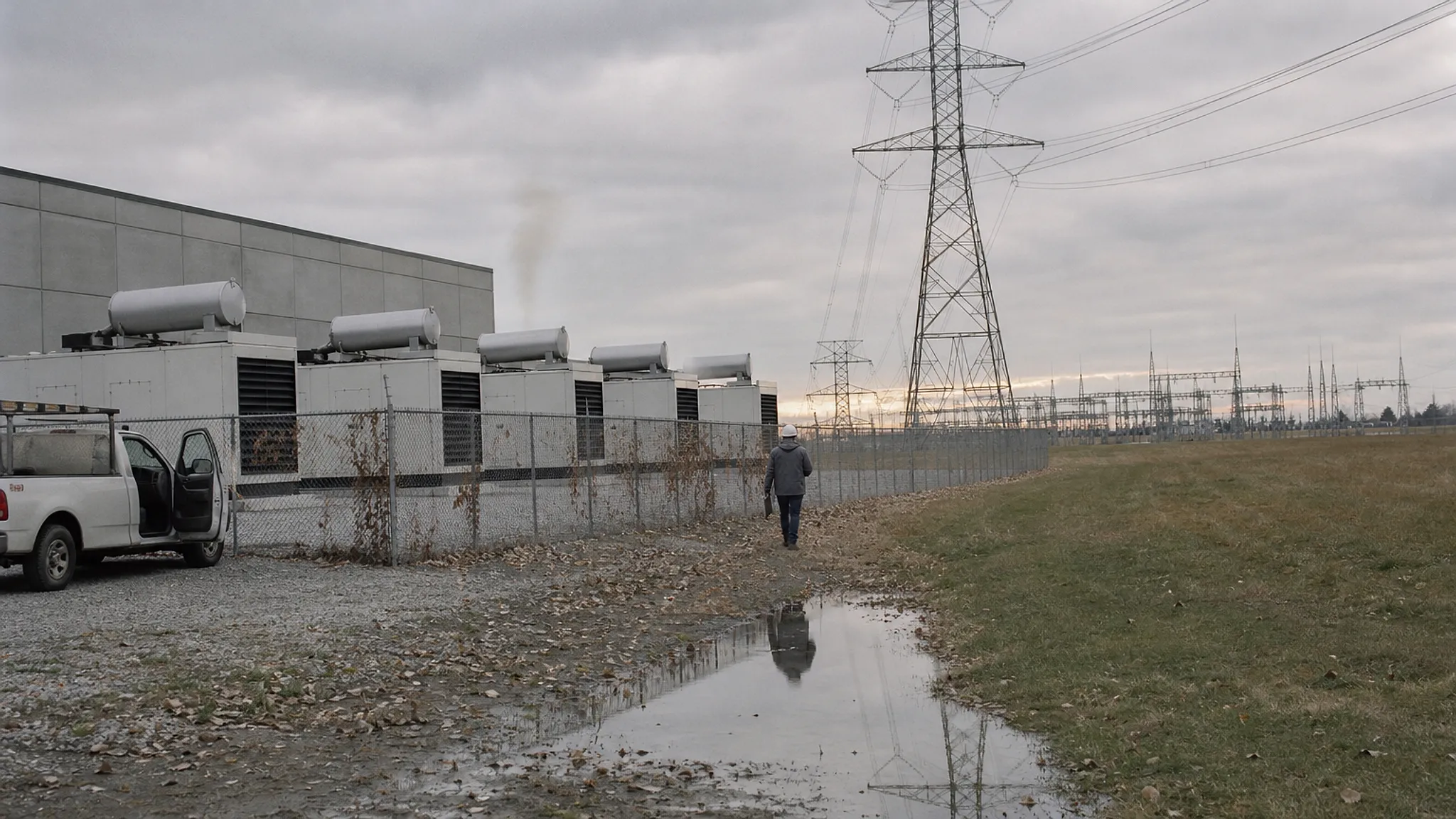
The most striking element of the order is data centers. The 11-page order states that PJM seeks to unlock backup generation resources at data centers, including hyperscaler facilities, and at other large industrial and commercial loads. The scope covers auxiliary, standby and directly connected generators as well as battery storage, including equipment not synchronized with the grid. Operation is limited to a last resort just before declaring Energy Emergency Alert 3, the highest emergency level under North American reliability standards, or during an EEA 3. Level 3 is the stage at which even firm-service customers lose power. The order excludes backup generators at defense and homeland security facilities, first responders, air traffic control, hospitals, 911 centers, water and wastewater treatment, and natural gas pipeline facilities.
Environmental rules are temporarily set aside. In its application, PJM said specified plants could exceed permit limits for air pollutants including sulfur dioxide, nitrogen oxides, carbon monoxide, wastewater discharge and ammonia. The order provides that emissions, operating hours and fuel burned by specified resources and backup generators during the order will not count toward 12-month or 30-day rolling-average limits. In return, operation is restricted to the times and parameters PJM deems necessary for reliability, and PJM must report daily to the Energy Department on each facility operated in reliance on the order. Backup generation resources are not considered capacity resources, and all laws apply again once the order ends.
"PJM does not lightly request this authorization," Bryson wrote in the application, adding, "It understands the importance of the Operating Limits that are at issue." He explained that without running specified plants regardless of those limits, critical facilities such as homes, hospitals, military installations and water treatment plants risked losing power. In the press release, Wright claimed that "past leaders' energy subtraction policies have made the grid more vulnerable to the risk of blackouts when the sun doesn't shine or the wind doesn't blow." The Energy Department estimates that more than 35 gigawatts of unused backup generation remains available nationwide.
This is not the first emergency order this year. According to a footnote in PJM's application, the Energy Department issued 202(c) orders under similar circumstances several times, from the January winter storm through May, June, July and September 1. Wright sent a letter to grid operators on January 22 urging them to use backup generation during emergencies, and both the application and the order cite that letter. The order, which METAL reviewed, states that any renewal must be requested before it expires and that cost recovery is available under the Federal Power Act. METAL has reported that the Energy Department backed the Federal Energy Regulatory Commission's call for PJM market reform.
Through the eyes of an AI infrastructure engineer, the order formally folds data center backup generators into the grid's reserve resources. Data centers have been singled out as a driver of rising electricity demand, yet in this order they appear as a way to step off the grid and relieve its burden. Still, the order also excluded backup generator emissions from rolling-average limit calculations, granting PJM's request to let large loads use backup generation notwithstanding federal, state or local environmental limits. How many facilities actually ran, and for how long, will be recorded in the daily reports PJM files with the Energy Department. On a day when the grid's margin narrows to 900 megawatts, a data center is both a facility drawing power and the last power plant.


Comments