


Summary
- On September 22, OpenAI published a case study on Parallel's adoption of GPT-6 Astra.
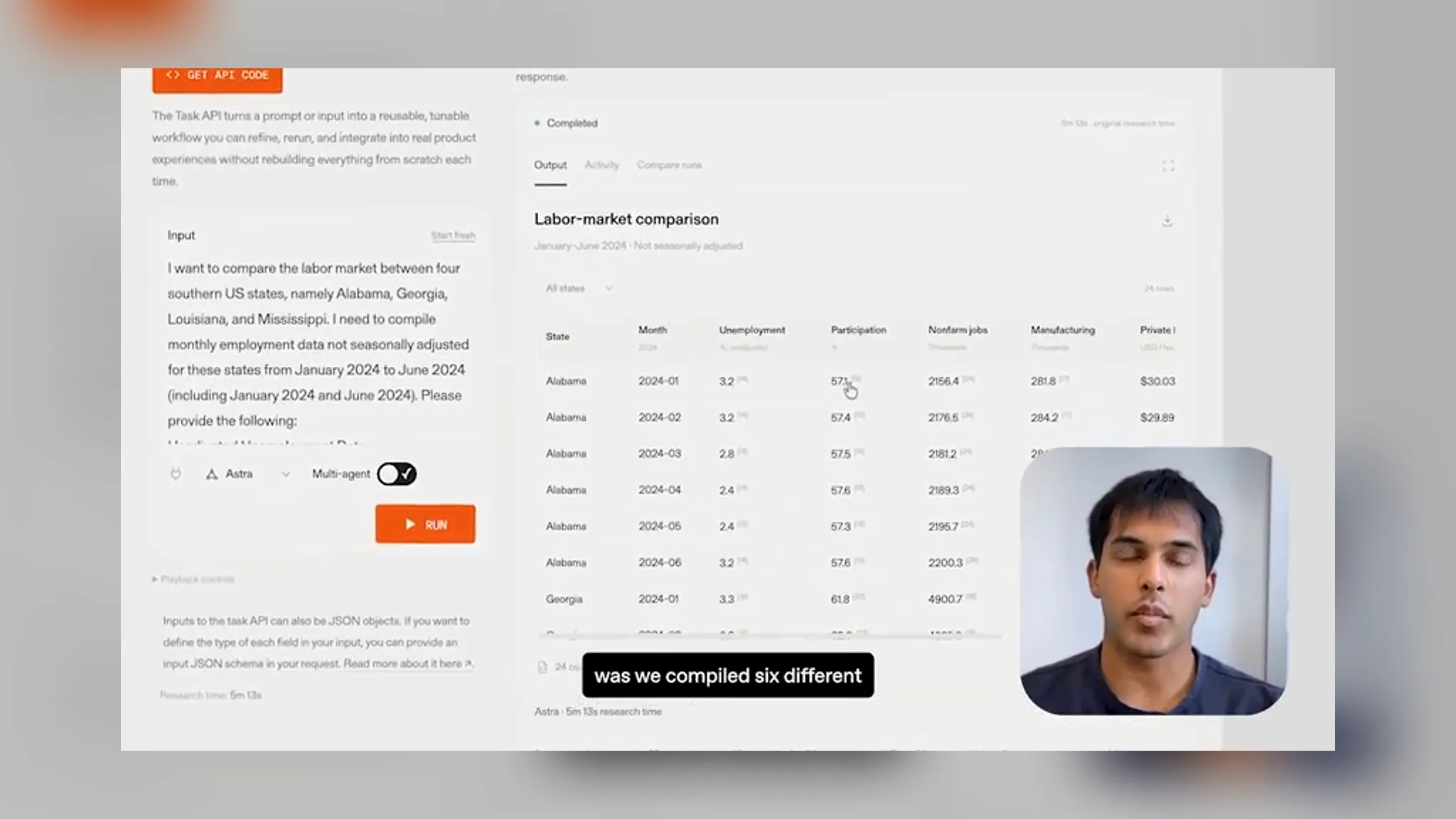
- In a labor-market research test, Astra finished in half the time of prior models, with roughly 50% lower code cost.
- On Parallel's own Search Capability Leaderboard, Astra also ranked first of 24 models with a Search Intelligence Score of 70.3.
On September 22, OpenAI published a case study on how Parallel, a startup that builds web research infrastructure for AI agents, adopted GPT-6 Astra. Parallel said that after moving its long research tasks to Astra, completion time fell to half that of prior models and code cost dropped by roughly 50%. According to the company, the quality of the output stayed the same.
Parallel sells tools to agents that do knowledge work by searching the web. According to OpenAI's case study page, its tools are used for everything from web grounding for voice agents to research for financial institutions and legal customers, and they work by combining frontier models with web search. The page lists the company as a startup based in North America that uses the API.
The problem was the longest-running research. Until now, getting a good answer on those tasks meant running a bigger model with extended reasoning, which cost more time and resources. Devin Gupta, a member of technical staff at Parallel, said: "With Astra, we've demonstrated that you can get the same high-quality research much, much faster with fewer research calls and less tokens."
The test task was labor-market statistics. Parallel asked its agent to research six different labor-market statistics across four states over six months; the agent had to search multiple websites, gather the information and compile it into a single report. Astra finished the job in half the time of prior models.
For an engineer, the more interesting part is why it was faster. Parallel observed that Astra made more focused searches and took fewer steps to reach a useful result. "Astra issued more targeted search queries and focused on the ultimate task better, incorporating its world knowledge compared to previous models," Gupta explained. Fewer search calls mean less of the latency and tokens attached to each call, which fits the result that time and cost fell by half together.
Higher efficiency also changed the design. According to OpenAI, Astra can delegate specific research tasks to sub-agents, which makes it more practical for Parallel to have several agents handle searches at once instead of one long sequence. It is a way of turning the wait of sequential search into parallel work.
In the 54-second video on the case study page, which METAL reviewed, Gupta describes the same test as statistics across many states and frames the saving as a token cost reduction. The written page says four states and code cost reduction. Both put the figure at roughly 50%.
Parallel's high view of Astra also rests on its own measurements. On September 16 the company launched a Search Capability Leaderboard to help developers choose models for applications that use web search, comparing 24 open- and closed-source models in its first edition. On the Search Intelligence Score, which measures accuracy across three public benchmark suites, GPT-6 Astra scored highest at 70.3. The results are a snapshot as of September 15.
The same table also shows the cost side. In the Search Efficiency ranking, which orders models by cost among those that meet or exceed the median accuracy, GPT-5.6 Luna ranked first with 55.0 at about one-thirteenth of Astra's cost. DeepSeek V4.1 Flash gained 45 points with search, the most of any model, and ranked third on intelligence at 65.3 and second on efficiency. Parallel wrote that whether higher accuracy justifies the additional cost depends on the application.
This is not the first Astra customer story. METAL reported that OpenAI published a case study on AI video tool company Higgsfield's Astra adoption the previous day, and earlier covered how Astra for Law, launched on September 17 with its own legal search index, reached a 54.0% pass rate on accuracy checks versus 38.7% for Astra with web search alone. The bottom of the case study page also lists Hex on September 16 and V7 on September 21.
From a TPM's perspective, the message of this case is that swapping the model alone can change a pipeline's unit cost. Parallel said it got the same quality in half the time and at half the cost by using a model that searches less and more precisely, instead of putting extended reasoning on a bigger model. The case study page does not, however, name the prior model used for comparison or how many test runs were made. As Parallel's leaderboard shows, the top model for accuracy and the top model for efficiency are different, so the question left for teams building agents is which tasks to give Astra and which to hand to a cheaper model.



Comments