


Summary
- Higgsfield published a case study documenting the production sequence of Gabo, a creator making one-hour AI films.
- The El Libro Sagrado channel has 289,000 subscribers, 55 public videos and 54.21 million cumulative views.
- The core of the method is separating layers: character references on a plain background, environment references with atmosphere built in.
One person is releasing an hour-long film every twenty days. Gabo, who runs a channel called El Libro Sagrado, turns historical and mythological stories into feature-length AI films. The case study Higgsfield published on September 22 sets out, step by step, the order in which he sustains that length. The company said that since Gabo joined its CPP program, both the quality and the volume of his output have grown considerably.
METAL checked the public figures on the El Libro Sagrado channel: 289,000 subscribers, 55 public videos and 54.21 million cumulative views. The channel opened on April 2, 2025. The case study's top-performing title, "Las Crónicas de Enoch," runs one hour and 21 seconds with 6.15 million views, and most of the videos listed end somewhere around the one-hour mark. These are the numbers of a year and a half.
It did not start with long films. Gabo's first experiments were short videos for TikTok, Facebook and Instagram. He made images with Midjourney and movement with Hailuo, later trying Krea AI, Flux and ChatGPT in turn. Each project introduced a new problem: making a still image move, joining two shots, keeping the same character recognisable, and then carrying a single story to the end, in that order. An interest in acting and cinema pushed those experiments toward longer narrative, and Interstellar, Django Unchained, The Odyssey, Breaking Bad and Dark became his models for building tension, developing characters and weaving several threads together.
When the length grows, the nature of the problem changes. Because each shot is generated separately, a character's face, the lighting, the background and body positions shift between clips. Movement reads as unnatural unless it is deliberately directed. On a project that crosses dozens of scenes, the tone and detail of environments drift. Editing gets used to hide generation errors, and every handoff between separate tools adds friction. Some scenes have to be regenerated many times before one works, which eats into the schedule, and getting an exact pose is still difficult.
What the CPP program changed was the number of attempts available. It brought monthly credits, early access to new features, production resources and a community where creators and program leads exchange knowledge directly. That made it possible to test several ideas before committing to one, to refine difficult scenes across multiple generations, and to choose a combination of models before starting the film itself. Gabo said, "Higgsfield marked a before and after in my career. The quality and number of projects I can create have grown enormously."
The schedule is simple. One hour-long film takes 20 days to a month, and the first four to five days of that go to research, script, structure and character design. The order is fixed too. Several models get tested before production and the chosen one is not swapped midway. ChatGPT, Claude and custom agents are used to organise and refine prompts, not to invent the story. The final frame of the previous clip is analysed before the next shot is generated. Visual identity is settled during early planning, before scenes are generated in earnest.
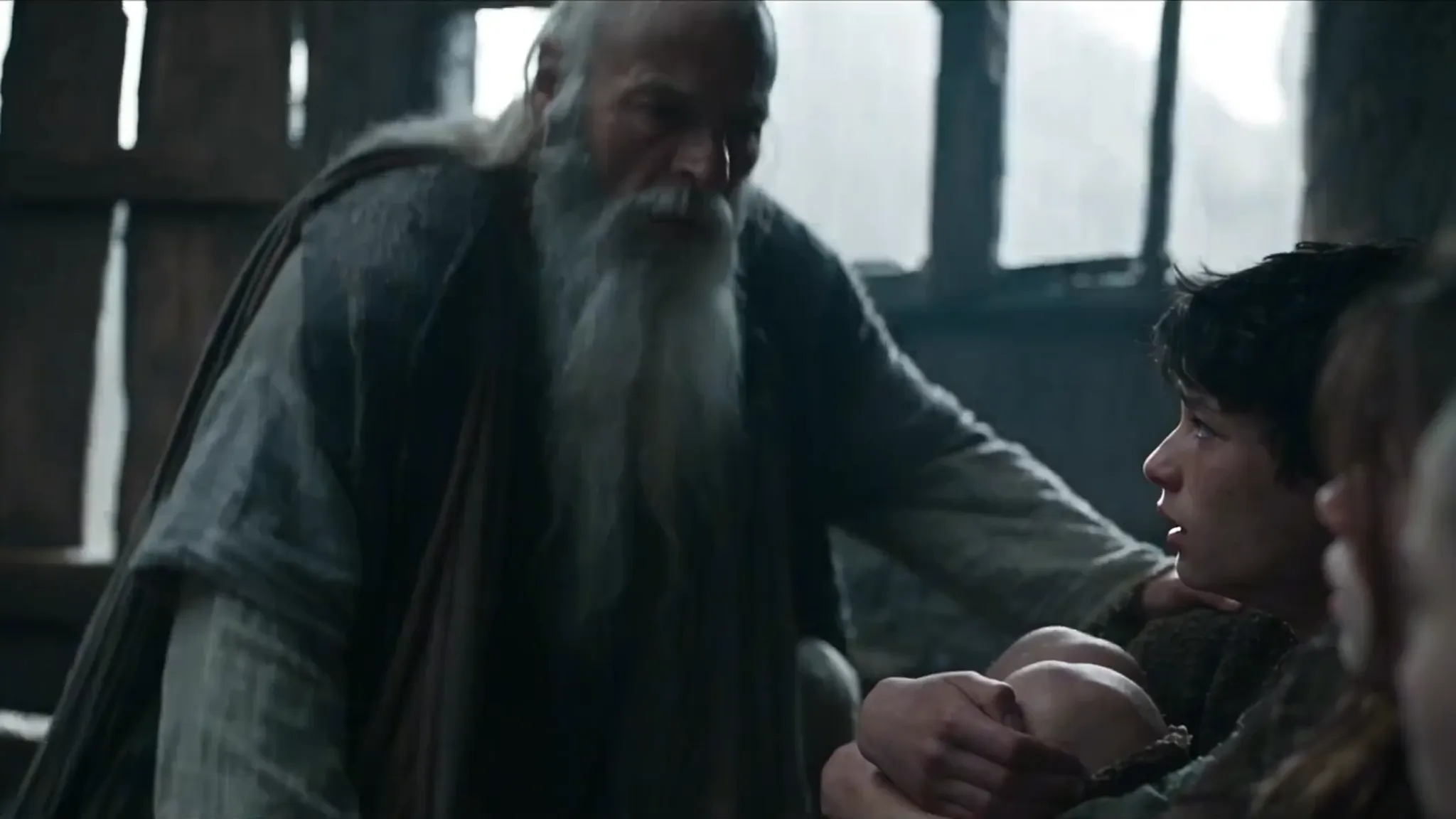
"The Chronicles of Enoch," named as his most ambitious work, starts from the mythology surrounding the Book of Enoch. Its world holds the Watchers, angels who descend to Earth, the emergence of giants, and characters like Ainmira, who becomes one of their first mothers. Rather than a literal rendering of the text, it is an adaptation with new conflicts, original characters and five storylines running at once. At this scale, he first decides where each major character has to arrive and then builds the journey backward from there. That keeps the overall direction intact while leaving room for new ideas mid-production.
Work begins with characters, before the script is finished. Faces, clothing, proportions, personalities and reference sheets come first, because seeing the characters is what makes it possible to understand how they speak, what they want and how they relate to each other. Nano Banana, GPT Image 2 and Seedream 5.0 go into fixing that identity, and reference images are built against a plain charcoal-grey background. Removing visual distractions is what holds the face, hair, clothing and body proportions steady across many scenes. Instead of asking one model for character, environment, atmosphere and movement at once, each layer is grown separately.
Environments go the opposite way. The intended weather, lighting, colour palette and environmental detail are built into the reference image from the start: rain and wet ground, heavy cloud, smoke, or direct sunlight already in the frame. Movement and direction are another layer again. "The Chronicles of Enoch" began on Seedance 2.0 and shifted increasingly to Seedance 2.5, which raised prompt interpretation, image quality and control over what happens inside the frame. Recent and ongoing work runs in Cinema Studio 4.0.
Prompts have an order as well. The principal action and dramatic intention come first, followed by camera position, lens, movement, lighting, depth of field, colour and environment. Composition gets the same treatment: the rule of thirds, layered depth, off-centre framing, characters shown in profile or partly from behind. These are the devices that push an image away from the centred symmetry that reads as generic AI output and toward the visual language of cinema. Colour is divided by the 60-30-10 rule.
A technically well-made character can still be lifeless. For a full hour the audience has to believe the characters are thinking, listening and reacting to what is around them. Gabo said, "I prefer to describe what a person physically does when they feel an emotion." So specific physical actions go in instead of the names of feelings. Fear is a tense jaw, interrupted breathing, a half-step backward, eyes searching beyond the frame. Sadness is rapid blinking to hold back tears, a lowered gaze, irregular breathing, a sleeve wiped across the nose. Tension is tightened fingers, restrained movement, a delayed reaction, a brief shift in posture.
Continuity is held frame by frame. He captures the final frame of the previous clip, checks the character's position, gaze, background and composition, and then generates the next shot. In dialogue scenes he cuts to the listening character's reaction before returning to the speaker. It is a double device: a natural cinematic edit that also conceals small differences between separately generated shots. According to Higgsfield, the point where generated characters turn into performers is where microactions, spatial continuity, believable physics and intentional editing overlap.
The six items the case study closes with are all habits rather than tools. Test models before production and do not switch midway; use a plain background for character references and atmosphere for environment references; write "photo of an actor" instead of "character sheet" when realism is needed; apply the 60-30-10 colour rule; analyse the final frame before the next shot; describe emotion as visible action instead of naming it. The company wrote that Higgsfield did not replace the storytelling, cinematography and editing, but gave the infrastructure to push all three further.
METAL has reported that a film by a Higgsfield CPP creator ranked above "Avatar" on Amazon. What that story and this one share is length. Generative tools started from clips of a few seconds, and the grammar that fits that length settled first. One hour is the stretch where that grammar stops working. A character has to keep the same face, the space must not wobble, and the audience has to be able to follow the flow of feeling. What Gabo built is not a new model but the order that crosses that stretch.
That the order has been published is itself the weight of this case. Filmmaking was for a long time work that could not begin until people, equipment and time were all present at once, which made who gets to tell a story a question of capital. In a structure where one person delivers an hour every twenty days, the bottleneck moves elsewhere. What remains is the judgement of choosing models, designing characters and checking continuity, and that judgement is still bound to human time. The point where Gabo stated flatly that he does not use AI to invent the script shows that boundary most precisely.
Comments