


Summary
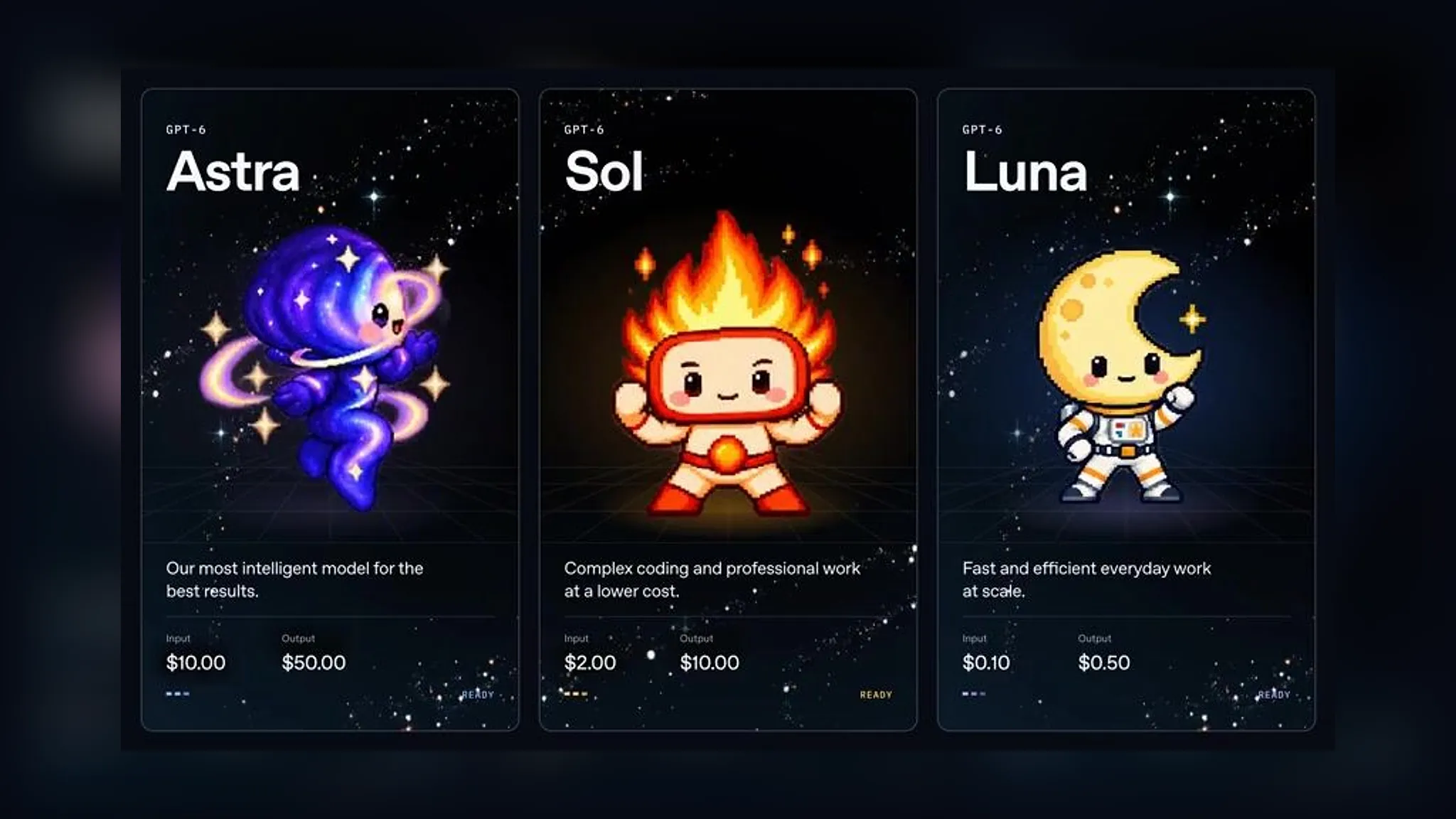
- OpenAI unveiled GPT-6 Sol and GPT-6 Luna on September 22 and put them into ChatGPT Work, Codex and the API.
- API prices for both models came down 50% against GPT-5.6 promotional pricing, and cached input-token reads carry a 90% discount.
- On AutomationBench 1.0.6, GPT-6 Sol scored 33.2% against Claude Opus 5's 26.9%, at roughly 9% of its cost per task.
OpenAI unveiled GPT-6 Sol and GPT-6 Luna on September 22. They were trained with methods similar to GPT-6 Astra, which the company released earlier this month, but the axis this announcement aims at is cost rather than capability. The company said it made caching and inference more efficient and is passing those savings directly to users and customers, cutting API prices for both models by 50% against GPT-5.6 promotional pricing.
The gap shows up most clearly on business automation. On AutomationBench 1.0.6, which runs agents end to end across sales, marketing, operations, support, finance and HR work using 47 tools, GPT-6 Sol scored 33.2% at xhigh effort. In the same table Claude Opus 5 scored 26.9% at max effort, and its cost per task was 11.1 times Sol's. Claude Fable 5.1 with a fallback scored higher at 31.4%, but its cost ran past 8.9 times Sol's, and that figure leaves out the Opus 5 fallback cost incurred on about 40% of the tasks. Even GPT-6 Astra came in below Sol at low effort, at 30.3%, at 3.9 times the cost.
The order looks similar on Agents' Last Exam V1, which measures long-horizon professional work. Across 55 sub-industries covering most major fields of work performed on a computer, GPT-6 Sol scored 56.4% at max effort. That sits above Claude Opus 5's highest score in the same evaluation at 60% lower cost per task.
The coding numbers are tighter. On FrontierCode 1.1 Main, which checks whether an agent produces changes ready to merge into real codebases, Sol improved substantially over its predecessor GPT-5.6 Sol and matched Claude Fable 5.1 at xhigh effort. On DeepSWE 1.1, which sets long-horizon software engineering tasks, Sol scored 68.8% at max effort, within 1.1 percentage points of Claude Fable 5's best score of 69.9%, at roughly 80% lower cost per task. GPT-6 Luna scored 66.6% on the same evaluation, comparable to Claude Opus 5 and Fable 5 at medium effort, while costing 93% less per task than Opus 5 and 96% less than Fable 5.
On tasks that drive a computer directly the two sit almost on top of each other. On the OSWorld 2.0 offline set, Sol scored 60.5% at xhigh effort against Claude Opus 5's 60.3% at medium effort, at roughly 80% lower cost per task. GPT-6 Luna at max effort exceeded GPT-5.6 Sol at medium effort at one tenth of the cost. The best model in the world for computer use is still GPT-6 Astra, the company wrote.
Factuality was measured with an internal evaluation built from de-identified real conversations in which users flagged errors. On this set of error-inducing prompts, GPT-6 Sol makes about half as many mistakes as its predecessor, and GPT-6 Luna reaches GPT-5.6 Sol's level at higher effort settings at about one hundredth of the cost. The company added the caveat that these prompts are not representative of typical usage, where factual errors are rare.
Caching carries as much weight in this announcement as price. Higher cache hit rates by default let agents reuse more context, and cached input-token reads carry a 90% discount. Developers can see how much of their input is cached in the Prompt Caching Dashboard and use the diagnostics tool to find missed caching opportunities and what to fix. Raising or lowering reasoning effort and enabling or disabling tools now preserve earlier context, and explicit breakpoints let developers choose where a cached prompt prefix ends. GitHub reported that over the past several months these improvements reduced the share of prompt tokens requiring fresh processing by more than half across billions of requests.
The communication style was reworked too. The conversational manner refined in Astra was carried into Sol and Luna, with less jargon, fewer low-value details and slightly shorter answers, and the company says it will be most noticeable in technical and coding conversations. On alignment evaluations both models improved over the GPT-5.6 generation, with lower rates of misleading claims about their own coding work.
In its announcement OpenAI wrote that "while the most demanding and important projects still call for Astra's full depth, work happens at different scales, rhythms, and budgets." The company's official developer account said the same day, "Build with Sol. Scale with Luna."
Both models opened on launch day in ChatGPT Work and Codex for Plus, Pro, Business, Enterprise and Edu users. Free and Go users can reach GPT-6 Luna in the desktop app, and neither model has arrived in Chat. In the API they are named gpt-6-sol and gpt-6-luna. According to reports, administrators of enterprise workspaces have to enable the new models before they appear, and the desktop app release notes say the models use fewer tokens than GPT-5.6 models of the same class.
METAL checked OpenAI's official account video: it ran 8 seconds at 1920×1080, and the post had 2.33 million views and 30,000 likes. METAL previously reported that GPT-6 Astra arrived carrying both alignment gains and a critical cyber rating, and these two models push that generation's methods down into lower tiers.
Taken together, what is being contested in this announcement is not new capability but the price of the same capability. Every comparison in the tables pairs a score with a cost per task, and the rivals OpenAI chose are its own top model and a competitor's top models. It is a signal that choosing a model is shifting from a single line of performance to two axes, score and cost.
Sources
- OpenAI — Introducing GPT-6 Sol and Luna →
- OpenAI — OpenAI 공식 X 게시물 — GPT-6 Sol·Luna 공개 →
- OpenAI — OpenAI Developers 공식 X 게시물 — Sol·Luna API 공개 →
- Techmeme — OpenAI launches GPT-6 Sol and Luna (David Gewirtz/ZDNET) →
- Techmeme — GPT-6 Sol and Luna pricing (Nat Rubio-Licht/The Deep View) →
- 9to5Mac — OpenAI upgrading ChatGPT and Codex with two more GPT-6 models →




Comments