



Image: METAL
Summary
- According to a customer story OpenAI published on September 25, Wayfair has validated and corrected more than 11 million product specs with OpenAI models.
- Wilma, Wayfair's in-house supplier support platform, automates 41,000 tickets a month, with automation reaching up to 70% in some workflows.
- An A/B test of the catalog quality system showed significant gains in impressions, clicks and page rank, and Wayfair has deployed 1,200 ChatGPT Enterprise seats across roughly 12,000 employees.
Wayfair, the U.S. e-commerce company for furniture and home goods, is using OpenAI models to validate more than 11 million product specs and to automatically handle 41,000 supplier support tickets every month, OpenAI said in a customer story published on September 25. In some workflows, up to 70% of all tickets are now handled without a person touching them. Wayfair has also deployed 1,200 ChatGPT Enterprise seats to its roughly 12,000 employees. The core of the story is that, instead of adding new products, the company is fixing the information on the roughly 40 million items it already sells to create more sales opportunities.
The starting point was product data quality. Wayfair's catalog team manages tens of millions of products across nearly a thousand product classes, and tags for color, material and size drive search, recommendations and merchandising. The company has to support 47,000 tags. Before working with OpenAI, errors were fixed only after suppliers or customers reported that something looked wrong, and manual effort could not keep up with the volume. Early custom tagging models were effective but became too expensive at scale.
"The better our data quality, the more trust we build with the customer," said Jessica D'Arcy, Associate Director of Catalog Merchandising at Wayfair, adding that it "directly" reduces "costly downstream issues like returns from misrepresented products." When a listing is wrong, customers receive something other than what they expected, and the cost comes back as a return.
The catalog quality system Wayfair built with OpenAI models works in two steps. First, it uses web information and Wayfair's internal definitions to create a guide explaining what each label means. Then the models use that guide to review product information and assign the right labels. With this approach, Wayfair is expanding the range of product attributes its AI can check at 70 times last year's pace, the company said.
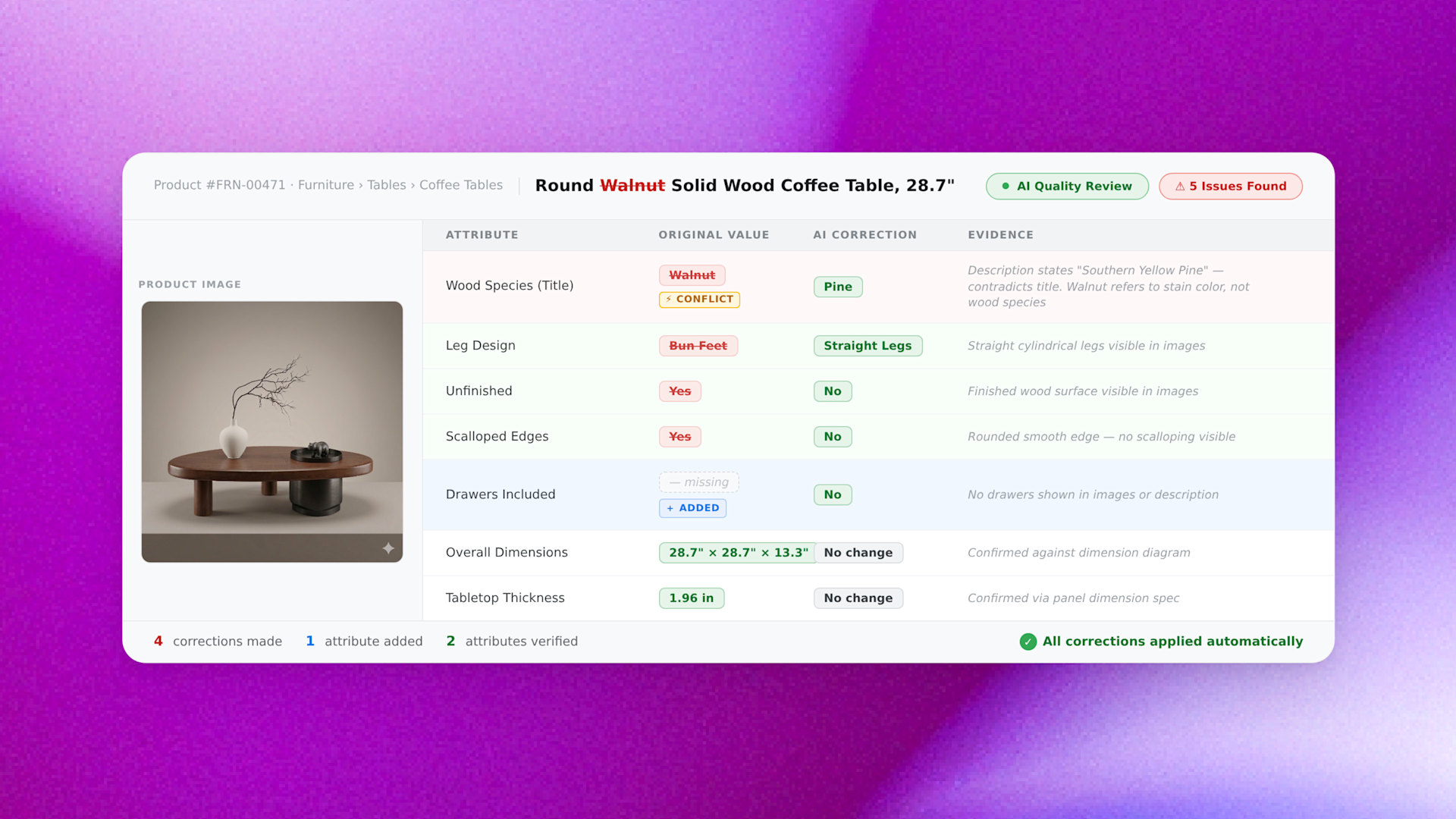
A screen published by OpenAI, which Metal reviewed, shows what the system actually fixes. For a "round solid wood coffee table," the title said walnut while the description said Southern Yellow Pine, so the AI corrected the wood species to pine and noted that walnut referred to the stain color, not the wood. It also corrected the leg design, the finish and the edge shape by comparing them against the images, filled in a missing drawers field, and only confirmed the dimensions and tabletop thickness against the diagram. One product yielded four corrections, one added attribute and two verifications.
Automatic corrections come with safeguards. Wayfair runs a structured audit in which associates inspect physical product samples to check the output, and suppliers help validate changes. When the system's confidence is high, it updates the product content directly and notifies the supplier; low-confidence or high-risk changes require supplier confirmation before taking effect.
The results showed up in search metrics. The system has processed more than 1 million products so far, and a controlled A/B test showed a significant increase in impressions, clicks and page rank in the treatment group. Wayfair validated and corrected attribute data across more than 11 million of its most visible and frequently purchased products. "When you improve attribute completeness, it's not abstract," said Wayfair's Carolyn Phillips. "You see it show up in SEO and PLA performance—in how customers discover products." The company plans to apply the capability to every new product added to the catalog.
The second pillar is supplier support. Wayfair works with tens of thousands of suppliers each month, and associates used to read each incoming ticket, work out what the supplier needed and route it to the right team. "Supplier support covers hundreds of different issue types," said Brian Seaman, Head of Applied Science for Global Supplier at Wayfair. "It's not realistic to expect any one associate to have deep expertise in every one of them." Wayfair added OpenAI models to Wilma, its custom supplier support platform, so it can read requests, fill in missing context from databases, follow up with suppliers when needed and route tickets to the right team. Thanks to an existing API integration, the team went from idea to production in under one month.
The level of automation is set by a number. Wayfair measures how often the AI's recommendation matches the human agent's final decision, a metric called the alignment rate, and only workflows that consistently clear a predetermined threshold move from assistive to semi-autonomous mode. On the Replacement Parts Operations team, AI reviews past records, assesses complex cases and drafts next steps and responses for associates to review. Dozens of such agentic workflows have been deployed, and the company said it has seen faster resolution times, higher supplier satisfaction and fewer reopened tickets.
Metal has reported on U.S. grocery chain Albertsons expanding its work with OpenAI, and OpenAI has recently published a string of retail customer stories. Internally, Wayfair has also connected ChatGPT Work to Slack and Google Drive for everyday tasks. "What's been most valuable about working with OpenAI is the partnership," said Fiona Tan, Wayfair's Chief Technology Officer. "It's not just access to the models. It's working through new use cases together and being able to move quickly."
From a content marketing perspective, the key point of this case is that product detail data has become a marketing asset in its own right. Without spending more on ads, fixing a single wrong attribute brings more search impressions and clicks, and an A/B test confirmed the effect. Tan said Wayfair is building for a world where AI is part of the shopping journey, whether on its site, through support or through conversational interfaces. As AI assistants increasingly find products on shoppers' behalf, the accuracy of machine-readable product data matters as much as shelf placement, and Wayfair has made cleaning up the data on 40 million products its first bet.


Comments