


Image: METAL
Summary
- Hanwha Qcells, Tandem PV and First Solar are nearing commercial sales of tandem solar panels, which stack extra thin-film layers on top of silicon.
- Hanwha Qcells received IEC and UL certification from TÜV Rheinland in July, and Tandem PV opened a roughly 40-megawatt-a-year demonstration factory in Fremont in April.
- Estimates that the panels could cost 3 to 3.5 times as much as conventional ones, and a shortage of long-term degradation data, are the remaining hurdles in catching China.
US solar panel makers are close to selling a new kind of panel that, they say, produces about 25% more electricity than most panels on the market today. The technology is tandem solar, which stacks a second and third layer of material on top of silicon to pull more electricity out of the same sunlight. Hanwha Qcells, Tandem PV and First Solar said they are ready to bring products to market soon after testing and certification. An American industry that lost its factories to China, which controls about 80% of the global market for panels and components, sees this generational shift as a chance to catch up.
The principle is to split sunlight between layers. A conventional panel catches light with a single silicon layer, while in a tandem panel a thin perovskite film on top absorbs part of the spectrum first and the silicon underneath takes the light that passes through. Picture a fisherman setting two nets with different mesh sizes, one over the other. The lower net catches the fish the upper one misses, so the same sea yields a bigger haul. Tandem PV explained that its panels capture more of the solar spectrum than silicon alone and therefore generate more electricity from the same area.
The first company through the certification gate was Hanwha Qcells. In July, Hanwha Qcells announced that TÜV Rheinland, the German certification body, had certified that its tandem modules meet the IEC 61215 and UL 61215 reliability standards and the IEC 61730 and UL 61730 safety standards. According to the company, it is the industry's first tandem certification that satisfies both sets of standards. The Hanwha Qcells announcement that METAL reviewed says the cells and modules were made on its R&D pilot line in Bitterfeld-Wolfen, Germany, using only mass-production processes. The design is a two-terminal structure that combines a perovskite top layer with the company's Q.ANTUM silicon bottom layer, and power output was measured under IEC TS 60904-1-1, the standard for multi-junction modules.
A certificate alone does not settle the matter. Beyond its German lab, Hanwha Qcells ran panels at outdoor test sites in the United States, Australia, Cyprus and South Korea. It blasted the panels with intense LED light to measure output and fired balls of ice ranging from marble size to slightly larger than a golf ball at them to check how they withstand hail. The tests are meant to convince power producers, investors and lenders that the panels will last 20 to 30 years in desert heat or heavy rain. "Hitting these milestones means we are getting closer to bringing a product to market that is reliable, saves money and works better," Fabian Fertig, head of tandem R&D at Hanwha Qcells in Germany, said when announcing the certification.
Silicon Valley startup Tandem PV answered with a factory. In April the company opened a commercial demonstration factory of about 65,000 square feet (about 6,000 square meters) in Fremont, California. The line has an annual nameplate capacity of about 40 megawatts, and its panels are roughly 60 times larger than the company's R&D-scale devices. The company reported 29.7% efficiency in internal testing, and in accelerated lifetime testing its latest panels showed an average annual power loss of less than 1%, about a tenfold improvement over a year earlier. "This factory marks the shift from impressive R&D results to repeatable manufacturing at a commercially meaningful scale," said Tandem PV CEO Scott Wharton.
Tandem PV aims to sell its first commercial panels this year and to begin high-volume manufacturing in 2028. The company said it has spent the past year testing panels under different conditions across the United States. In local reporting, Wharton argued that tandem panels will dominate the industry by the mid-2030s and that there is no disagreement in the industry about the shift to tandem. The company has raised $87 million to date in venture capital, debt and government funding.
First Solar reaches the same point by a different route. One of the few American manufacturers to survive while Chinese companies swept the market, First Solar makes panels from cadmium telluride (CdTe) thin film rather than silicon. In the shareholder letter of its 2024 annual report, the company stated its view that the semiconductors in a tandem device must both be thin film and that there is no tandem without thin-film technology. That implies other manufacturers will likely need to master thin-film technology to build the multiple layers of a tandem panel. First Solar CEO Mark Widmar said in local reporting that the company has invested more than $2 billion in thin-film R&D, including its tandem program.
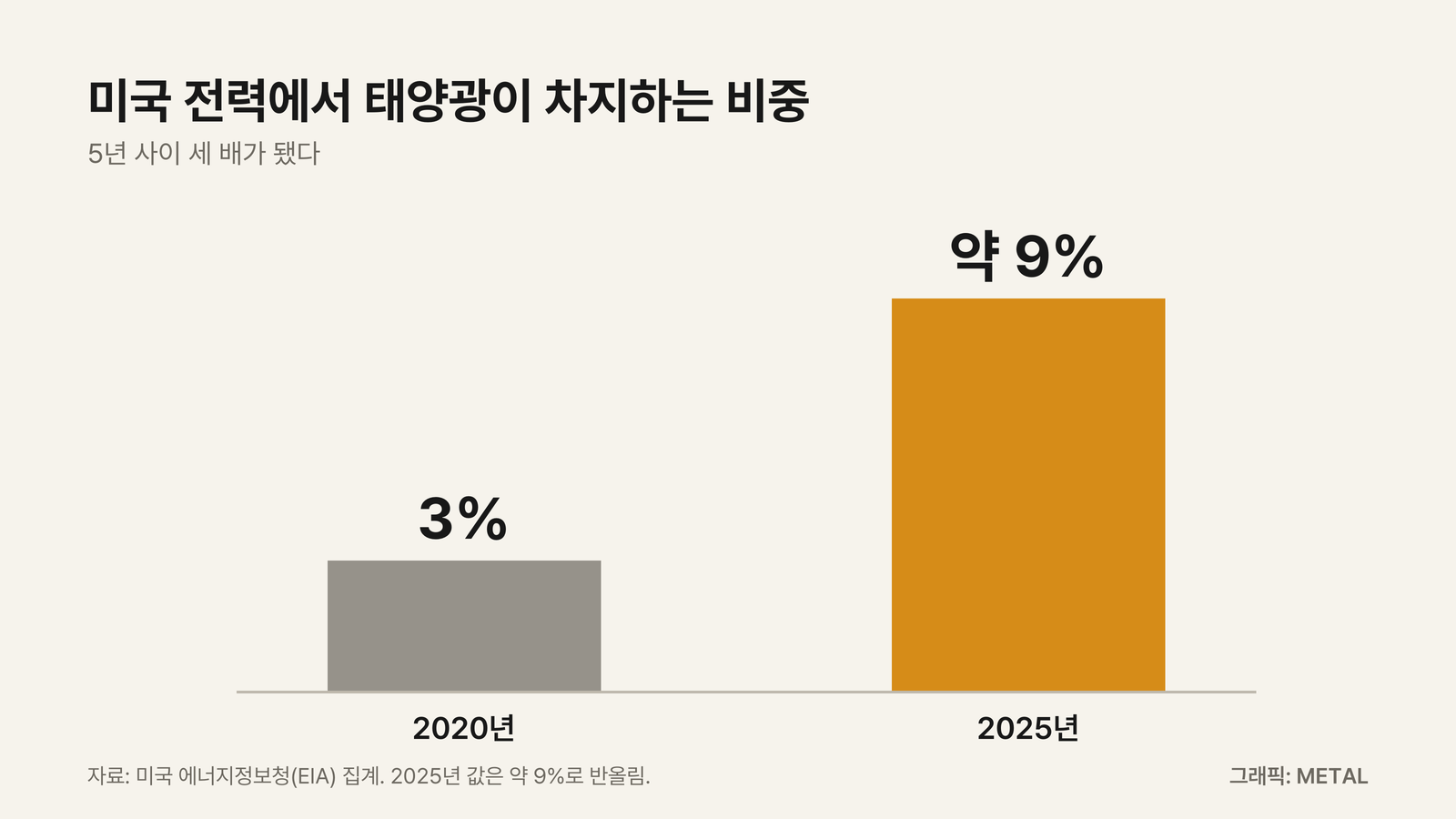
Demand is already here. According to the Solar Energy Industries Association (SEIA) and Wood Mackenzie, solar and batteries accounted for 70% of the new generating capacity added to the US grid in the first half of this year. By the count of the US Energy Information Administration (EIA), solar supplied about 9% of US electricity in 2025, triple the 3% of 2020. Power demand driven up by data centers used for AI development is pushing that share higher. METAL has reported on Google's power purchase agreement to buy up to half the output of Finland's Loviisa nuclear plant for 22 years. At a time when big tech is securing power from every source, a panel that pulls more electricity from the same land quickly becomes a question of business economics.
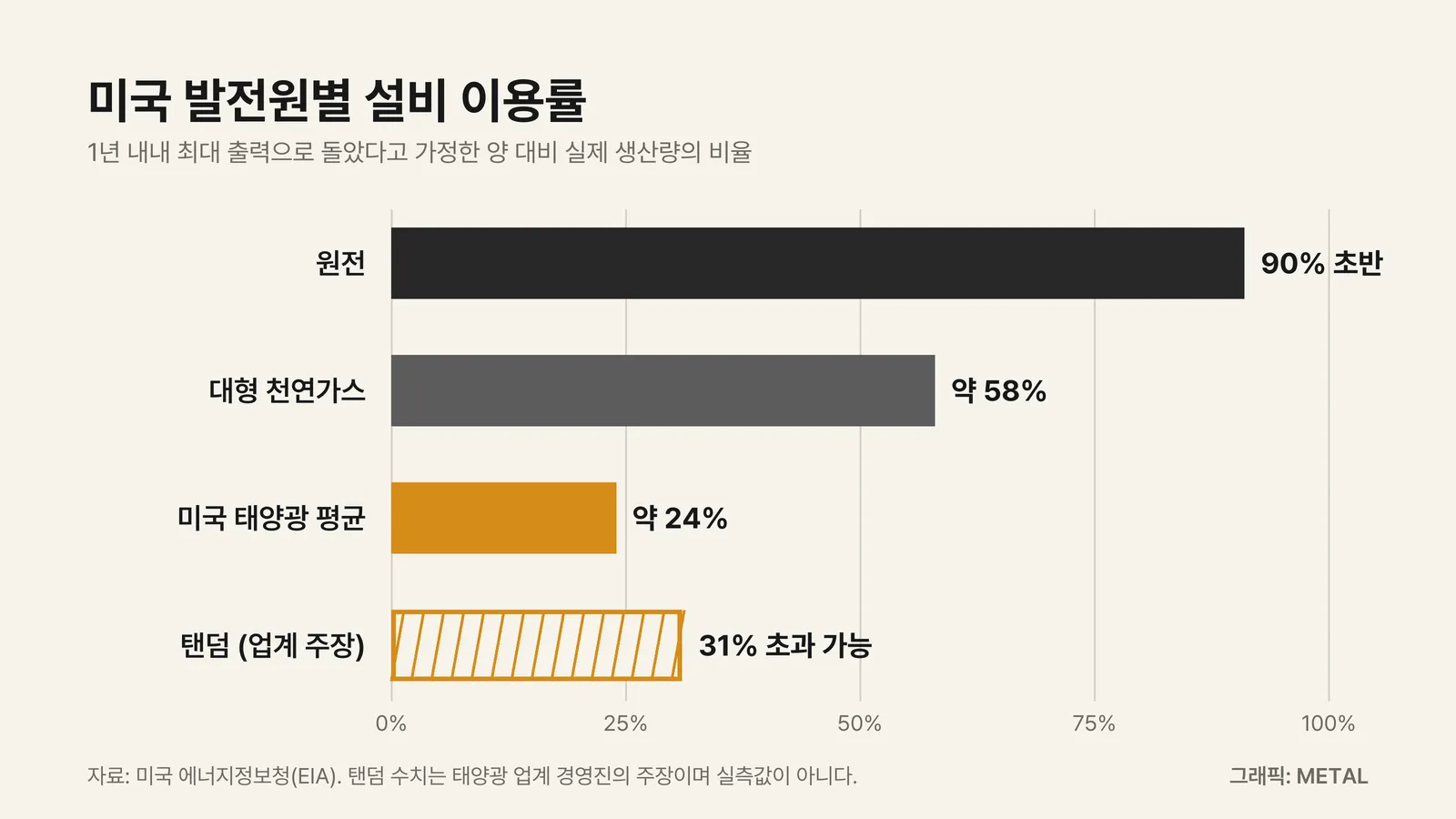
The number the industry leads with is capacity factor. It is the ratio of actual output to what a plant would produce running at full power all year, and according to the EIA nuclear plants typically run in the low 90s percent, large natural gas plants about 58% and the average US solar plant about 24%. Solar produces power only while the sun is up and cannot convert all the light it receives into electricity. Industry executives claim tandem panels could exceed a 31% capacity factor. That would mean producing the same power with less land, cable and rooftop space, and Tandem PV noted that labor, land and balance-of-system costs make up about 75% of utility-scale solar deployment costs, so efficiency translates directly into savings.
The biggest obstacle is price. By some estimates, tandem panels could cost 3 to 3.5 times as much as conventional products made from a single layer of silicon. According to an SEIA report, buying and installing conventional panels for a utility-scale plant costs about $0.93 to $1.06 per watt. AES CEO Andrés Gluski said in local reporting that because Chinese manufacturers sell panels so cheaply, price will decide whether tandem succeeds. He said China could probably supply twice the world's demand.
Durability still has to be proven. Scientists built early tandem devices decades ago, but it took a long time to make them withstand heat, humidity and pounding hail. Chetan Krishna, a principal at RMI, raised questions about lifespan, saying there could be degradation problems that are not yet known. Fertig also acknowledged that the power industry is quite conservative about new technology and that banks have to be convinced. Wayne Li, a principal technical leader at the Electric Power Research Institute (EPRI), noted that some energy companies have already bought early tandem panels so as not to fall behind, but said manufacturers do not readily share detailed data and that extensive third-party testing is needed.
Politics and history are also variables. The Trump administration and congressional Republicans, while seeking to expand fossil fuels and nuclear power, have made it harder for new solar plants to obtain federal permits. Around 2010, a market once led by American, German and Japanese companies collapsed under Chinese manufacturers offering far lower prices. The Biden and Trump administrations tried to revive US solar manufacturing with tariffs and subsidies, and Hanwha, which acquired Germany's Q-Cells in 2012, has invested billions of dollars in production lines in Georgia, including Cartersville north of Atlanta. Mike Carr, executive director of the Solar Energy Manufacturers for America Coalition, argued that Chinese companies are also developing tandem technology but that it is no better than America's and may even lag behind.
This race will be decided not by lab efficiency records but by whether banks sign loan documents. With certificates, a demonstration factory and billions of dollars in research spending, the US industry has cleared the first stage of proof. The next gate is enough field data, and a low enough price, for power producers to trust that a panel will last more than 20 years and pay for it. For tandem to become the means of catching China, the industry has to show that a difference in efficiency becomes a difference in price per watt.
Sources
- The New York Times — A New Crop of Solar Panels Is the U.S.’s Best Hope of Catching China →
- Qcells — Qcells Becomes the First Company to Achieve UL and IEC Certification by TÜV Rheinland on Next Generation Solar Technology →
- Tandem PV — Tandem PV Opens California Factory for Next-Generation Solar Manufacturing →
- First Solar — First Solar 2024 Annual Report →
- Solar Energy Industries Association · Wood Mackenzie — US Solar Market Insight →
- U.S. Energy Information Administration — Electric Power Monthly — Capacity factors for utility scale generators →



Comments