


Image: METAL
Summary
- Runway published a customer case study showing how World Juggling Federation president Jason Garfield used Aleph 2.0 to fill empty seats on the second day of a competition in the Netherlands.
- Garfield built competitor cards, leaderboards, a rematch scoreboard and fireworks through several image-generation steps and a single video-generation step, then stitched clips of about 15 seconds into a one-hour special by himself.
- Only one extreme wide shot went back to After Effects, and Garfield plans to change how he shoots next year's event.
Runway has published a case study on how the World Juggling Federation (WJF) generated a broadcast crowd. Jason Garfield, the federation's founder and president, used Runway's video model to fill empty seats on the second day of a two-day competition in the Netherlands, generated a full broadcast graphics package with opening titles, competitor introductions and leaderboards, and finished a roughly one-hour special on his own. According to Runway, this was work he previously would have needed rotoscoping and masking to attempt, if he could attempt it at all.
Garfield founded the World Juggling Federation in 2000 with the goal of getting juggling into the Olympics, and the federation has produced competition programming for ESPN since 2004. A juggling broadcast needs the same production value as any other televised sport: multiple cameras, animated leaderboards, opening titles and a crowd that looks full to viewers at home. Until now Garfield had built almost all of that in Final Cut Pro and After Effects. The federation was re-established as a nonprofit in 2021 and set Olympic inclusion as its formal goal.
The problem was the second day's crowd. On the first night the audience filled the front, left and right of the stage. The second day was scheduled earlier, and people were still arriving when the cameras started rolling, so the side angles showed rows of empty chairs. "It's either don't use those shots and you're limited to really one angle with nothing to edit from, or put people in the seats," Garfield said.
He had tried Runway a year earlier but set it aside because video models back then did not follow text instructions closely enough. When the empty seats became a problem, he came back and found he could add people while leaving the rest of the shot untouched. Garfield gathered the camera angles he already had into a single contact sheet, then prompted a drone-style flythrough into the tent that revealed the stage and the audience. He also fed in footage of a competitor walking onto the stage so the model could recreate that movement from the angles the edit needed.
The choice of model made a difference. According to Runway, early attempts with Seedance were usable but inconsistent, and the work only stabilized after he switched to Aleph 2.0, which let him add people without changing anything else in the source footage. Juggling moves fast enough to flicker in 30-frames-per-second broadcast footage, so Garfield exported clips in slow motion before bringing them into Runway and used Topaz to rebuild the dropped frames. His bar was simple: the second day had to look as full as the first. Every shot cleared it except one extreme wide angle, which went back to After Effects. "There was a lot of experimenting with different prompts. I'd paint certain areas white and tell it to fill that space with people behind the person," Garfield explained.
The crowd was only part of the job. Every broadcast needs opening animations, competitor profiles, leaderboards and scoring graphics. Garfield built a pipeline of several image-generation steps followed by one video-generation step. He generated a profile card for one competitor until it worked, used it as the reference for the other competitors and their stats, composited all three cards into one still and then added a crane-style camera move to turn it into a video sequence. The same approach produced show titles, leaderboards, a rematch scoreboard that separated red and green scores, and fireworks around the stage that never went off at the venue. For the leaderboards he fed in a screenshot of the judges' printed scoring sheet instead of retyping scores into an After Effects template.
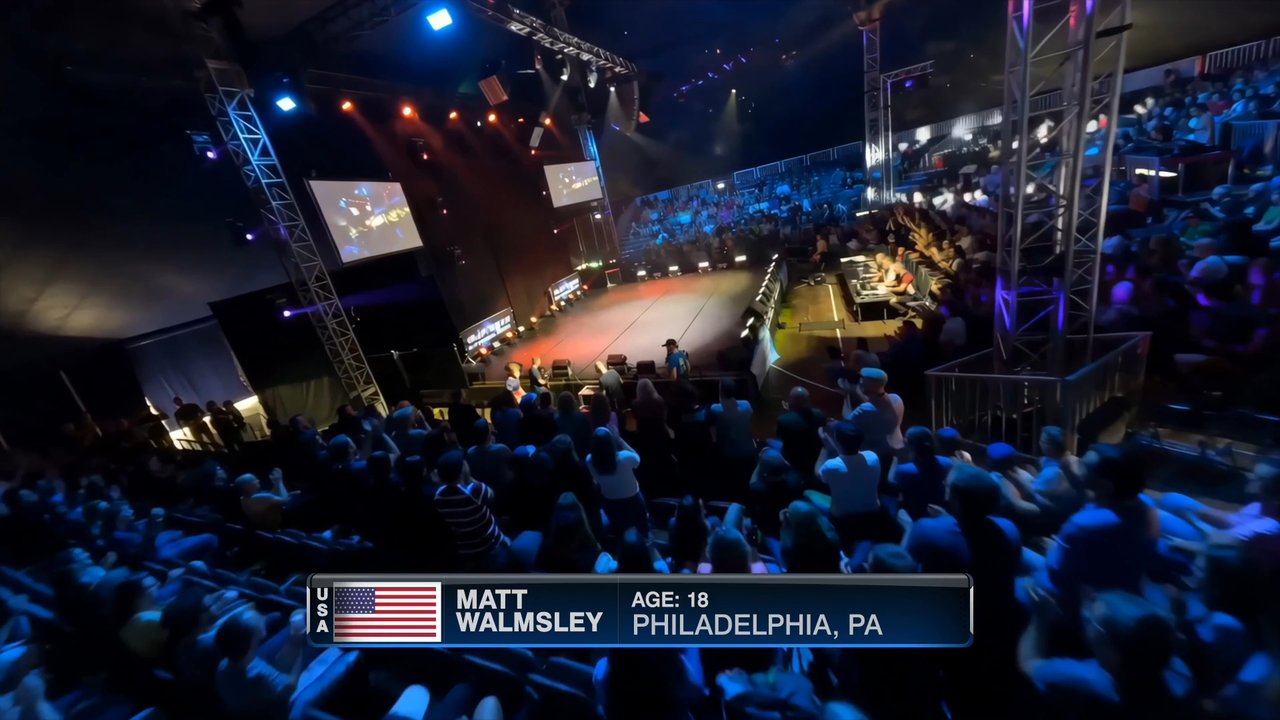
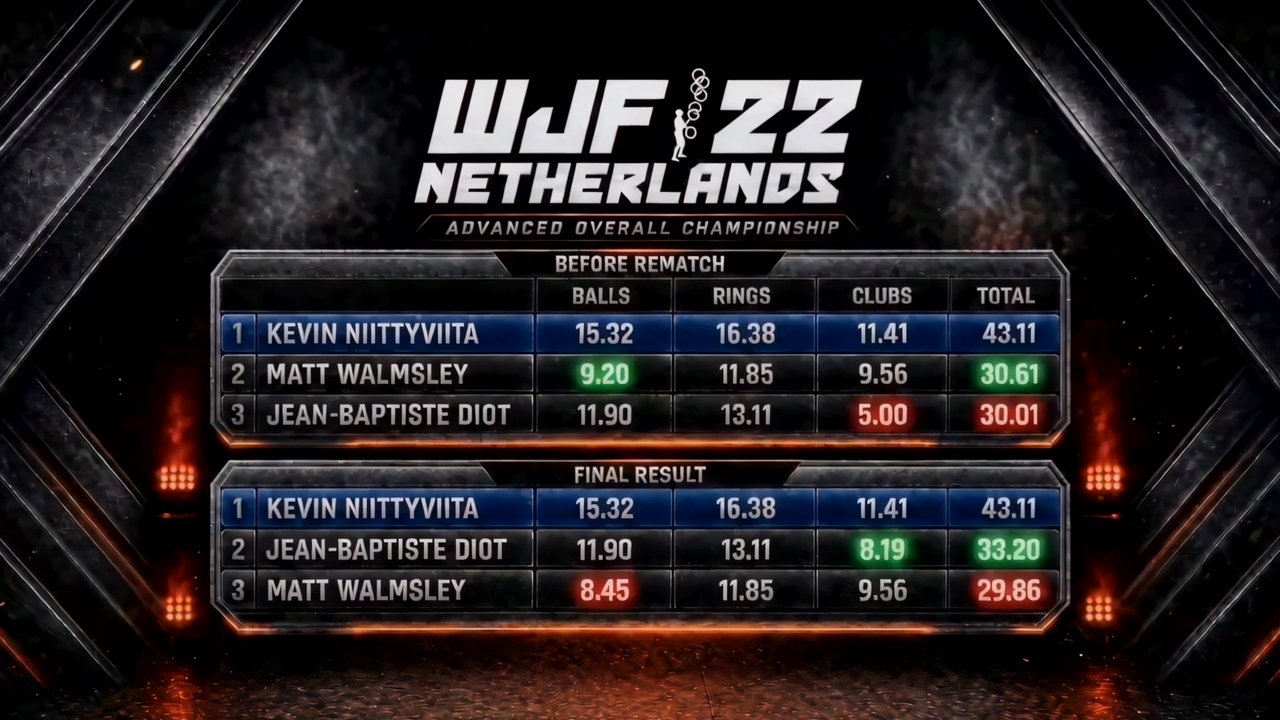
The Runway case study page METAL reviewed includes three videos from the broadcast. They show a packed tent arena with a competitor's name caption on screen, three competitor cards set against the French, Finnish and American flags, and a scoreboard under a "WJF 22 NETHERLANDS" logo that lays out the standings before and after the rematch. On that scoreboard, the competitors in second and third place before the rematch swap positions afterward, with the changed scores marked in green and red.
Text accuracy improved as well. According to Runway, the previous year it took days of prompting to get competitors' names spelled correctly, while this year they came out right on the first try. Broadcast title-safe margins were handled with a workaround that combines Photoshop and Runway. "Adherence to text is better in Runway than anywhere else. If something can't get a name spelled correctly or present a score the way I type it in the prompt, that's a dealbreaker," Garfield said.
The finished special runs about an hour. Garfield assembled it in Final Cut Pro from generated clips capped at roughly 15 seconds each, and he produces the entire broadcast package alone. Runway said the project will also change how the next event is shot. When turnout near the stage is thin, he will frame shots differently rather than rely on generated people, and when a crane is out of budget, he can generate the coverage it would have provided. Next year Garfield plans to start his graphics from this year's successful generations, such as the competitor cards, keep using Runway for leaderboards and scoring graphics, the most time-consuming part of his edits, and move full-screen wipes and transitions he now builds in After Effects over to Runway.
METAL has previously reported on Runway's Layers tool, which splits images into editable layers, and on Ruby, which converts AI video to broadcast HDR standards. This case study lays out, step by step, how far a sports organization with a one-person production team can fill camera coverage and graphics with generation in exactly the broadcast setting those tools target.
Seen through a content marketer's lens, the weight of this case lies less in cost than in the signal a crowd sends. In sports broadcasting, a full house is social proof that an event is worth watching, and for a federation chasing Olympic inclusion, that signal doubles as a persuasion tool. Runway's case study openly says the second-day crowd and the fireworks were generated, but it does not say how, or whether, viewers were told on screen. Runway's reason for featuring the story as a customer case is clear enough: one person producing the graphics and missing camera angles for an hour-long broadcast is the shortest possible advertisement for what video models can do. Once a generated crowd fills empty seats, the line between what a broadcast records and what it stages is left to the judgment of a single producer.
Comments