



Image: METAL
Summary
- According to a case study OpenAI published on September 23, Ringg's agents automatically resolve up to 65% of customer inquiries without a human.
- Real-time traffic runs on GPT-4.1 and GPT-5.6 Luna, post-call analysis on Terra and evaluation on Sol, and moving some workloads cut model costs by about 90%.
- Policybazaar handles 67% of calls without human intervention and has cut response times to under 60 seconds.
Indian voice and chat agent company Ringg is using OpenAI models to resolve up to 65% of customer inquiries without a human agent. According to a customer story OpenAI published on September 23, Ringg's agents handle more than 7 million connected calls a month, and its customers have an average customer satisfaction score of 4.8. Moving some real-time workloads from GPT-4.1 to GPT-5.6 Luna cut model costs by about 90%.
Ringg saw the problem firsthand while working with large consumer businesses in India. When call volume rose, customer service teams coped by hiring more people, which raised the cost and complexity of every interaction. Agents wrestled with fragmented, manual systems to help customers with everything from buying insurance to booking appointments. Drawing on that experience, Ringg built an enterprise agent platform that ties voice, chat, WhatsApp and the web into a single flow.
Siddharth Tripathi, Ringg's co-founder, explained how the company chose its models. "Model quality is only part of the equation. We also need low latency, reliable tool use, strong instruction following, and economics that work at scale," he said, adding, "OpenAI gave us the balance we needed." Ringg said it chose OpenAI after comparing alternatives on conversational quality, latency, multilingual performance, reliability and cost.
The core of the architecture is routing each job to a different model. GPT-4.1 handles most real-time voice and chat traffic, and GPT-5.6 Luna is used for requests where its performance, latency or price-performance fits better. GPT-5.6 Terra handles post-call summaries and sentiment classification, while GPT-5.6 Sol handles evaluation, prompt improvement and model-as-judge work. When a conversation grows long and its context approaches about 80,000 tokens, the system creates a structured summary so the conversation can continue without resending the full history each time.
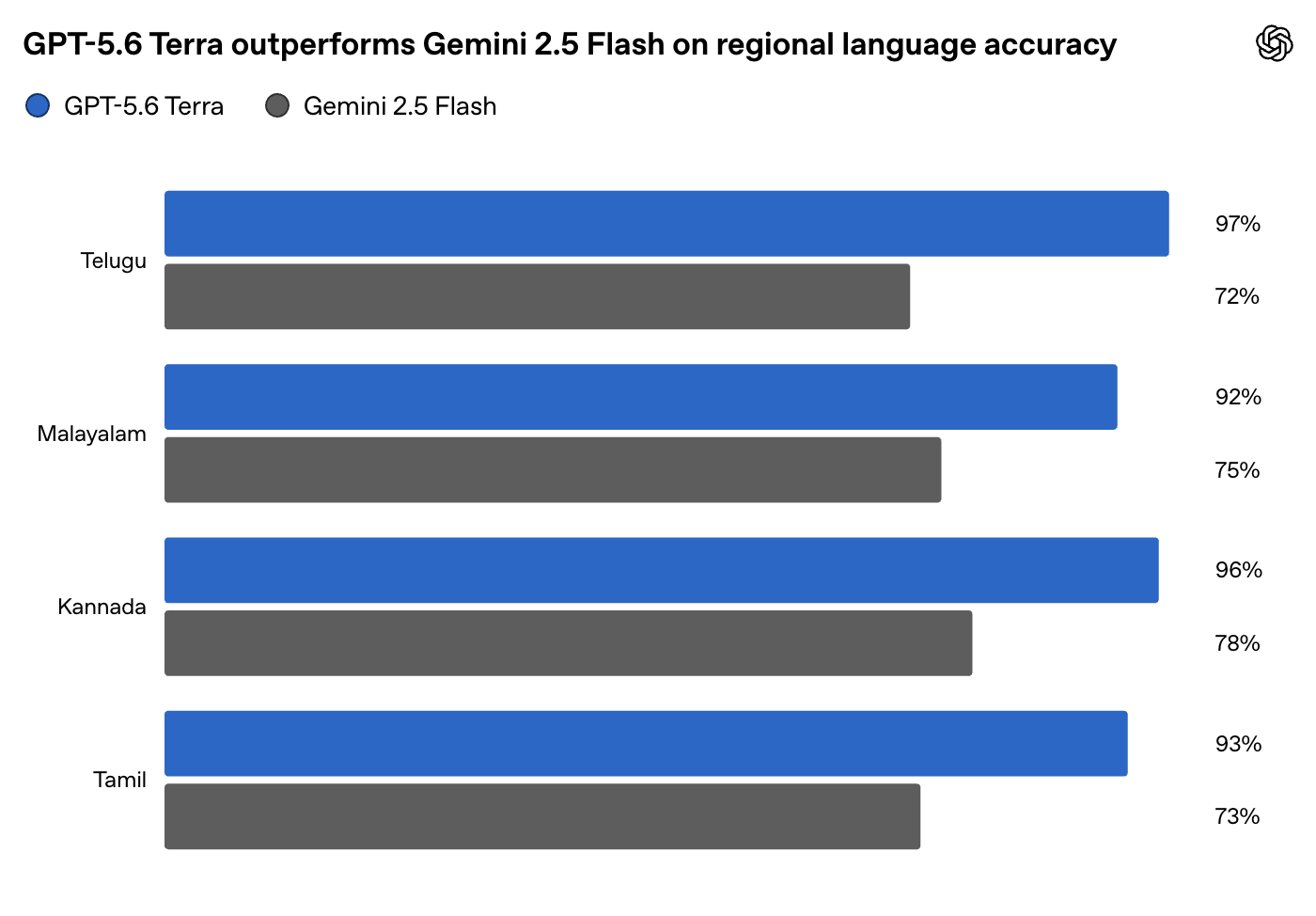
Evaluation drives every model change. Ringg first tests models on historical conversations and simulated customer flows, then introduces models that pass to a small share of live traffic before expanding. In its post-call analysis workflow, GPT-5.6 Terra beat Gemini 2.5 Flash and took over summaries and sentiment classification. In regional language tests that included conversations mixing languages, Terra was more accurate: 97% versus 72% in Telugu, 96% versus 78% in Kannada, 93% versus 73% in Tamil and 92% versus 75% in Malayalam.
The customer numbers are specific. Online insurance platform Policybazaar has connected more than 57,000 customer requests through Ringg and handles 67% of calls without human intervention. Its average response time fell from 8–12 minutes to under 60 seconds, a drop of about 88%. Healthcare platform Practo recorded an 85% first-call resolution rate and response times under three seconds, operating costs fell 70% compared with its previous human-led workflow, and Ringg now handles more than 1,000 appointment bookings a day. Investment platform Groww resolves 72% of inbound queries about IPOs, futures and options through self-service, with an average handling time of two minutes.
The company's roots are in speech synthesis. According to reports, Ringg started as a text-to-speech startup called DesiVocal but pivoted to enterprise voice agents after training its own speech models proved too expensive, and fintech company Cred became its first customer. Referring to early high-volume, low-complexity work such as outbound calling and loan collection, Tripathi said, "We quickly realized these are not sticky use cases, and so it's always going to be a price game." In August, Ringg raised $10 million from Peak XV Partners as an extension of its Series A, bringing the round's total to $15.5 million, and it had 40 employees at the time of the report.
The next stage is the browser. Using OpenAI's computer-use capabilities, Ringg is building browser agents for platform onboarding, Know Your Customer checks, IT troubleshooting, on-call incident support and claims processing. It is also developing a context layer so a customer who starts a request by voice, continues on WhatsApp and finishes in a browser does not have to repeat the same details. "OpenAI's computer-use capabilities accelerated our browser-agent roadmap. They let us combine what is happening on a user's screen with conversational context, so agents can guide people through complex workflows in real time," Tripathi said.
In the words of the OpenAI case study page that METAL reviewed, Ringg says the next generation of customer operations will be measured by completed business outcomes and automation depth rather than call volume or headcount. METAL previously reported on how Base44 cut tokens by 20% with GPT-5.6, and on the same day OpenAI also published Harvey's GPT-6 Astra case study. While the flagship model takes on legal documents, on the front line of phone support it is routing, swapping models of several generations task by task, that determines cost.
From a reporter's view, the weightiest number in this case study is not 65% but 90%. It means the contest in support automation has shifted from the intelligence of a single model to which model is attached to which job. Tripathi calling high-volume, simple work a price game and moving toward complex tasks such as bookings and identity checks follows the same calculation. As more calls end without a human agent, how smoothly agents hand the remaining calls to people will decide service quality.


Comments