


Summary
- Google released two models, Gemini 3.8 Flash TTS and Flash-Lite TTS, on September 23.
- It expands from 30 default voices to a library of more than 2,000, and users can design new voices in text or replicate one from a 30-second sample.
- Flash TTS ranked first on Hume AI's Voice Design Benchmark with 71.4, and input is capped at 8K tokens of text.
Google on September 23 released two Gemini 3.8 TTS models that turn text into speech. Gemini 3.8 Flash TTS, built for creative work, designs new voices from natural-language descriptions alone, while Gemini 3.8 Flash-Lite TTS, built for scale, handles high-volume jobs such as dubbing and voice agents. Both began rolling out the same day in the Gemini API and Google AI Studio.
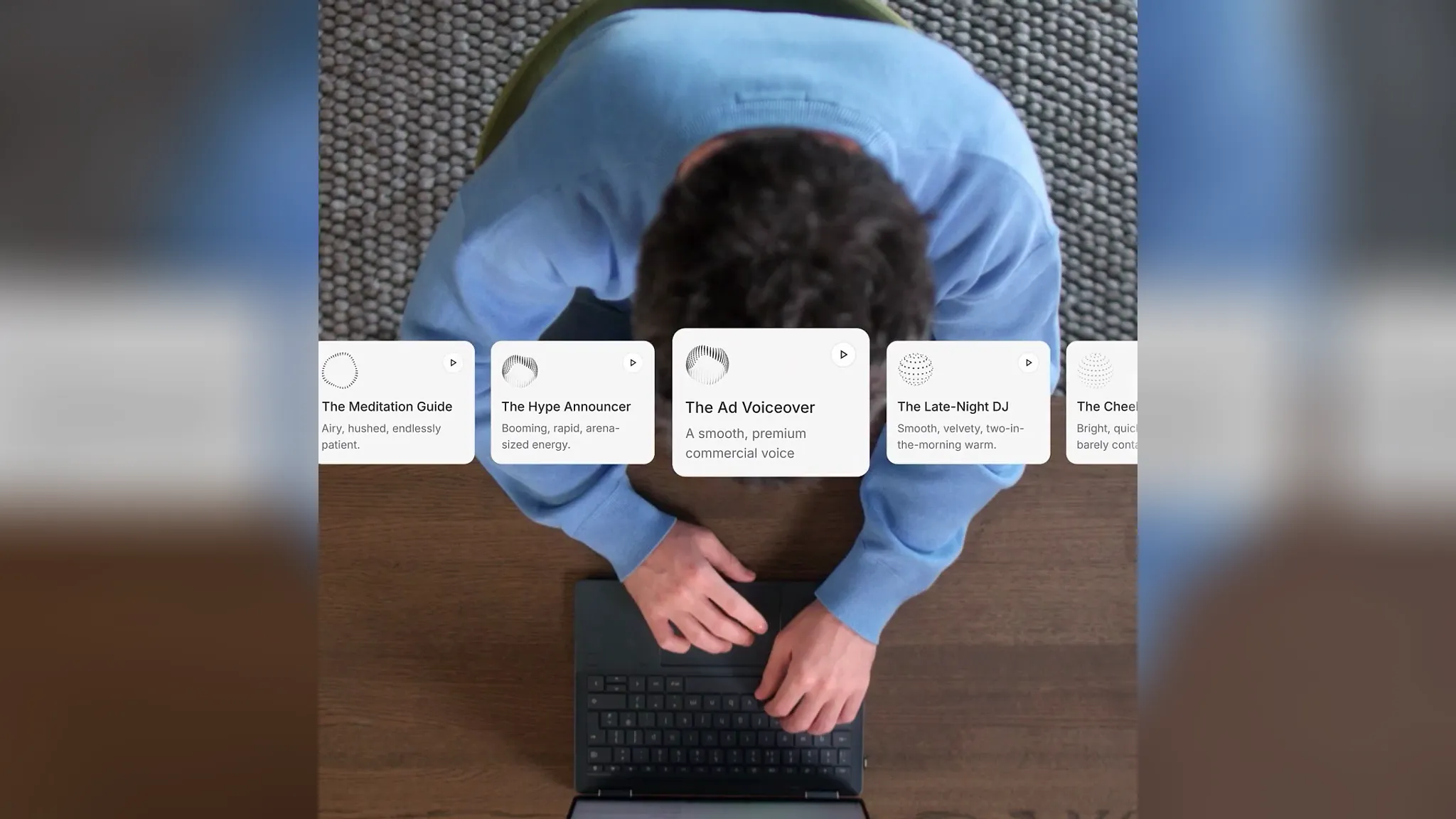
Google's pitch comes down to one sentence. Leland Rechis, Group Product Manager, and Alan Cowen, Director of Research Science, who wrote the announcement, said the models are "transforming voice generation from static presets into a dynamic creative studio." In practice that means moving from picking among 30 default voices to a library of more than 2,000 production-ready voices plus voices users build themselves. The library includes regional varieties such as Mexican Spanish, Quebec French and Scots English.
There are three ways to make a voice. The first is to write out a role, accent and timbre and build a voice from scratch, which works across more than 100 languages and dialects. The second is to recreate your own voice, or one you have the rights to use, from a 30-second audio sample. The third, voice remixing, lets users adjust the timbre, pitch, pace and accent of a library voice with prompts, and is listed only as coming soon. Created voices can be saved and reused with the same sound across projects.
For engineers, the notable part is the direction syntax. Users can write stage directions for each line of a script or let Gemini read cues in the script and set the delivery. Laughs, sighs and gasps go in as angle-bracket tags, and backchannel interjections go in as short words wrapped in vertical bars. The model also natively stages two-speaker dialogue from a single script without the voices bleeding into each other, and Google says speaker timbre barely drifts across hours of continuous audio. The design is aimed at podcasts and audiobooks.
The specifications are in the model card. According to Google DeepMind's Gemini 3.8 Audio model card, both TTS models are based on Gemini 3 Pro, take up to 8K tokens of text as input and return up to 64K tokens of audio. Unlike Gemini 3.8 Live, covered by the same card, which accepts audio, images, video and text up to 128K, the TTS models take text only. The knowledge cutoff is January 2025, and known limitations include hallucinations and occasional slowness or timeouts.
The performance evidence comes from outside leaderboards. According to Google, Gemini 3.8 Flash TTS placed first overall on Hume AI's Voice Design Benchmark with 71.4 and first in accent modeling with 60.8. On the same company's Overall Quality Index, Flash TTS ranked first and Flash-Lite TTS second. Google said that in blind preference evaluations on Voice Arena the models took top positions in Japanese, Brazilian Portuguese, Vietnamese, Modern Standard Arabic, Mexican Spanish and Hindi. Compared with the previous Gemini 3.1 Flash TTS, the company says they improved substantially on long-form content and two-speaker screenplay control.
Voice replication has a gate. Rechis and Cowen wrote in the announcement that "users must provide a verbal consent recording from the voice owner that matches the reference speaker before a voice can be created." Every generated clip carries an imperceptible SynthID watermark woven into the audio, and replication also comes with C2PA credentials. According to reports, voice replication in AI Studio is not available in Illinois, Texas, the European Economic Area, the United Kingdom, Switzerland or India. Regulation around biometric data and voice rights is drawn directly onto the feature map.
The 59-second promotional video on X from Google DeepMind, which METAL reviewed, walks through ordering a voice in text, picking one of three candidates, making one speaker slightly deeper, dropping the voices into a two-speaker scene, and switching to the user's own voice after a short spoken identity check. The narration in the video describes more than a thousand ready-made voices, while the announcement says more than 2,000. The post passed 18,000 views less than an hour after it went up.
Distribution differs by model. Flash TTS reaches developers through the Gemini API and AI Studio and general users through Gemini Notebook, while Flash-Lite TTS goes into Google Vids. Enterprise access via the Gemini Enterprise API is listed only as coming soon for both. Among developer platforms, Agora, LiveKit, Pipecat and Vercel support the models through the Gemini API, and six partners including Figma, HeyGen and Wondercraft are integrating them for dubbing, localization and voice agents.
Google's voice lineup has filled in quickly in September. METAL previously reported that Google released Gemini 3.8 Live and Live Extended Thinking for real-time conversation on September 15, and the two TTS models follow that release. The model card concludes that the TTS models have no meaningful new capabilities compared with Gemini 3.7 Flash and are not likely to reach any tracked or critical capability levels under its frontier safety framework.
From a TPM's point of view, the core of the announcement is that voice has shifted from a pick list to an asset managed in code. Voices are built with prompts, saved and attached to multiple products with the same sound, and acting directions are versioned as script tags. Splitting creative quality into Flash and volume into Flash-Lite maps directly onto pipeline design. What remains open is how to run the same product in regions where replication is blocked, and when the enterprise API will open.



Comments