



Image: Higgsfield (video still)
Summary
- Higgsfield has published a four-stage process that turns catalog data into a product video per SKU.
- Five groups of fields, product photos, name and SKU, features, price and offer, and market and CTA, are substituted into the template.
- The same company's volume production guide describes a weekday rhythm that stacks up to 25 ads a week and 100 a month.
Higgsfield has published a process that turns ecommerce catalog data into product video. Product photos, descriptions, prices and offer details become generation inputs as they are, and one SKU comes out as one video. An AI video tool such as Marketing Studio sits in the place where the per-category template is built, while human review protects product accuracy and brand consistency.
The company pinned down the nature of the work first. Higgsfield wrote in its official documentation, "Catalog automation isn't multiplying one video with one product across a batch. It's applying a small set of approved templates across many different SKUs." The brand's visual language stays fixed while the product, its data and sometimes even the per-category format change underneath. It is closer to newspaper typesetting, where the frame stays put and only the type set into each column is swapped out.
Five groups of data get poured into that frame. Product photos, name and SKU, features and benefits, price and offer details, and market and call to action. Because those fields are substituted into an approved video structure, each SKU gets its own product, message and closing frame without a brief written from scratch.
The ads it can make come in four kinds. The product hero shows the product itself, and the feature video explains what it does. The promotional ad adds a price and a discount, and the marketplace ad fits the format of a particular listing platform. All four come out of one catalog.
The process runs in four stages. The first is getting the catalog data in. Export it through a CSV or JSON file, a product feed API or a PIM, and validate required fields and product images first. Higgsfield wrote in its documentation that the exact import method and the available connectors should be confirmed with the product team.
The second stage is the per-category master ad. Different product types need different formats, so apparel splits toward a try-on, cosmetics toward a product hero or a texture demonstration, and electronics toward a feature video. Marketing Studio or Cinema Studio fixes the composition, camera movement, duration and message structure for each category. Soul HEX and Moodboard hold reference images toward the brand, but the work of setting up each category's master ad properly once remains. Soul ID goes on only when the same spokesperson has to appear throughout the campaign. According to the same company's volume production guide, Soul ID is an identity model trained once from 20 or more reference photos, so from then on the same face goes in without re-uploading for each ad.
The third stage is where SKUs are joined to templates. Each product's image, name, features, price, offer and call to action are substituted into the matching category template. Genjutsu Object Swap replaces the product while leaving the camera, motion and composition alone, and it fits best when the replacement is visually compatible with the original. A product with a very different shape or size needs a fresh version from the category workflow instead. Background or prop changes specific to that SKU are handled by Seedance 2.5 Edit. METAL has reported that Genjutsu arrived as a model that keeps the performance and the camera while swapping the background.
The fourth stage is submission and tracking. The Higgsfield API runs a separate generation job per product and returns a request ID, with status coming back through polling or webhooks. The SKU, request ID, template, market, output and review status have to be kept in the brand's own database, spreadsheet, DAM or PIM. The company pinned it down in the documentation that Higgsfield does not store this for you.
Tool choice is split by the nature of the task. Marketing Studio for making an ad from one product URL or image, Cinema Studio for a custom cinematic hero video, Canvas for saving a visual workflow to reuse, Supercomputer for running a broader task through chat and connected apps, and the Higgsfield API for processing a catalog programmatically. The company drew a line saying these five are not interchangeable options for the same job.
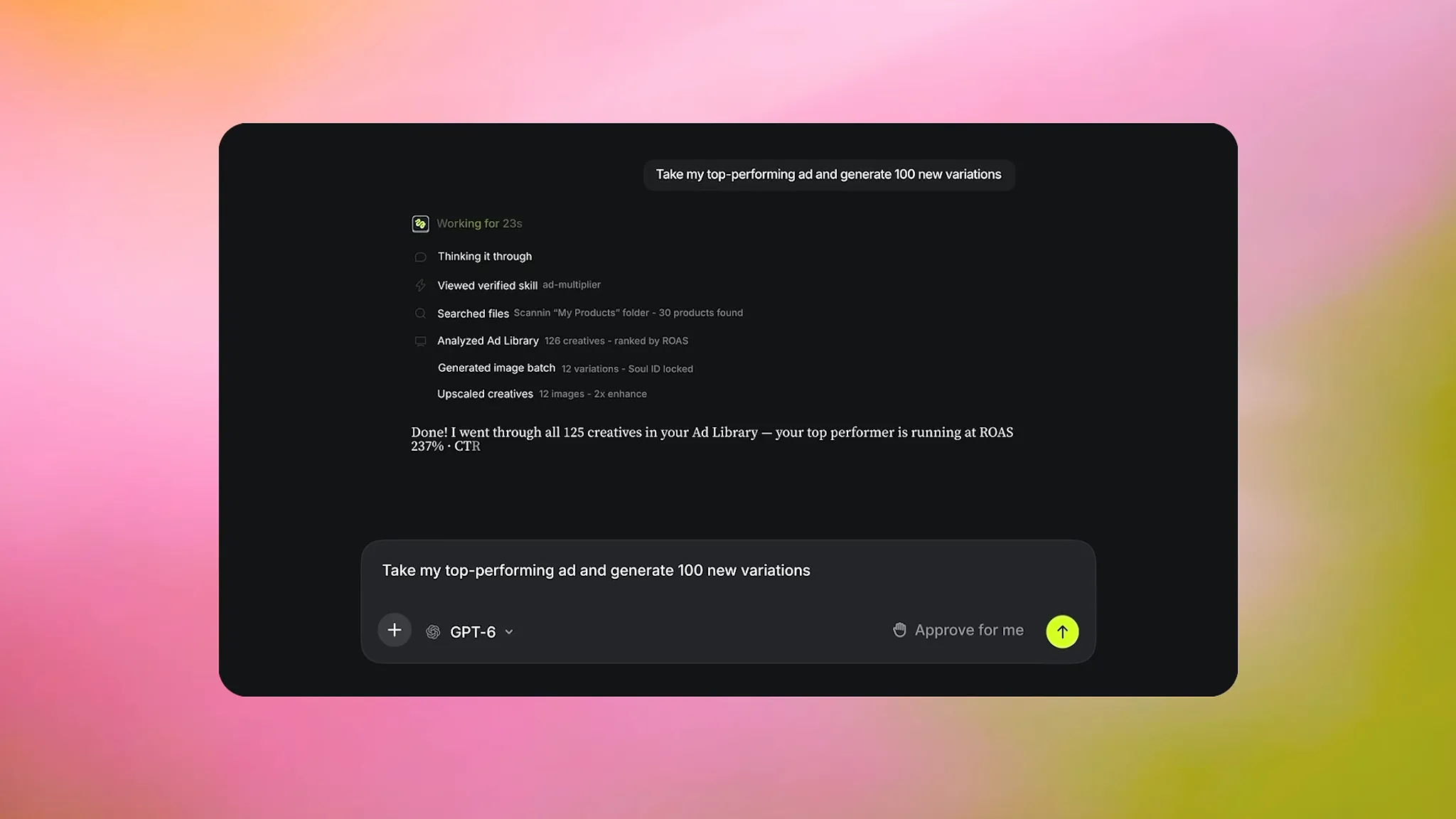
The same company's volume production guide that METAL read sets out why this pipeline turns on a weekly cycle. Five on Monday from a new angle, five on Tuesday with the same script in a different format, a review of last week's performance on Wednesday, five on Thursday built on that week's winner, and ten on Friday in the best performing format. That stacks up to twenty-five a week and 100 a month, with each week's generation informed by the previous week's performance data. The same document recommends creating variation at the script level, giving problem-solution, social proof, feature highlight, lifestyle, and price-value as five example angles. The weekly repetition itself is handled by Canvas, a node-based workspace where prompts, product references and generations from several models sit on one board, so a board for one ad format can be saved as a template and duplicated each week with only the inputs swapped.
Adapting a finished piece to channels and markets breaks into four separate jobs. Reframe makes the vertical, horizontal and square versions, and Seedance 2.5 Edit changes an object, a background or the audio inside a clip. Audio Translate translates the dialogue and re-voices it, and Lipsync Studio matches the mouth to that audio. The company pinned it down in the documentation that these four are never one combined step. The aspect ratio is decided by where the ad runs: vertical for TikTok and Reels, horizontal for YouTube, square for feed ads. A change to the hook or the script itself is not a layer these tools touch, and is handled at the script level before generation.
The same company's ecommerce guide also explains why the approach is template-first. Marketing Studio holds more than 1,500 templates across six kinds, product shots, ads, marketplace banners, posters, UGC and motion, and each template already knows the format and the specs, so only the product has to be plugged in. When a more specific scene is needed, you go down to Seedance 2.5, which takes up to 30 seconds in a single clip and up to 50 reference images to lock the shape, color and packaging. That model also has a selector that sets the era in one line, anywhere from the 1960s to the 2020s.
The company listed the review items before anything goes out, too. Whether the product's shape, color, material and proportions are right, whether the logo and packaging text read correctly, whether the SKU and the offer dates match, whether the translation and pronunciation sound natural, whether hands handle the product realistically, whether the aspect ratio and safe areas are right, whether there is permission to use the face and the voice, and whether a final human approval happened. Higgsfield wrote, "Overlay text stays exact and editable; generated text does not," and recommended that prices, SKUs, offer dates, disclaimers and legal copy not be generated inside the video but laid on top of it as a controlled text layer.
The centre of gravity in this design is not generation quality but the ability to check work against a source. The catalog is the record of truth, the template is the frame, and the output is a function of the two, so when a wrong video comes out the cause narrows to either a data row or a template version. The demand that a request ID be kept in the brand's own ledger comes from the same place. Back when videos were made one at a time by hand, nobody needed a word for tracking. The moment a catalog with thousands of SKUs goes onto one pipeline, the tracking ledger becomes a part as important as the production tool.



Comments