


Image: METAL
Summary
- Official curtailment figures show about 9% of China's wind and solar output was wasted in the first half of this year, and CREA estimates China could have generated 401 terawatt-hours more in the first half alone.
- BNEF estimates China must invest $3.9 trillion in its grid through 2049 and projects that Gansu and Inner Mongolia will become top computing hubs by 2028 as data center capacity doubles within five years.
- China's battery storage fleet is the world's largest, but standalone batteries ran 299 cycles a year, short of the 350-cycle international benchmark, and short-term power trading stays at 12%, leaving market reform as the key.
China is trying to turn the power it generates from wind and sunlight but cannot use into an AI advantage. Official curtailment figures show that about 9% of wind and solar output in the first half of this year was wasted because grid capacity or demand fell short. Energy market research firm BNEF estimates that China must pour $3.9 trillion into its grid through 2049 to build the transmission lines, large batteries and long-duration storage needed to move and hold surplus power. That is more than a quarter above what is expected in Europe or the U.S. According to reports, using surplus renewable energy in the west to expand AI data centers has emerged as a variable that could decide the AI race with the U.S.
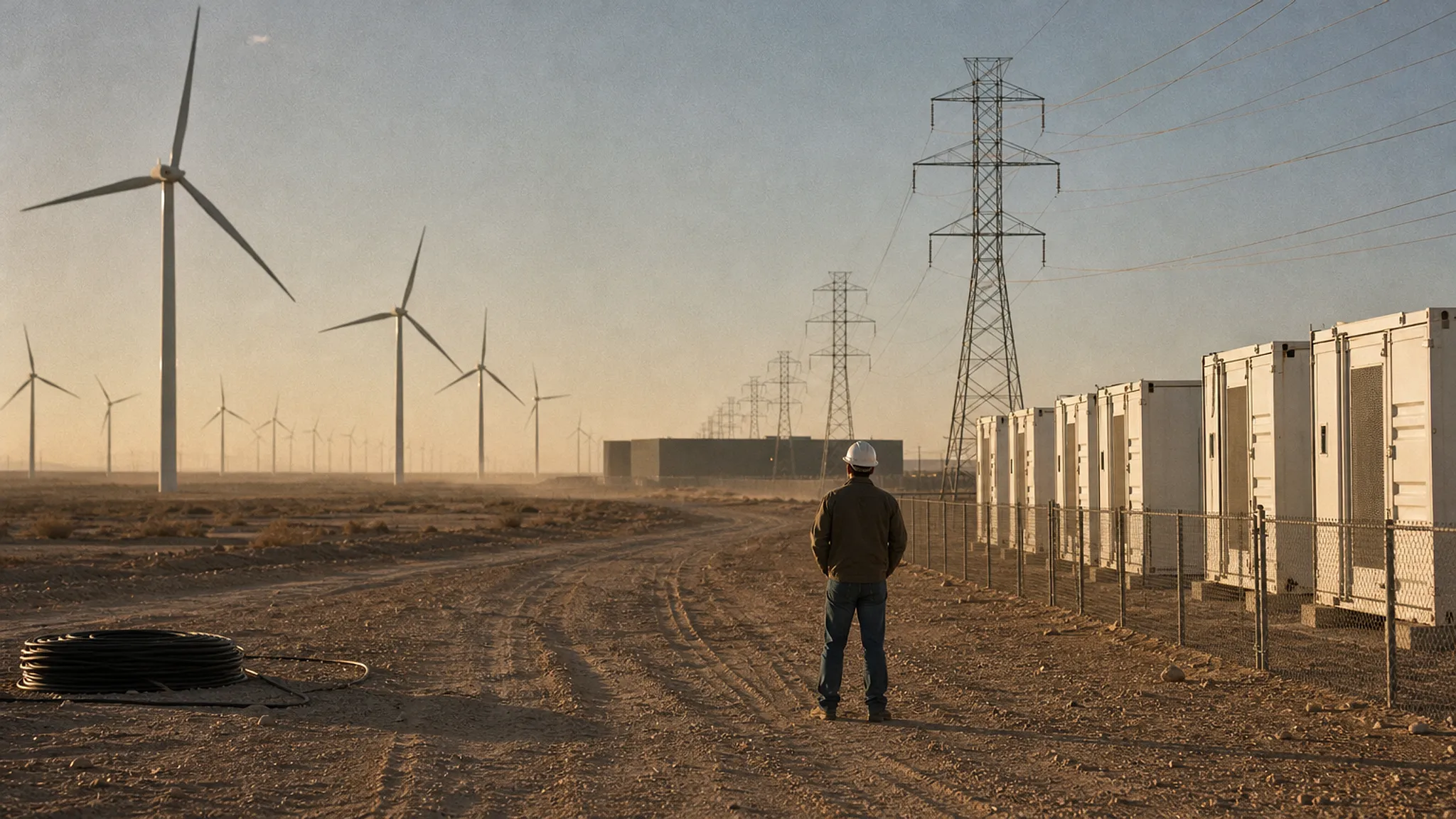
The scale shows in Gansu province. In Jiuquan, in the north of the province, sits the world's largest wind farm, more than 20 gigawatts built on the edge of the Gobi desert by dozens of companies over the past two decades. That is enough to power as many as 20 million Chinese homes, but neither households nor factories are nearby, so much of the power is sent to cities hundreds of kilometers away. Every year more is produced and more is wasted.
The official 9% is likely smaller than reality. The Centre for Research on Energy and Clean Air (CREA) compared weather-adjusted expected generation with actual generation and estimated that China could have generated 401 terawatt-hours more in the first half alone. That roughly equals the combined annual generation of Spain and the Philippines.
This surplus began with a shortage a few years ago. In 2021 and 2022 China suffered widespread power shortages as coal mine disruptions, drought-reduced hydropower and fuel prices driven up by Russia's invasion of Ukraine overlapped. The five-year plan starting in 2021 set 2025 energy output at a minimum of 4.6 billion tons of coal equivalent, but actual output reached 5.13 billion tons. Electricity's share of total energy use was 30% last year and could rise to 35% by the end of the decade. Power demand in 2025 exceeded 10 trillion kilowatt-hours, a first for any country. According to reports, Ren Yuzhi, director of planning at the National Energy Administration, said it was "a remarkable achievement, one that we had not previously anticipated would reach such a high level of growth."
China answered by expanding supply on every front at once. From 2022 to 2025 it added more generating capacity than the entire U.S. power system, expanding coal, solar, wind, nuclear and hydropower together. At least 10 reactors were approved each year over the same period. Last year it installed record amounts of 315 gigawatts of solar and 119 gigawatts of wind, and while additions in the first half of this year slowed to 72 gigawatts of solar and 39 gigawatts of wind, that is still more than any other country has installed in a full year. "China's not going slowly. It's going super-fast or super-duper fast," said Michal Meidan, head of China energy research at the Oxford Institute for Energy Studies.
This is where it meets AI. BNEF projects that western regions such as Gansu and Inner Mongolia, which produce more than they consume, will become China's top computing hubs by 2028, and that China's data center capacity will double in the next five years. Shantou, on the coast of Guangdong, exports computing capacity through a fiber-optic link to Singapore. In the U.S., backlash against data centers over power bills has become a major issue in this year's midterm elections, and several states have effectively frozen new developments. METAL has reported on the AI data center boom in Ulanqab, Inner Mongolia.
The burden falls on the grid. Wind and solar now account for about half of China's generating capacity and about a quarter of generation. One in four electrons on the grid rises and falls with clouds and wind, and greater intermittency raises the risk that frequency and voltage drift outside safe limits. Unused renewable power has also revived fossil fuel generation. Coal capacity additions in the first half of this year were the highest of any first half in a decade, and leaders call coal the country's ballast stone and are allowing increased use through 2030. According to reports, Muyi Yang, an analyst at Ember, said "building more wind and solar and even electric vehicles, those are the easier parts of the transition," adding that the new system has entered a phase that puts more direct pressure on the legacy system.
The fix is equipment that moves electricity across time and space. According to reports, Zhao Li, planning director at the Guangdong unit of China Southern Power Grid, said "absorbing renewable energy into the grid is of paramount importance," and "new energy is defined by its intermittency and volatility, and that is what makes grid integration the central challenge." According to BNEF, China's battery storage capacity stood at 144 gigawatts at the end of 2025, more than the rest of the world combined. According to Ember's July 16 analysis METAL reviewed, China had installed almost 150 gigawatts of lithium-ion battery storage by the first quarter of 2026, and in June it raised its 2030 target for new energy storage to 300 gigawatts. Of the capacity installed from January to April this year, 84.7% was standalone batteries dispatched directly by the grid rather than batteries attached to renewable plants.
What lags is operation, not equipment. According to Ember, standalone batteries averaged 299 charge-discharge cycles in 2025, more than double the 2022 level, but still short of the international benchmark of 350 a year, roughly once a day. Ember calculated that if all utility-scale batteries had reached 350 cycles a year, they could have shifted an additional 23 terawatt-hours in 2025. Ma Kui, who operates a 100-megawatt battery storage plant in Jiangsu province, follows the grid's instructions without price signals. According to reports, he said "we don't decide when to charge or discharge. The grid tells us what to do, and we follow the dispatch plan exactly."
Market reform is in its infancy. Most coal power is still sold under long-term contracts that can crowd out wind and solar. Short-term power trading made up 12% of all transactions in the first half of this year, up from just over 4% in 2025, and in June private players for the first time bid for transmission line capacity. The government has set a goal of creating a unified national power market by 2030. According to reports, Belinda Schäpe, an analyst at CREA, said "the biggest bottleneck that is left is really changing the system and the incentives," and "the long-term trajectory is very clear. The question of how to get there is a lot more unclear." Even if $3.9 trillion of transmission lines and batteries is laid, turning surplus power into an edge for AI data centers will first require a structure in which prices decide when and to whom that electricity goes.
Sources
- Techmeme — A look at China's bid to turn excess wind and solar energy into an AI edge via a $3.9T grid buildout through 2049 →
- Bloomberg — China's AI Race Against the US Hinges on Harnessing Its Green Energy Advantage →
- Ember — China's batteries move beyond capacity scale-up: utility-scale storage could have shifted 23 TWh more clean power in 2025 →
Comments