


Image: METAL
Summary
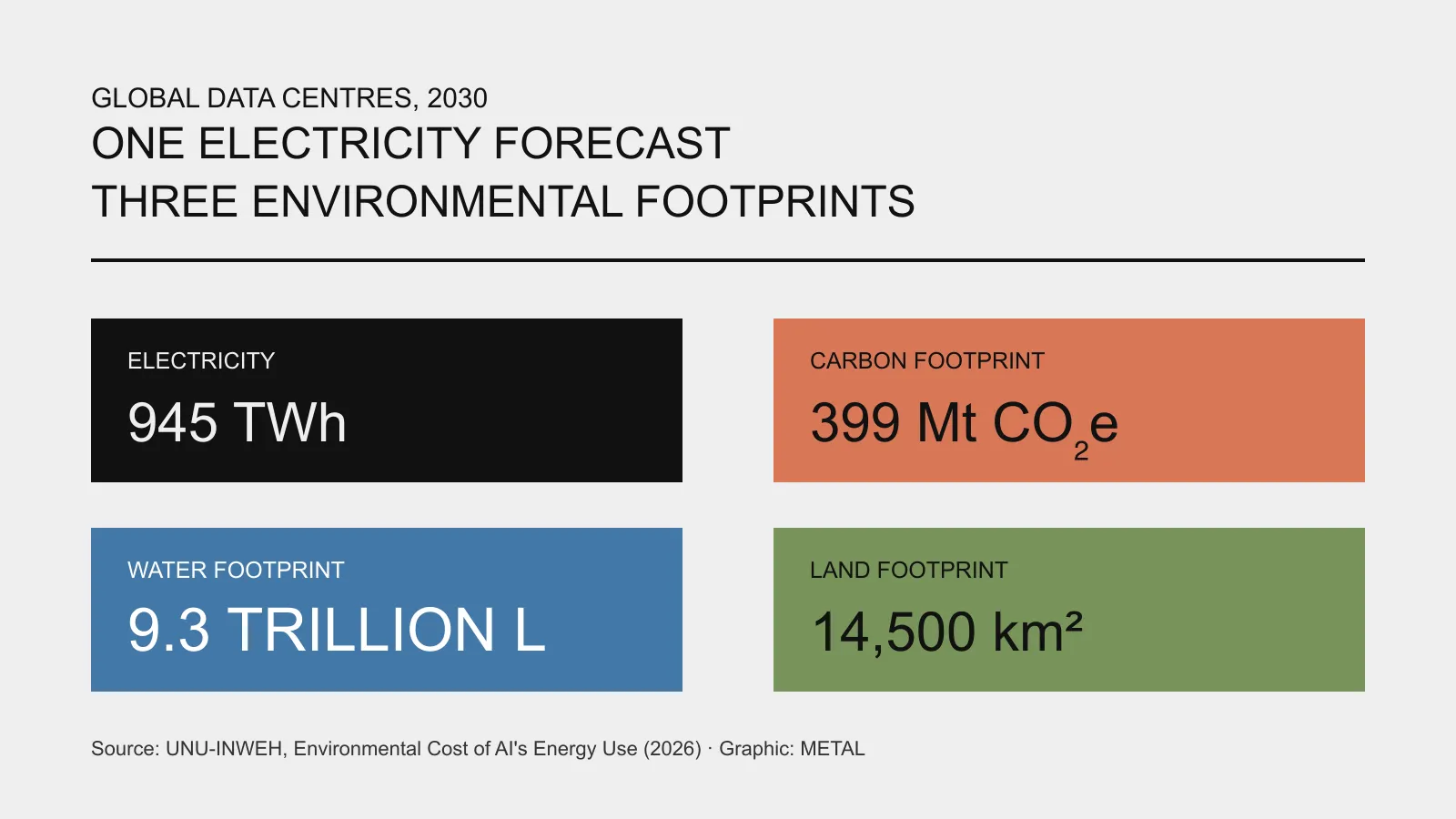
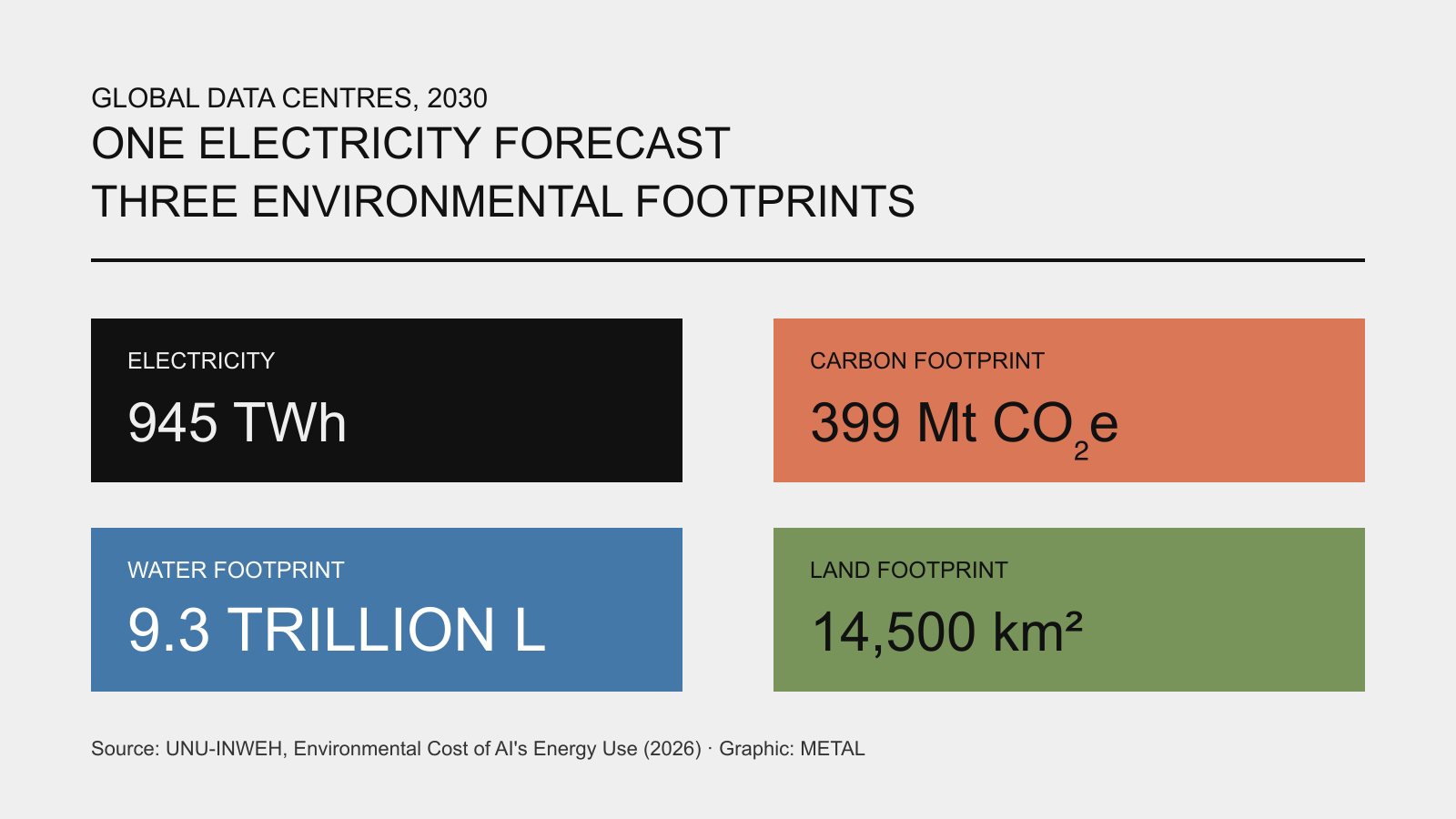
- United Nations University researchers estimate that data centers will require 945 terawatt-hours of electricity in 2030, with an associated water footprint of 9.3 trillion liters.
- Replacing coal with bioenergy can reduce carbon emissions while sharply increasing water and land use, making carbon an insufficient measure of environmental performance.
- The researchers estimate that inference accounts for 80–90% of AI energy use and recommend managing product defaults, including model selection, output length and resolution.
Using AI may seem to end at the chat window, but its bills remain on power grids, waterways and land. A report released on June 3 by the United Nations University Institute for Water, Environment and Health (UNU-INWEH) projected that global data centers would consume 945 terawatt-hours of electricity in 2030. The baseline projection represents roughly 3% of expected global electricity consumption that year.
This figure was not newly announced in September. It comes from the June report revisited in climate reporting on September 22. The report starts with electricity demand across all data centers, whose growth is being driven by AI adoption, rather than electricity measured for AI alone. The International Energy Agency (IEA) likewise projects that data center electricity consumption will more than double from an estimated 415 terawatt-hours in 2024 to 945 terawatt-hours in 2030 in its base case.
The UNU-INWEH researchers added three footprints behind that electricity. For 2030, they estimated an electricity-generation-related carbon footprint of 399 million tonnes of carbon dioxide equivalent (CO₂e), a water footprint of 9.3 trillion liters and a land footprint of 14,500 square kilometers. The water figure is comparable to the basic annual domestic needs of 1.3 billion people in sub-Saharan Africa; the land area is about twice that of Greater Jakarta.
“This report is not a case against artificial intelligence,” said Kaveh Madani, director of UNU-INWEH. The call is to address unintended impacts before they grow, rather than deny the technology's benefits. The full report and announcement reviewed by METAL stress that claims of lower carbon emissions alone cannot establish the sustainability of AI infrastructure.
The three footprints do not move together when power sources change. In the report's comparison of average values, replacing coal with bioenergy could cut electricity's carbon footprint by roughly 70%, while increasing its water footprint more than thirtyfold and its land footprint a hundredfold. Low carbon does not automatically mean low water or land use. Improving one measure can shift burdens onto another region's water and land.
Looking only at electricity used to train a large model once also misses the wider picture. The researchers estimate that inference—the stage in which deployed models repeatedly answer requests—accounts for 80–90% of AI energy use. Once a product is widely used, its defaults, the models to which requests are routed, answer length and resolution become major operational variables beyond a single training run.
The type of task matters, too. Relative to basic text classification, the report compares a typical conversational query at roughly 200 times the energy and one AI image at roughly 1,450 times. A complex short video can be comparable to 200,000 spam-classification tasks. The report also gives an electricity-generation-related water footprint of about 29 milliliters for an image and 4.1 liters for a complex video. These figures do not mean only cooling water consumed directly at the server site; they vary with the model and power mix.
According to Miriam Aczel, a UNU-INWEH researcher and the report's lead author, choices that “look greenest from a carbon perspective” can “end up worse for water or for land.” A carbon-free label on a power purchase agreement still leaves cooling, generation, transmission infrastructure and supply chains to examine before the full costs become clear.
The report also challenges expectations that better efficiency will automatically shrink the problem. More efficient models can lower prices and expand use, swallowing the savings—a rebound effect. The researchers recommend setting resource budgets for token counts, output length and image and video resolution, and choosing the lightest model and lowest-energy format capable of doing the job.
The burdens are unevenly distributed. According to 2025 data cited in the report, only 32 countries host AI-specialized data centers, and more than 90% of that computing capacity is concentrated in the United States and China. More than 150 countries, meanwhile, have little or no AI computing infrastructure under their own control. The researchers raise the possibility that the places bearing mineral-extraction and electronic-waste burdens differ from those receiving the economic and security benefits.
The cases assembled in the report show pressures on the ground. In Ireland, data centers used 21% of metered electricity in 2023, exceeding all urban households, and the grid operator paused approval of new connections around Dublin until 2028. Cases in Querétaro, Mexico, and Uruguay show drought overlapping with data center water demand. The report also cites a projection that annual AI-related electronic waste could reach as much as 2.5 million tonnes by 2030.
The numbers do not, however, support assigning all global electricity growth to data centers. In the IEA's base case, they account for less than 10% of the increase in global electricity demand from 2024 to 2030. The adoption of air conditioning and electric vehicles, industrial output growth and electrification contribute more. The risk from data centers lies in their concentration in particular locations, where they can put power grids and water supplies under pressure over a short period.
The question the report seeks to change is whether AI is simply good or bad for the climate. What matters is which models are deployed where, which electricity and water they use, and who receives the benefits and bears the costs. The researchers recommend that governments consider power planning, water management and land permitting together and require standardized disclosure. They urge companies to treat model selection and default outputs as environmental decisions.
AI companies' power contracts are already changing regional energy plans. METAL previously reported on Google's 22-year power purchase agreement to buy up to half the electricity from Finland's Loviisa nuclear power plant through 2050. A single corporate contract can now influence a power plant's lifespan and regional grid investment. The next sustainability report merits scrutiny beyond a carbon-neutrality statement: electricity, water, land, electronic waste and the locations bearing those burdens all matter.




Comments