


Summary
- OpenAI expanded ChatGPT Ads to seven markets on September 23: Indonesia, Malaysia, the Philippines, Singapore, Thailand, Vietnam and Taiwan.
- Ads appear only on the Free and Go plans, and can be bought through five agency groups, technology partners and self-service Ads Manager.
- ChatGPT Ads passed a $1 billion annualized revenue run rate in less than 200 days and now has tens of thousands of advertisers.
OpenAI announced on September 23 that it is expanding ChatGPT Ads to seven markets across Southeast Asia and Taiwan. The rollout covers Indonesia, Malaysia, the Philippines, Singapore, Thailand, Vietnam and Taiwan, and with it ChatGPT Ads is now available in more than 60 countries. It follows earlier Asia Pacific launches in Australia, New Zealand, Japan, South Korea and India. Ads are shown only to users on the Free and Go plans, while Plus, Pro and Enterprise subscriptions stay ad-free.
There are three ways to buy. Advertisers can work directly with OpenAI's Ads Solutions team, go through agency partners such as dentsu, Havas Media, Omnicom Media, Publicis Groupe and WPP or technology partners, or, if eligible, run campaigns themselves in Ads Manager. Dave Dugan, vice president and head of global ads solutions at OpenAI, said "we're at the beginning of a new chapter for advertising, with AI creating new ways for businesses and people to connect," adding that the expansion "brings that opportunity to businesses of every size, from global brands looking for new ways to grow to entrepreneurs and startups running their first campaign."
The first advertiser voice came from regional e-commerce. Peggy Zhu, executive director of brand and growth marketing at Shopee, called OpenAI a strategic partner and said "following the launch of ChatGPT Ads in Brazil, we are pleased to extend this collaboration to Southeast Asia and Taiwan." According to reports, Shopee runs marketplaces in all seven new markets as well as in Brazil.
The most practical change for advertisers is self-service from day one. According to reports, OpenAI's help center page on Ads Manager availability listed 63 countries as of September 24, all of them, including the seven new markets, open for self-service. Eligibility depends on where the billed legal entity is based rather than where the audience sits, so a regional hub registered in Singapore or a retailer registered in Vietnam can open an account right away. That is a different sequence from India, which went live on August 29 without self-service and opened direct buying only two days later.
Barriers to entry have come down quickly. According to reports, the US pilot on February 9 required a minimum commitment of $200,000, which fell to $50,000 in April before disappearing for US buyers on May 5, when cost-per-click bidding and self-serve Ads Manager opened. Markets that numbered nine with Brazil and Mexico on August 17 became 63 listed countries 37 days later. Benji Shomair, OpenAI's vice president of monetization, wrote on LinkedIn that for advertisers across Southeast Asia and Taiwan this "creates a new opportunity to reach people as they discover products, explore options, and make decisions."
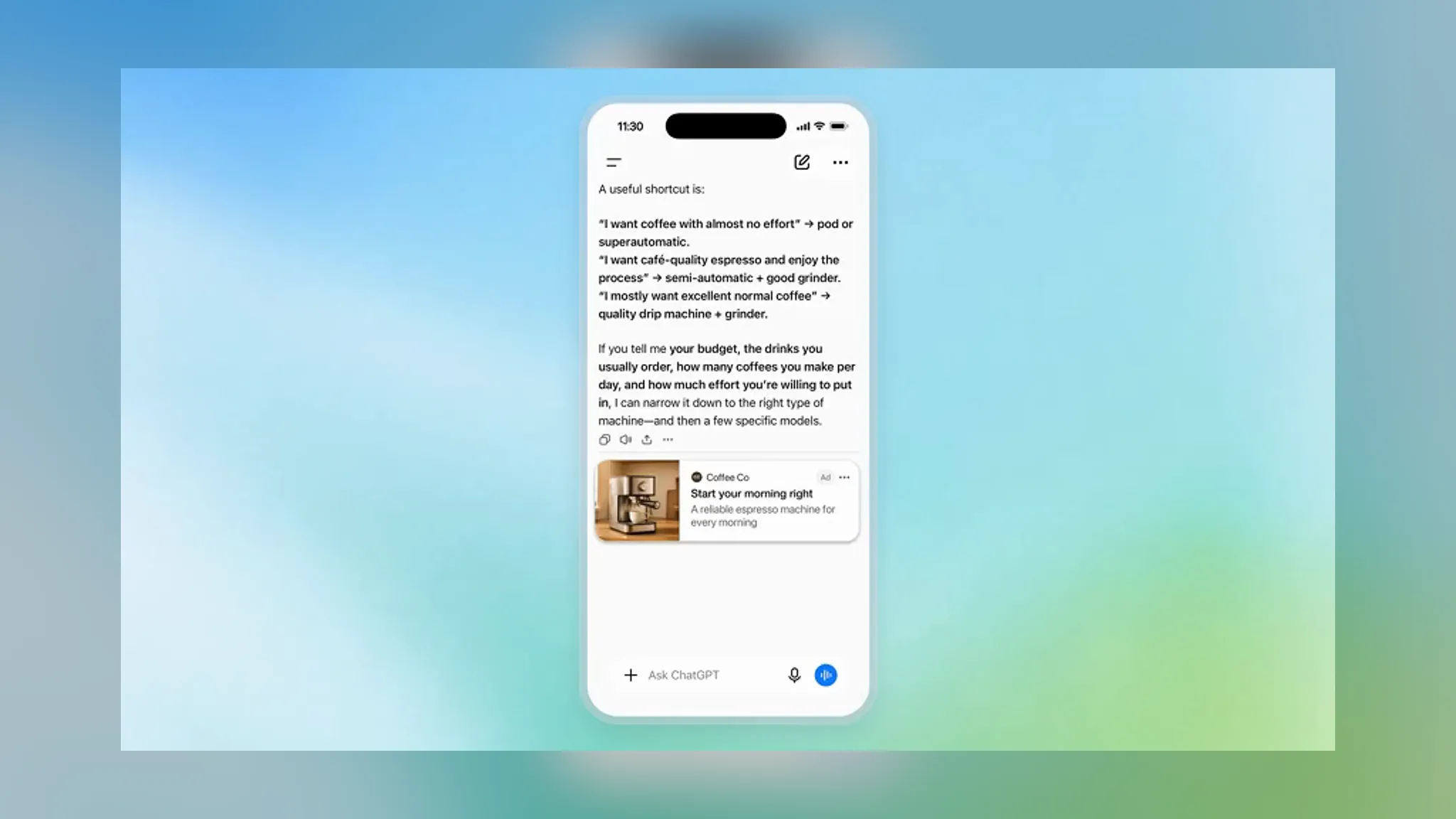
How the ads look is shown in an 11-second demo video on the announcement page, which METAL reviewed. A user asks what to consider when buying a coffee machine, ChatGPT lays out criteria such as brewing style, grinder, cleaning and size at length, and a separate coffee machine ad card appears below the finished answer. OpenAI said ads are always clearly labeled, separate from the answer and do not influence what ChatGPT says. It also restated its principles that conversations are kept private from advertisers, customer data is never sold, and users can control ad personalization.
The business is already large. According to OpenAI, ChatGPT Ads reached a $1 billion annualized revenue run rate in less than 200 days after launch, and tens of thousands of advertisers are now running ads. METAL has reported on the $1 billion run rate and the plan to expand to 31 European markets, and on September 16 covered the sponsored agents test. OpenAI said it will keep adding new markets, formats, optimization tools and measurement solutions over the coming months.
Measurement has not kept pace with the expansion. According to reports, app measurement partners AppsFlyer and Adjust are integrated in only seven markets, the United States, Canada, Australia, New Zealand, the United Kingdom, Japan and South Korea, and none of the new Asian markets is on that list. Independent data is also concentrated in the US: Similarweb counted ads on 26% of US desktop chats in June, with a 0.50% click-through rate. Language is another variable. Ad cards are short, with a headline of about 16 characters and a description of about 32, and neither announcement explains how the text customization and translation feature OpenAI added on September 16 works in Thai or Traditional Chinese.
Competition is arranged differently in this region. According to reports, Google has run ads in AI Overviews in Indonesia, Malaysia, the Philippines and Singapore since December 19, 2025. For advertisers in those four countries, ChatGPT is a second AI answer surface. Shopee also appears on Google's commerce audience list, so a single marketplace has a foot on both AI surfaces.
Through a content marketer's lens, the weight of this expansion lies less in the country count than in how the ads are bought. Small businesses can now test conversational ads themselves from the first day without going through an agency. Because discovery, comparison and purchase consideration can all happen inside one conversation with no results page or feed, what a single short ad card promises at the end of a long answer will decide performance. Until local performance data builds up, advertisers will have to measure for themselves whether they are shifting existing search and social budgets or creating new demand.



Comments