


Summary
- Because the palm camera and DINOv2 recognize the object and choose the grip, the user no longer has to switch hand positions manually.
- Meta AI glasses and the Wearables Device Access Toolkit add first-person point-of-view data, and users add new objects through a phone app.
- When smartARM won the 2018 Imagine Cup, Azure cloud was the brain; eight years on, it has moved to an open-source vision model.
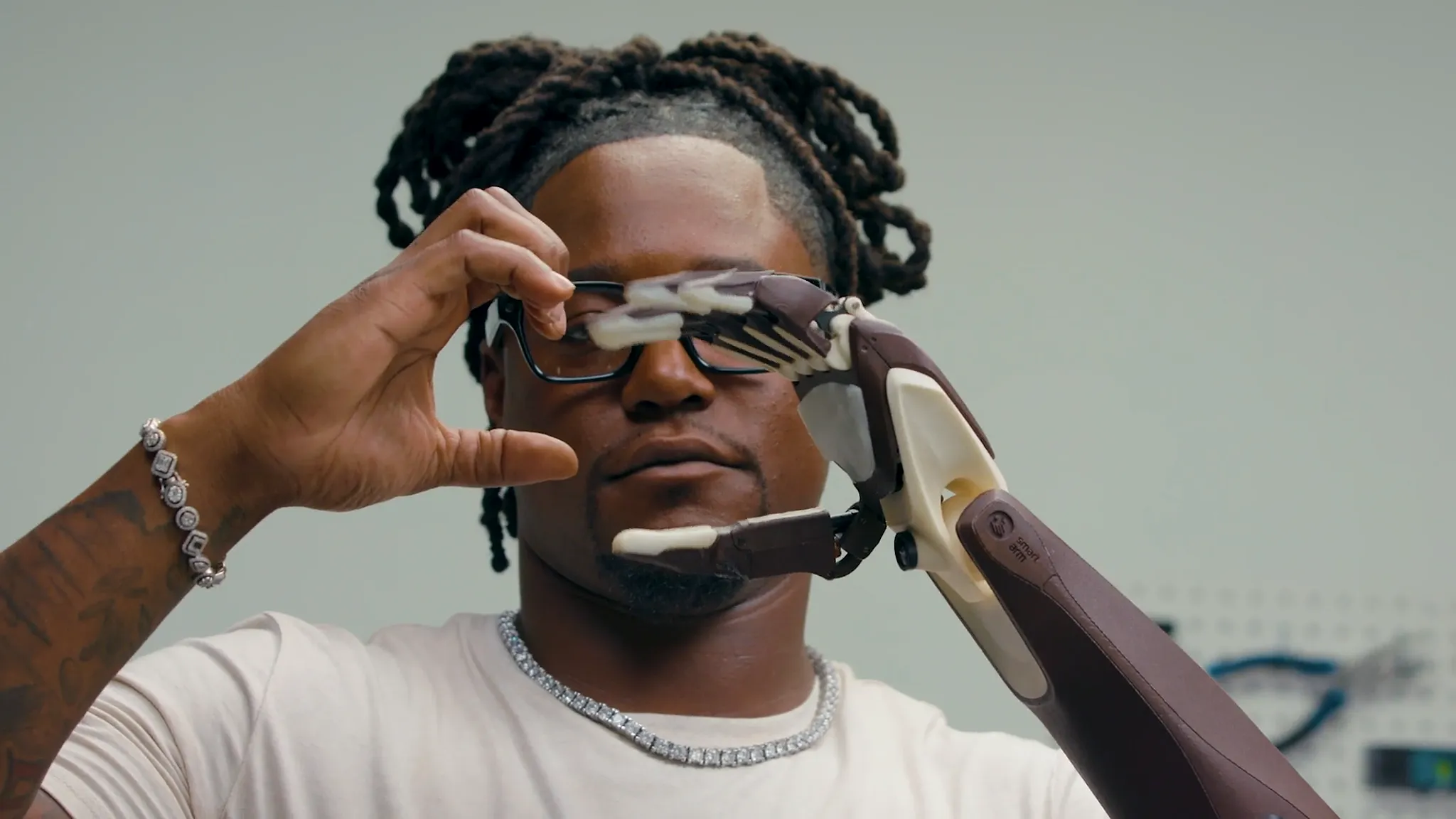
Shaquem Griffin played in the NFL with one hand. The first thing he says in a 2-minute-29-second video posted to Meta's newsroom on September 16 is a joke: people with two hands had better be thankful. In the video he wears a bionic arm from Toronto startup smartARM, picks up a water bottle and drinks from it, and at the end forms a heart with the prosthetic and his remaining hand. Meta put the story on its Canadian newsroom because the arm runs on DINOv2, Meta's open-source vision model, and on Meta AI glasses.
smartARM is a vision-first bionic arm prototype with a camera embedded in its palm. According to the company, most existing prosthetic hands require the user to switch grip patterns manually for each object, so a natural sequence like picking up a glass and then a spoon breaks into several steps. smartARM removes those steps by letting the camera mounted on the arm see the surroundings and choose a grip suited to the object on its own. According to reports, conventional myoelectric prosthetics rely on surface electromyography sensors placed against the muscles of the remaining arm, which read the electrical signals of specific muscle groups to trigger preset grips; learning to cycle through grip modes demands constant concentration, and muscle fatigue or sweat can throw off signal accuracy.
The eye that recognizes objects is DINOv2. According to Meta, smartARM uses the open-source vision model to recognize everyday objects from just a few reference photos and hands the result to its grip-selection software. Because it grips by reading an object's visual features directly, with no prior understanding or additional programming, adapting to a new object, which previously could take weeks, now finishes almost instantly with a few photos. In the video, Hamayal Choudhry, smartARM's founder and CEO, explains that when a user takes a couple of photos in the smartARM app, DINOv2 finds the similarities between the images and estimates the best grip. METAL has reported on Generalist AI's model that teaches a robot a new task from a three-second demonstration, and smartARM's way of teaching a new object from a few photos runs in the same direction.
Meta AI glasses are an optional add-on. According to the company, smartARM uses Meta AI glasses and the Meta Wearables Device Access Toolkit to take in first-person point-of-view data from the user's eye level, extending its object recognition and understanding. The palm camera alone lacks context about what the user is reaching for, and the glasses supply that context. Users can add new objects through the device app on their phones, so the whole smartARM community can personalize the prosthetic around their everyday needs. In the video, Choudhry says you can buy the glasses off the shelf and pair them with the smartARM app, and you are good to go. METAL has reported on RayNeo, which shipped AI glasses without a camera; smartARM does the opposite, using the glasses' camera as the prosthetic's second eye.
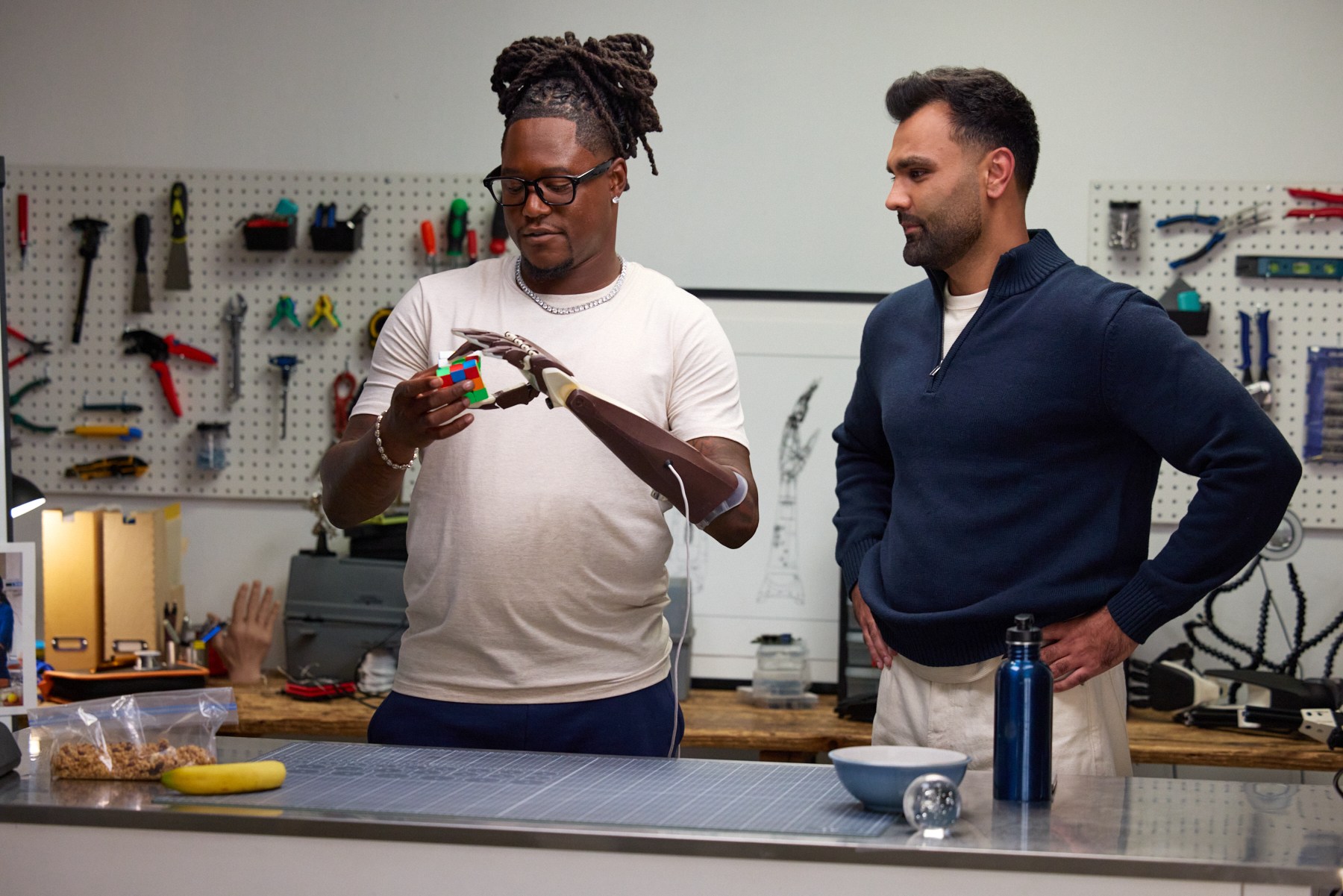
This company's eye has been a camera from the start. According to Microsoft's official blog, smartARM won the 2018 Imagine Cup World Finals over 49 teams from 33 countries, and the prototype then was also a robotic hand prosthetic with a camera in the palm that recognized objects and calculated the appropriate grip. The brain at the time, though, was Azure Computer Vision, Machine Learning, and Cloud Storage, and it grew more accurate the more it was used. The winning team received a mentoring session with Microsoft CEO Satya Nadella, $85,000 in cash, and a $50,000 Azure grant. According to Microsoft's Canadian news center, the company began in 2018 as a conversation between Hamayal Choudhry and his friend Sekai Trudy, who lives with a congenital limb difference, and the starting point was a gap in the market where people were forced to choose between an affordable prosthetic and a functioning one. The goal of using 3D printing to bring the price down and cut wait times was set then too, and it became the first Canadian organization to win the Imagine Cup. In eight years, the brain has moved from a cloud API to an open-source vision model.
Griffin's connection to smartARM is not new either. Microsoft's Canadian news center reported in 2023 that after struggling to find a prosthetic that suited him, he met co-founders Hamayal and Evan and was working with them on a smartARM of his own. In this new feature, Meta describes him as a long-time smartARM user and former NFL player. "Of all the tech packed into it, scalability and accessibility matter most to me. This is the future of consumer prosthetics," Griffin said. In the video he recalls that a tool his father built so he could lift weights was all he knew of prosthetics as a child, and that he did not know prosthetics existed that could do everyday tasks. He says he never knew how big a deal it was to shop with two hands, and that the arm is a confidence builder that makes him feel centered.
"Building a capable hand is only part of the challenge. Making it intuitive to use matters just as much," Choudhry said. "By helping the arm recognize everyday objects and select a suitable grip, we're working toward an experience where people can focus more on what they want to do and less on how to operate their prosthetic," he added. Meta says the arm works from the first try, with no training required. According to reports, the company is also trying to lower the cost barrier of expensive bionic limbs by relying on open-source software and commercially available wearable hardware, and, together with lightweight modular fabrication, it continues to test the prototype in real-world settings as it prepares a broader rollout.
The video METAL reviewed is the 2-minute-29-second cut that Meta's newsroom hosts on its own CDN, moving from Griffin's introduction to Choudhry's demonstration, the scene of picking up and drinking from a water bottle, and the scene of registering an object while wearing the glasses. METAL has reported on Meta launching its Meta One subscription worldwide and bundling AI features into it. On the other side of that push, Meta released its vision model as open source and opened the glasses' camera to outside developers, which let a small Toronto company build the eyes of a prosthetic. A large company opening its platform and a small company building something that touches the body on top of it is a structure contained in this one arm from smartARM.


Comments