


Summary
- LLM token-usage dashboard for easier management... Operations and observability upgraded with data-drift detection and more
- Focus on strengthening "Enterprise AI Sovereignty," where companies control AI performance, resources and costs themselves
Seoul, Wednesday, September 30, 2026 — MakinaRocks (CEO Sung-ho Yoon), Korea's leading physical AI company, has introduced new capabilities through the 2.4.0 update of its AI operating system (AI OS), Runway.
Runway is an AI OS that connects fragmented data, models and field systems so that AI actually works on the shop floor. It manages the entire AI lifecycle, from development through deployment and retraining, on a single platform, and provides the same operating environment even in high-security settings, including air-gapped networks.
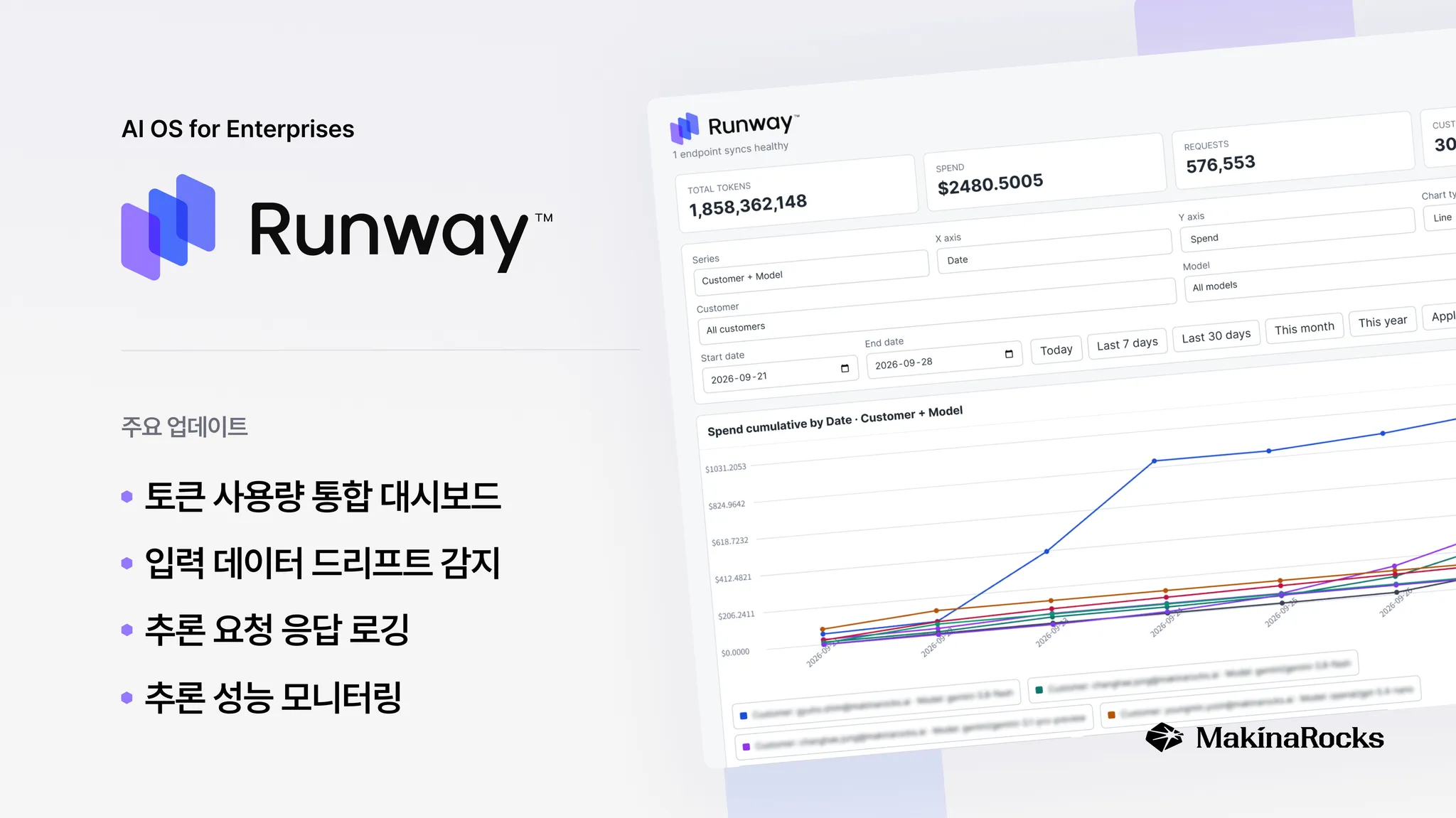
This update focuses on strengthening "governance," enabling companies to understand and control the performance, resources and costs of their AI on their own. To achieve this, it adds integrated observability and management features centered on cost management, model-quality observation, infrastructure visibility and data convenience: an integrated token-usage dashboard, input data-drift detection, inference request/response logging, inference performance (accuracy) monitoring, workload pod-level resource monitoring, tier-by-tier resource-usage statistics, and storage-browser upload/download. Users can directly manage their AI's resource and cost spending and performance reliability within Runway, further strengthening "Enterprise AI Sovereignty," in which companies operate and control their own AI without dependence on external platforms.
The most noticeable change is the "integrated token-usage dashboard." With the recent spread of LLMs (large language models) and rising token prices, cost burdens on companies have grown, but usage was scattered across departments and projects, making it hard to grasp in real time. Runway now ties together usage metrics that were previously dispersed across many places into a dashboard that shows token consumption by organization, project and model on a single screen. Because usage can be aggregated and managed regardless of deployment environment, whether on-premises or cloud, companies can cut indiscriminately wasted token usage and control costs consistently even in mixed-infrastructure environments.
The quality-observation framework for preventing performance degradation of AI models after deployment has also been upgraded. "Input data-drift detection" automatically compares and detects how far the distribution of input data flowing into a deployed model has diverged from reference data, such as the data used at training time. It can catch distribution changes and identify the potential for model performance degradation in advance, even before ground-truth data is available, and when a configured anomaly condition is reached, users are notified automatically, serving as an "early warning" before problems arise in the field. Added to this are "inference request/response logging," which automatically records inference requests and responses, and "inference performance monitoring," which tracks model accuracy using ground-truth data submitted by users, providing a data-driven basis for deciding when to re-validate or retrain, rather than relying on intuition.
Infrastructure operational visibility has become more granular as well. "Workload pod-level resource monitoring" provides GPU, CPU, memory and storage usage along with stability indicators such as restart counts at the level of the individual pods on which apps and models run, helping detect resource waste or signs of failure. "Tier-by-tier resource-usage statistics" lets operators view resource status in statistical tables by tier, such as workspace, project, creator and workload, so they can secure the rationale for resource allocation on one screen. In addition, "storage-browser upload/download," which lets users upload and download files directly on the web, has been added, improving data-management convenience.
In this way, Runway lays the foundation for companies to build proactive AI governance by enabling them to control enterprise assets such as performance, resources and costs on a single platform.
Meanwhile, Runway, which raised its maturity earlier this year with version 2.0 through an open-architecture overhaul, stronger security policies and the establishment of permission-based governance, is expanding its footprint across a range of industrial sites. In particular, it is proving outstanding operational capability in high-security, highly regulated environments across manufacturing, defense, finance and the public sector, including the Agency for Defense Development, K-water and the Korea Insurance Development Institute.
Sang-woo Shim, CTO (Chief Technology Officer) of MakinaRocks, said, "With this update, customers can transparently see not only whether performance has degraded after adopting AI, but also whether resources and costs are being used efficiently, and respond before problems occur." He added, "Securing autonomous control over performance, resources and costs is the core of realizing 'Enterprise AI Sovereignty,' in which companies proactively operate their own AI, and that is exactly the direction MakinaRocks and Runway are pursuing."




Comments