


Summary
- AWS announced the general availability (GA) of Web Search in Amazon Bedrock.
- The feature combines Amazon's own web index, spanning billions of documents, with a knowledge graph to ground responses.
- It requires adding just one parameter to an OpenAI-compatible API call, with zero data egress as the default setting.
Closing the "freshness" gap in foundation models at the server level
AWS announced the general availability of a Web Search feature in Amazon Bedrock. The goal is to reduce hallucinations by grounding model responses in up-to-date web knowledge when models need to answer questions about information not present in their training data — such as last week's earnings report, a regulation that changed yesterday, or this morning's weather.
AWS explained that developers previously had to find, integrate, and maintain third-party web search providers to achieve this kind of grounding, a process that led to project delays, data residency risks, and operational burden. Web Search absorbs this capability as a native feature of Bedrock, according to AWS, eliminating the need for separate vendor onboarding, external API orchestration, or additional security review.
Layering a knowledge graph over the web index
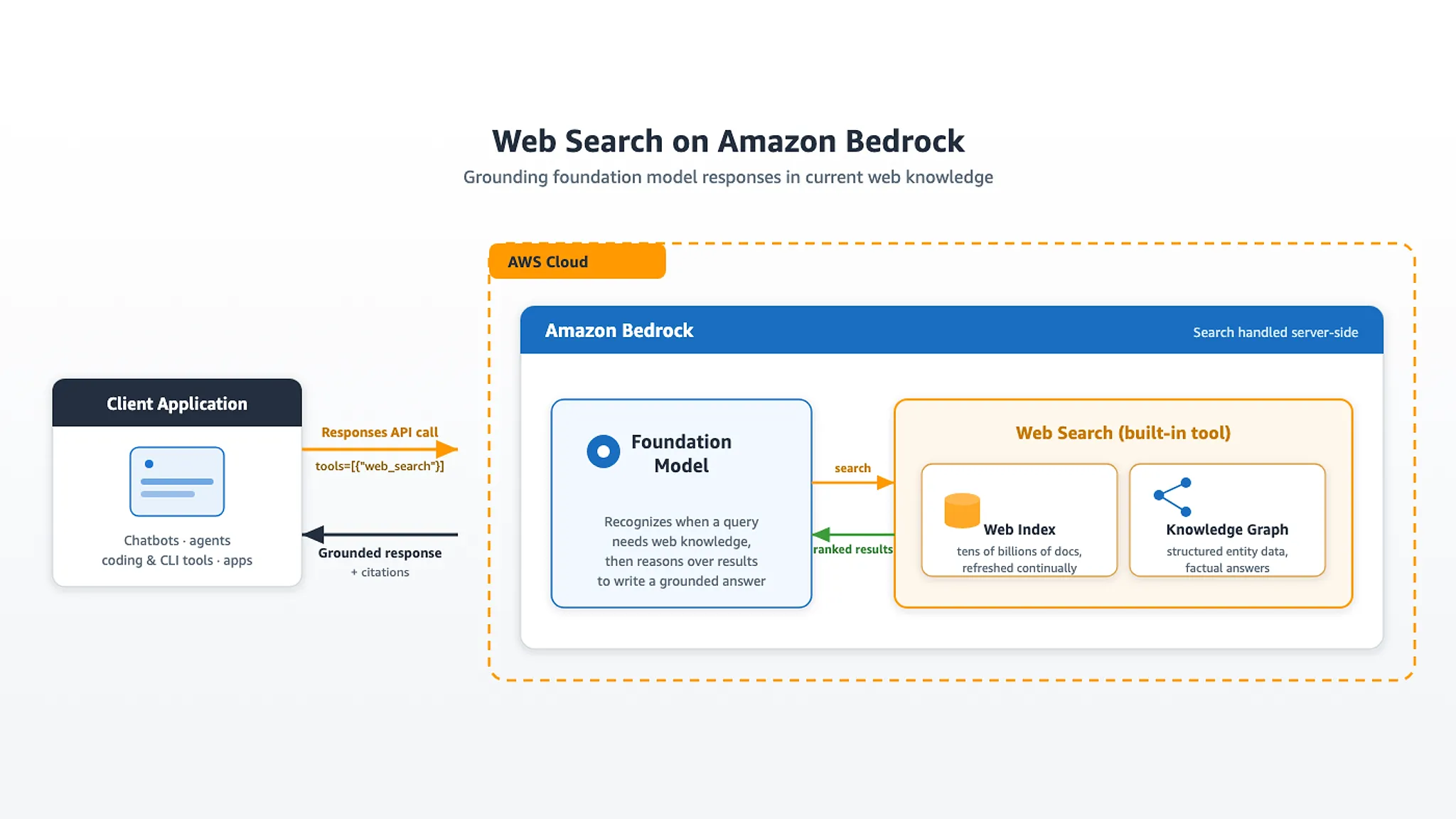
The core of the feature is its multi-source grounding approach. Web Search is built on a web index that Amazon operates directly, which AWS says spans billions of documents and is continuously updated. This is combined with a built-in knowledge graph that organizes entities and the connections between them within a domain.
For fact-based questions — such as who wrote a particular book or in what year an event took place — the knowledge graph provides high-confidence answers directly, rather than leaving the model to infer them from extracted page text. AWS said this approach helps reduce the small factual errors that can creep in when an agent has to piece together fragmented information on its own.
Snippet extraction that conserves context
Another notable feature is that search results are not passed through as whole raw pages. Web Search performs semantic snippet extraction, pulling out only the passages relevant to the query and returning them in a form optimized for the model's context window. This means the model sees only what it needs, without wasting tokens on boilerplate. AWS added that the search runs quickly, allowing grounded responses to be delivered with minimal latency.
| Item | Web Search on Amazon Bedrock |
|---|---|
| Execution location | Server-side (within Bedrock infrastructure) |
| Data source | Amazon-operated web index + knowledge graph |
| Result format | Semantic snippets, including source URLs and page titles |
| Activation | Single parameter within the API call |
| Client-side tool loop | No implementation required |
| Data egress | None by default (zero data egress) |
One line of code, citations delivered in structured form
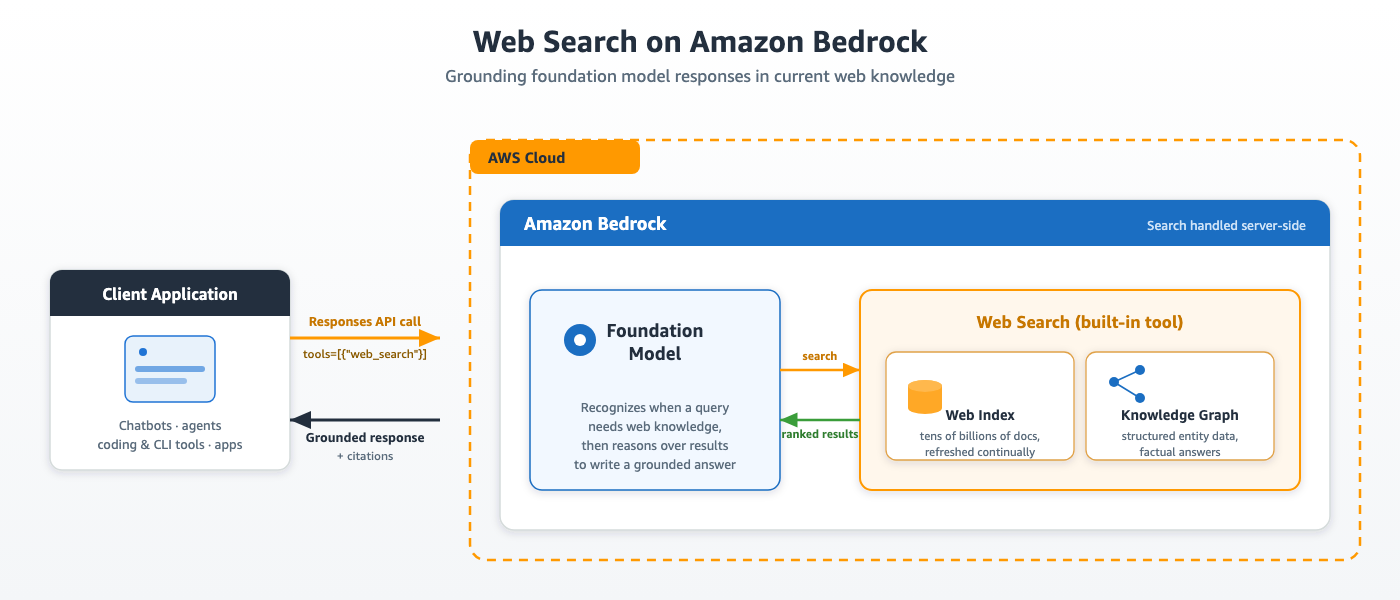
The entire process runs server-side. When the model determines that a query requires up-to-date web knowledge, Bedrock generates a search query, retrieves relevant content from Amazon's web index and knowledge graph, and injects snippets, source URLs, and titles into the model's context. The model generates its answer based on this content, and the API returns the final response along with structured citation annotations containing the URL and page title of each referenced source. There is no need to implement a separate tool-calling loop on the client side.
Activation involves adding a single parameter to an existing OpenAI-compatible API call. In its blog post, AWS provided activation instructions based on the OpenAI Responses API. According to AWS, this eliminates the need for vendor onboarding, API keys, an orchestration layer, or a separate SDK.
The trend of cloud providers pulling the search and grounding layer directly into their own inference stacks intersects with the broader landscape of the agentic tool ecosystem. Related discussion can be found in metallab.ai's coverage of AI agent infrastructure.
Defaults aimed at regulatory compliance
AWS said that, by default, zero data egress ensures customer data does not leave the AWS environment. However, the company noted that as new features are added, some may expose data only when explicitly requested by the customer, and advised referring to the Amazon Bedrock documentation for the latest details. Web Search operates entirely within Bedrock infrastructure.
Ahead of this announcement, AWS revealed the general availability of Web Search for AgentCore at the AWS New York Summit 2026, and this Bedrock rollout represents an extension of that capability. Specific supported regions, target models, and pricing structure were not confirmed in this announcement.


Comments