


Summary
- AWS has officially launched native vector search for Amazon DynamoDB
- The company says it can handle trillions of vectors with single-digit millisecond latency and over 99% recall
- Similarity search is performed via the SearchVectors API, eliminating the need to build a separate vector database or maintain a sync pipeline
Service Overview
Amazon Web Services (AWS) announced the general availability of vector search for Amazon DynamoDB. With this update, developers can manage operational data and vector embeddings together within DynamoDB and run similarity searches without building a separate vector database.
Performance and Scalability
According to AWS, DynamoDB's native vector search delivers single-digit millisecond latency with recall above 99%. It's designed to handle trillions of vectors, and the company says it requires no server provisioning, patching, or maintenance work. Vector indexes have no storage capacity limits and scale horizontally as data grows.
| Item | Value |
|---|---|
| Latency | Single-digit milliseconds |
| Recall | Above 99% |
| Max dimensions | 4096 |
| Distance functions | Euclidean, Cosine, Dot product |
| Scale | Trillions of vectors |
| Results returned | Up to 100 |
Difference from the Previous Approach
Previously, adding vector search to applications built on DynamoDB required replicating data to a separate, dedicated vector database and maintaining a sync pipeline between the two services. AWS said this process created operational burden, data transfer costs, licensing costs, and difficulty maintaining predictable low latency at scale. With vector search now built into DynamoDB, vector data and operational data share the same serverless infrastructure and pay-per-request pricing model.
How It Works
The new index type is created on top of an attribute that stores vector embeddings. Developers generate embeddings using their model of choice — such as Amazon Bedrock Titan Text Embeddings, Cohere Embed, or OpenAI text embedding models — and store them in the table as a list of floating-point numbers via a standard PutItem call. They then create a vector index on that attribute, specifying the number of dimensions, a distance function, and any non-vector attributes to use as filters for narrowing search results.
Searches are performed through the SearchVectors API. By specifying a query vector, the number of results to return (up to 100), and optional filter conditions, results are returned sorted by similarity. Vector search supports up to 4096 dimensions and offers three distance functions — Euclidean, Cosine, and Dot product — along with inline filtering.
Use Cases and Getting Started
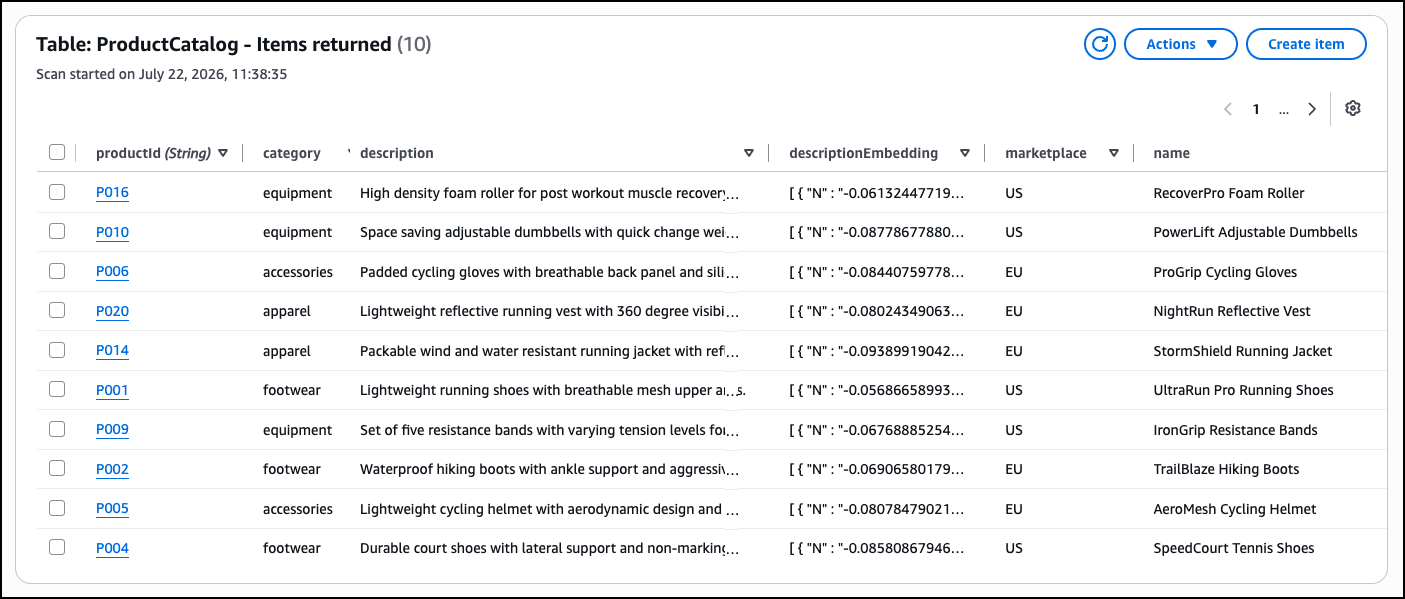
AWS said the feature can be used to build applications requiring semantic search, such as agentic memory, retrieval-augmented generation (RAG), recommendation engines, personalization experiences, and anomaly detection. In a demo the company published, it used a product catalog table for an online sporting goods store as an example. Starting from an existing item with attributes such as productId, category, description, marketplace, name, and price, the demo showed how adding a new attribute called descriptionEmbedding via an UpdateItem call enables natural-language-based semantic search.
The trend of integrating retrieval-augmented generation capabilities into cloud databases is spreading to other providers as well, and related infrastructure competition trends can also be found in METAL LAB's cloud infrastructure coverage.
What to Watch
AWS did not disclose detailed pricing or a region-by-region rollout schedule in this announcement. While the core message is that vector and operational data can now be handled together without separate infrastructure management, real-world latency and cost efficiency under large-scale traffic remain to be validated by the market.


Comments