


Summary
- According to the Oracle case study OpenAI published on October 8, Oracle has 130,000 active ChatGPT users and more than 95,000 active Codex users.
- The recruiting team cut preparation that took two to four days to 15 to 20 minutes with a talent market intelligence tool built in ChatGPT Work, reducing research time by 98%.
- Oracle Applications Lab built an ontology so Codex can turn plain-language questions into SQL, and site reliability engineers now handle simple incidents that took an hour in minutes.
OpenAI published a case study on October 8 about Oracle's adoption of ChatGPT Work and Codex. According to OpenAI, Oracle has 130,000 active ChatGPT users and more than 95,000 active Codex users. Its recruiting team cut the time spent on talent market research by 98% with a tool it built itself. OpenAI said that across recruiting, engineering and operations, work that relied on specialists and took days can now be done by anyone in minutes.
The biggest number came from recruiting. Oracle's talent acquisition team used ChatGPT Work to build a talent market intelligence tool. Given a job description, it researches comparable roles, benchmarks compensation and assesses the talent pool across relevant locations. That information, which a recruiter needs before sitting down with a hiring manager, used to take two to four days to compile. "We've gone from zero to a hundred," said Jan Ackerman, Senior Vice President and Global Head of Talent Acquisition at Oracle. "Now we're able to sit down and prep for about 15 to 20 minutes using the tool that we've built using Work."
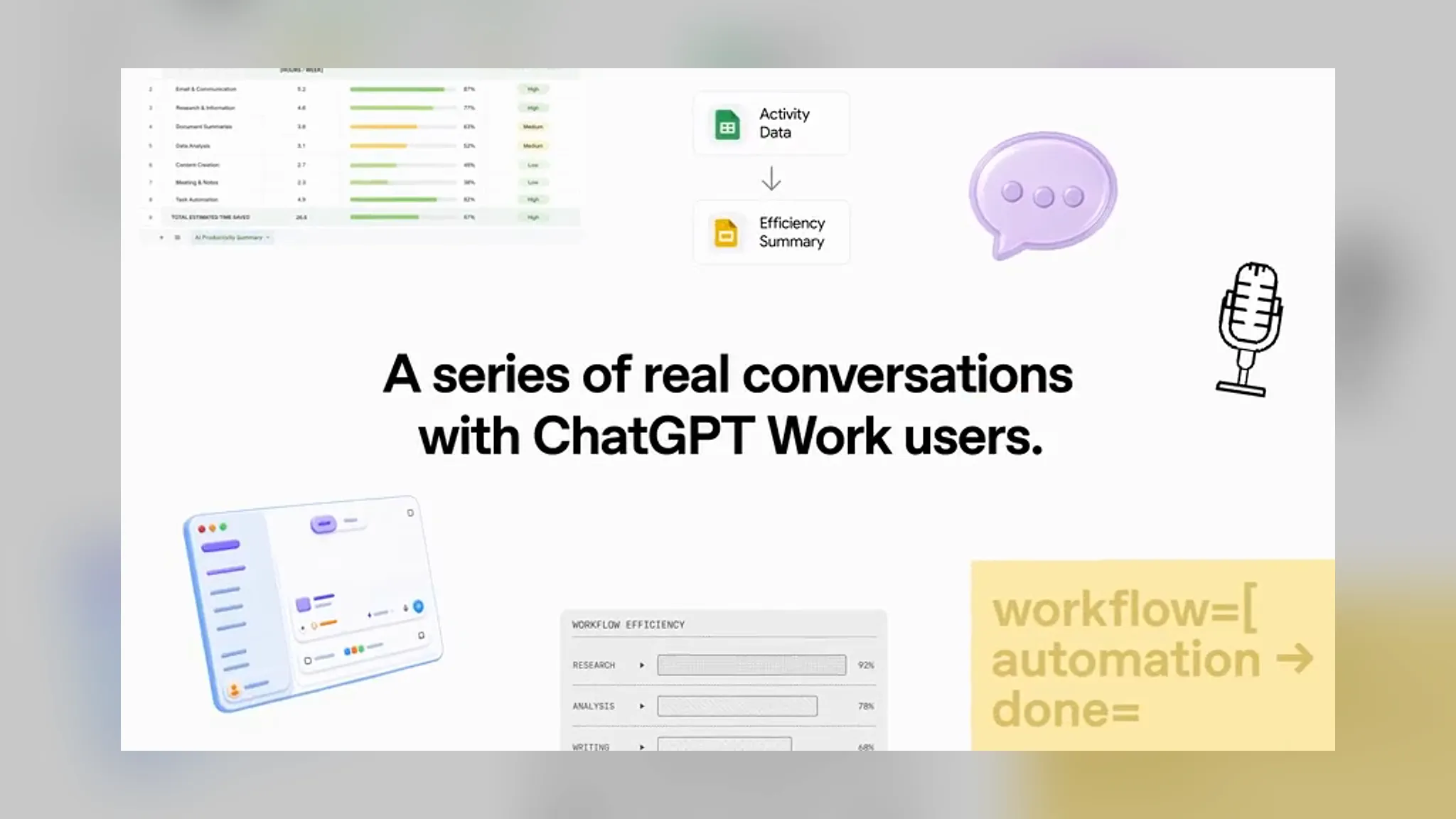
Speed was not the only change. Recruiters used to run the intake process differently from one search to the next, but the tool has standardized it. OpenAI said every hiring manager now receives the same quality of data and insights no matter which recruiter they work with. In a 77-second interview video reviewed by METAL, Ackerman explains that the team starts from a job description and uses a GPT it built to search external sources for comparable roles and what competitors are doing. On screen, a report scoring demand for an AI community leader role and a heat map showing talent distribution by city as bubbles pass by. The video is one installment in a series of conversations with ChatGPT Work users.
The way staff query internal data has changed too. The Oracle Applications Lab team, which runs many of Oracle's core business processes, built an ontology of the company's objects, relationships and rules. With it, Codex turns business questions asked in plain language into reliable SQL queries. A user describes the outcome they want, and Codex decides which internal systems to call, gathers the information and returns an analysis, a report or an application. "Business users now describe the outcome they want instead of hunting for a report," said Richard Lam, Group Vice President of Oracle Applications Lab. "I would even call it a business transformation."
Lam's examples are concrete. One user who asked a question that would normally have taken a couple of hours to answer said, "With the new tool, I put in the request and got a response almost immediately," and when she checked the result against the old manual process, the numbers matched exactly. In production engineering, site reliability engineers (SREs) use Codex to gather context about an incident and automatically pull up the right playbook. "A typical simple incident that used to take an hour to resolve can now be handled in minutes," Lam said.
The principles Oracle's leaders highlighted center on people remaining responsible for the output. "You have to still be very responsible about your system design, your architecture, your security, and how you would like Codex to structure the code for you," Lam said. He added that "if you don't work alongside Codex, you're going to get into a situation of having lots of code that is not going to be maintainable," urging teams to own the code. Barry Shilmover, Vice President and Technical Advisor to the CIO, said, "Normally, I put my idea down on paper, but now I put it down in a prototype," recommending prototypes over specs. He said that whatever his next problem turns out to be, one of the first things he will do is use Codex.
METAL previously reported on The Den's adoption of ChatGPT Work, and OpenAI has also released a ChatGPT Work data agent for querying company data. OpenAI said more than 1 million businesses worldwide are achieving meaningful results with its tools. This case study puts at the front a customer where more than 100,000 employees use ChatGPT Work and Codex.
Seen through a marketer's eyes, the case study is built on three numbers and three job titles. The scale of 130,000 and 95,000 users and a 98% reduction fill the first screen, and the voices of the leaders of recruiting, data and engineering testify to each figure. What other companies can copy is less the tool itself than the way Oracle fixed a single process running from job description to report.


Comments