



Image: METAL
Summary
- On October 7, Google DeepMind opened SynthID Detector to everyone worldwide in English, with no waitlist.
- It checks images, video and audio made with tools from Google, OpenAI, NVIDIA and Kakao, and will soon support output from Apple Intelligence.
- SynthID watermarks have been applied to more than 180 billion images and videos and 240,000 years of audio, and verification features in Search, Gemini and Chrome handle over 1 million requests a day.
Google has opened SynthID Detector, a tool that lets anyone check whether images, video and audio were made with AI, to the general public. Google DeepMind said on October 7 that the checker is available globally in English starting that day. Users can upload a file at synthid.com to see whether it was made with Google AI or a partner's tools. The partners include OpenAI, NVIDIA and Kakao, with Apple joining soon.
The tool first arrived last year as an early version. At the time, media professionals such as journalists and researchers had to go through a waitlist to use it. According to reports, the waitlist is now gone, and anyone can sign in with a Google, Apple or OpenAI account and use it right away. Pushmeet Kohli, Google DeepMind's vice president for science and strategic initiatives, wrote in the announcement that "as AI tools become better and easier to use, having clear context about the content you encounter online helps you make informed decisions about what to trust."
The foundation is the SynthID watermark, introduced in 2023. At the moment of generation it embeds a signal that human eyes and ears cannot perceive into the pixels of images and video or into the audio signal. Because it does not rely on a visible label or metadata, it was reportedly designed to survive cropping, compression, color adjustment and audio processing. According to Google, the watermark has so far been applied to more than 180 billion images and videos and 240,000 years of audio.
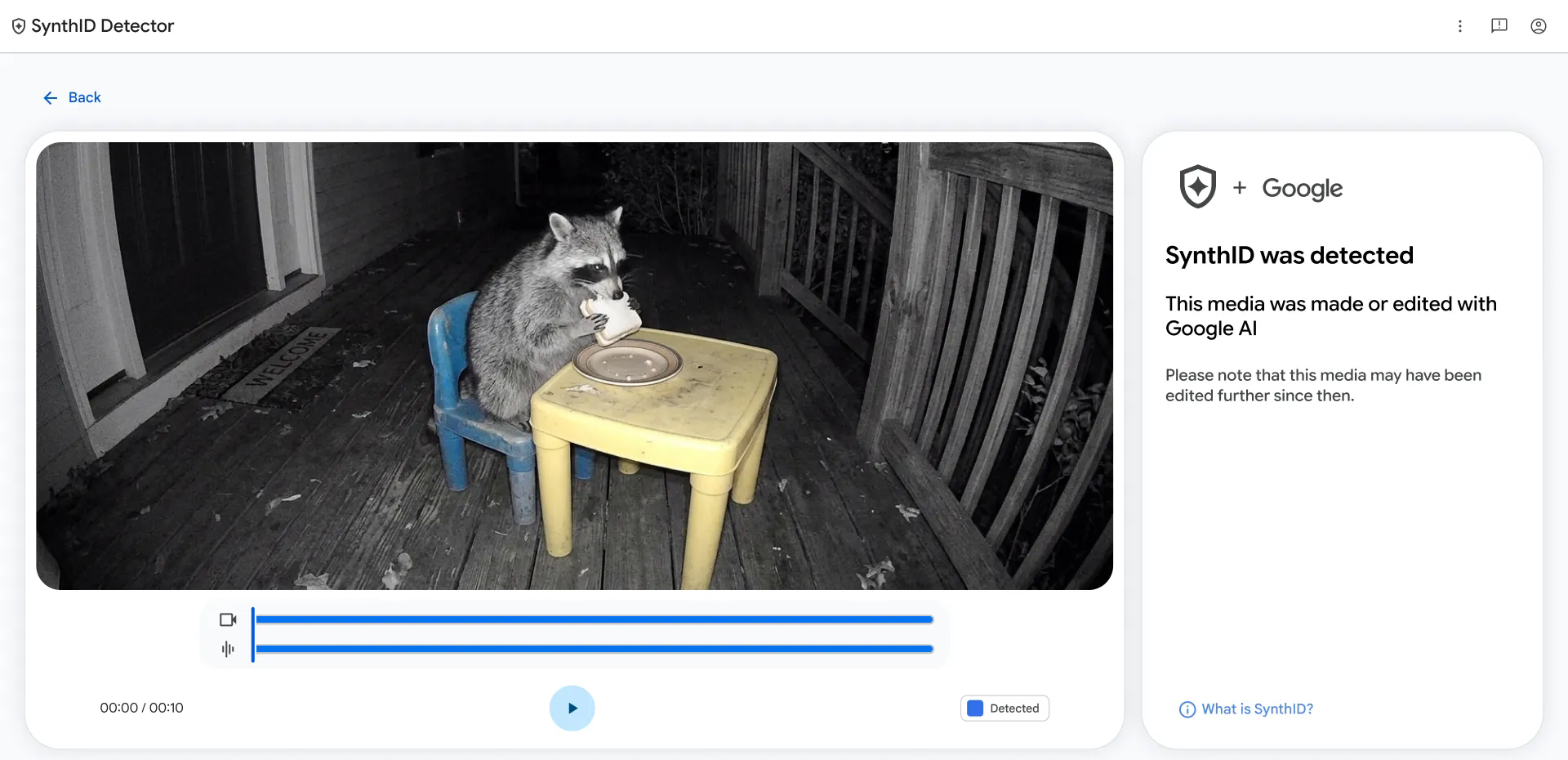
A demo screen in the announcement, which METAL reviewed, shows the result of uploading a 10-second night-camera video of a raccoon. Under the verdict "SynthID was detected," a line says the media was made or edited with Google AI, and both the video track and the audio track are marked as detected segments. The same screen also notes that the file may have been edited further since then. According to reports, the checker does not only return a verdict for the whole file but points to the regions or segments where the watermark was found. That lets it catch cases where a generative editing tool changed a single object in a photo or a single stretch of audio.
The checks already run inside Google products as well. Kohli said the tool joins built-in verification features in Search, the Gemini app and Chrome, which now handle over 1 million requests a day. He added that "it's all part of our ongoing work to give you more context about the media you see online, so you can navigate the web with confidence." Google DeepMind's post announcing the launch on its official X account had passed 63,000 views when METAL checked.
The expansion of partners is the other pillar of this launch. Watermark detection works only when the generator has embedded the same signal. The synthid.com landing page itself states that the tool is not a general AI detector and can only identify output from companies that have adopted SynthID, and it advises uploading the highest-quality file possible for accuracy. That is why it matters that output from tools outside Google, made by OpenAI, NVIDIA and Kakao, can now be checked in one place. Apple's part is still at the announcement stage. According to reports, Google said images made with Apple Intelligence will carry a SynthID watermark "soon." It was also reported that being a partner does not mean every model and every past output from that company carries the watermark, and that Midjourney and many open-source models run on personal computers remain outside the system.
Google holds the verification key. According to reports, files are uploaded to Google's servers for analysis, and the launch includes neither an offline verifier nor an unrestricted API. Bulk programmatic checks require Google Cloud's AI Content Detection API, which is open only to selected partners. Images made by Google can also carry C2PA Content Credentials, a cryptographically signed provenance record, and that record can declare that a SynthID watermark is present. A C2PA record disappears when metadata is stripped, while SynthID places its signal inside the content and holds up better through copying and editing.
Seen through the lens of a legal dispute, every sentence of the verdict carries weight. A positive result means a supported system made or edited at least part of the file. It says nothing about whether the events, statements or claims inside it are true. A negative result is not proof of authenticity either. Unsupported generators, output from older models, heavy re-encoding and deliberate tampering can all produce an empty result, and detection is probabilistic. That is why, to use these results as grounds in a dispute or in handling reports, observers say the detection score, location data, file history and C2PA records should all be preserved together. METAL has previously reported that Google DeepMind released SynthID Bio, which carries the same name.
With this launch, SynthID has moved from being a tag on Google products to a shared checking window used by several companies. The more companies embed the mark, the wider the range a single upload can verify, and the more clearly output from generators that do not embed it stands out as a blank. Whether to treat a one-line verdict as the conclusion, or as a starting point layered with provenance records and history checks, is up to the people and platforms using the checker.
Sources
- Google — Google expands SynthID Detector for AI content →
- 9to5Google — Google's SynthID AI content detector expands globally, will work on Apple's models 'soon' →
- AlphaSignal — Google DeepMind Opens SynthID Detector to Spot AI Media From 6 Major Providers →
- Google DeepMind — SynthID Detector →
- TechCentral.ie — Google's AI-generated content detector now available to the public →
- Google DeepMind (X) — SynthID Detector is now available to everyone. →


Comments