



Image: @AIatMeta (X) (video still)
Summary
- On October 14, Meta released 10 health research manuscripts that medical researchers produced over four weeks using a coding scaffold built on Muse Spark 1.3 and Muse Wonder.
- Working with de-identified electronic health records covering about 5 million people, the researchers went from first prompt to manuscript in under two weeks and reported up to a tenfold speedup in the best cases.
- The research team's report disclosed model errors that physicians caught, including a miscalculated 1% mortality rate and confusion over heparin doses, and stated that final responsibility rests with the investigators.
Meta on October 14 released 10 health research manuscripts written by medical researchers using its Muse AI models. The papers are the output of an experiment in which Meta built an internal coding scaffold combining Muse Spark 1.3 and Muse Wonder and had medical researchers use it for everything from forming hypotheses to running code and drafting manuscripts. In its research blog, Meta described the setup as a human-led system in which AI speeds up every stage of research while domain experts remain responsible for scientific decisions and conclusions. The manuscripts cover infectious disease, sports medicine, emergency medicine, oncology, endocrinology, oral health and other fields.
Data is what gave the project its scale. The scaffold had access to public data as well as a licensed, retrospective database of de-identified electronic health records (EHR). Meta put the database at 5 million people, while papers released alongside the blog describe a June 2026 release covering 4.95 million patients, with linked records and claims from 21 US health systems. Researchers with backgrounds in cardiology, epidemiology, infectious disease and internal medicine used the system to conduct original research over four weeks. In a 2-minute-22-second video released by Meta, the team said 15 medical experts took part.
Speed is the number Meta put front and center. According to the research blog, it took less than two weeks to go from the first prompt to a finished manuscript, and the fastest paper was done in seven days. Participants unanimously reported a significant productivity gain, with up to a tenfold improvement over traditional research processes in the best cases. One researcher in the video said work that would normally take two to three months now goes from idea to manuscript within two weeks.
The individual papers report concrete results. A study of infective endocarditis matched 9,599 of 12,553 patients with endocarditis to 47,974 patients with bacteremia but no endocarditis. The hazard ratio for newly diagnosed arrhythmias and conduction disorders between days 31 and 365 after the index date was 1.73, peaking at 2.41 for days 31 to 90. Standardized one-year risks were 6.98% versus 4.14%. A study of behavioral health patients in emergency departments found that those who left without being seen had relative risks of 1.86 for return visits, 4.41 for admission and 2.15 for short-term death. A pickleball injury study analyzed 1,738 adjudicated cases from US emergency department data for 2014 to 2023, and a study of social-needs diagnosis codes compared 26,153 matched adults.
The manuscripts went through three layers of checks. Each paper received feedback from peers in the research cohort, a review of its analysis by a biostatistician, and summary reviews from independent outside experts. The original text of the research team's report, which METAL reviewed, states that all code and analyses were separately reviewed by biostatisticians and computer scientists. Each study also went through at least two rounds of internal peer review. The outside reviews paired praise with caveats. Michael Farbaniec, a cardiology professor at Penn State Health, said of the endocarditis paper, "I would consider this hypothesis generating rather than practice changing."
The report puts more weight on cases where human judgment changed the outcome. Muse calculated a 1% mortality rate for patients with Staphylococcus aureus bacteremia, but an infectious disease physician pointed out that published studies put it closer to 30%, prompting the team to audit how deaths were recorded and uncovering other implausible patterns. When the model counted a small heparin flush used to keep an intravenous line open and a full treatment dose for a blood clot as the same exposure, the investigator redefined the exposure by dose and route. The model also at times insisted that fields present in the dataset were unavailable, and because it could read only summaries of subscription journal articles, it risked missing caveats in prior research. The researchers wrote in the report that the system behaved like a high-throughput but unevenly reliable research assistant.
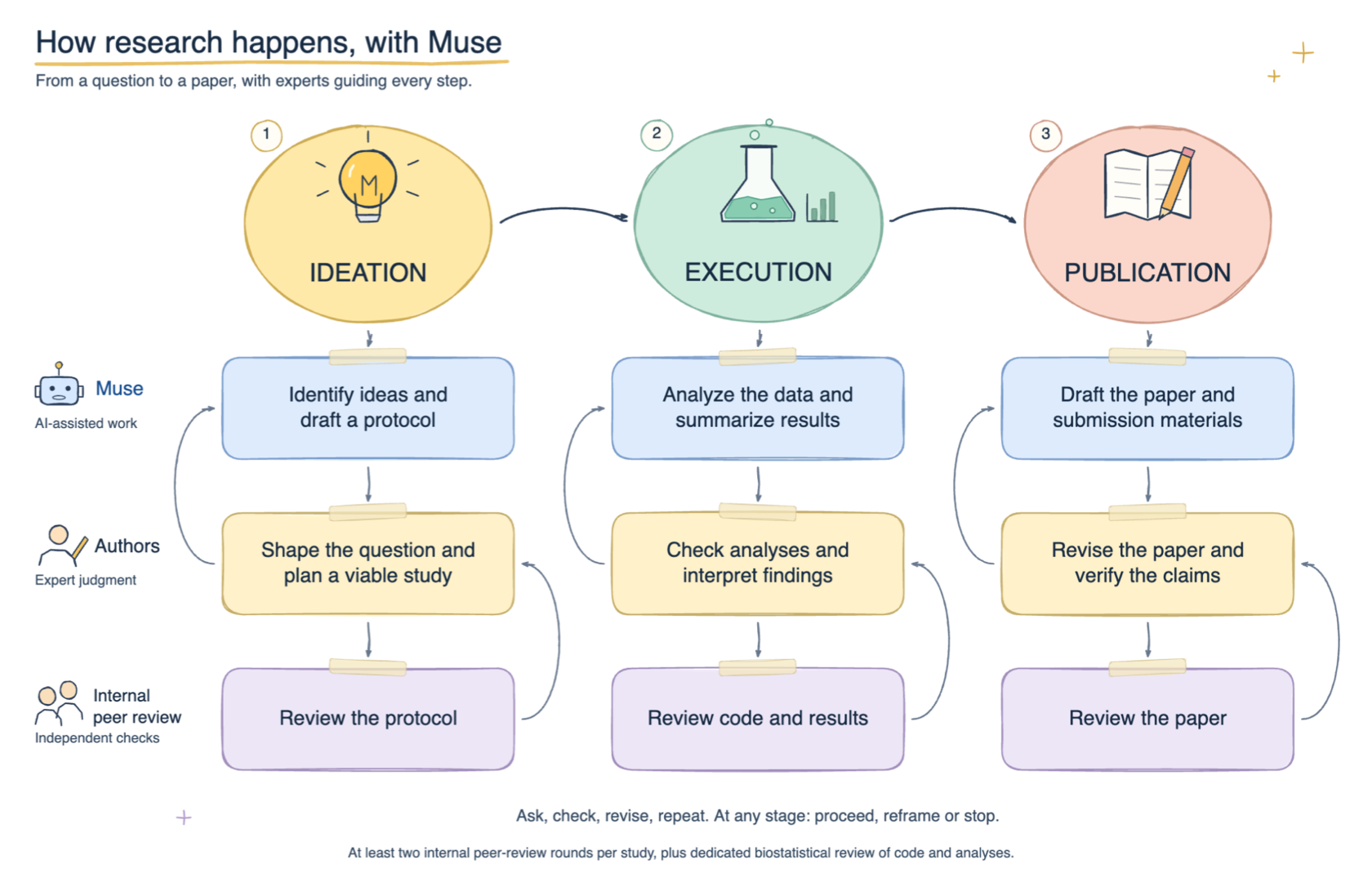
The biggest gain the researchers identified was not writing faster but stopping faster. According to the report, Muse flagged early on questions the literature had already answered and questions the data could not answer. It warned in advance that a flu vaccine question, which depends on the season, could not be answered with data whose dates had been shifted to protect patient privacy, saving the team time. S. Michelle Ogunwole, an assistant professor of medicine at Johns Hopkins School of Medicine, said, "What excites me most about this project is that it concentrates the best parts of science - the curiosity, creativity, collaboration, and bouncing ideas around - while removing so much of the friction." One researcher in the video said going back and forth with the model produced at least 50 hypotheses.
Seen through a tech-law lens, the experiment's design matters because it documents where responsibility sits. Meta used only licensed, de-identified data, and the report states that judgments about causality and final conclusions always remained with the investigators. The researchers noted that fully autonomous "AI scientist" systems that aim to remove humans from the loop carry risks such as unverifiable citations and opaque provenance, and said they deliberately chose a middle ground with prespecified gates at each stage. Meta presented the approach as a candidate best practice rather than a finished standard.
Meta unveiled its frontier model Muse Wonder on October 12, highlighting its performance on personal and professional agent tasks, and this release shows the same model applied to scientific research. For now, the work is limited to retrospective analyses. Meta said it plans to move toward generating new hypotheses from more comprehensive data and testing them in prospective clinical trials. The next picture Meta is sketching is one in which models work as supervised auto-research agents in fields where findings cannot be formally verified. For that picture to hold up in medicine, the 10 manuscripts first need to clear actual journal peer review.

Comments