



Image: METAL
Summary
- On October 13, Meta introduced Your algorithm, a space where Facebook users can directly add and manage the topics that shape their Feed and Reels recommendations.
- After tapping Interested or Not interested, users can answer follow-up questions in their own words, and Meta says ranking systems now powered in part by large language models update recommendations within the same session.
- The announcement gives no user numbers, launch countries or timeline, and does not say whether the typed text is used for ads or model training.
Meta on October 13 introduced Your algorithm, a tool that lets people adjust Facebook Feed and Reels recommendations in their own words. Users can add and manage the topics they want to see from the three-dot menu attached to every post, and after tapping Interested or Not interested they can describe in a sentence what they liked or disliked. Meta said those requests are reflected in recommendations right away, within the same session. The company said the change rests on adding large language models (LLMs) to Facebook's ranking systems.
What changes is the kind of signal that feeds recommendations. According to Meta's announcement, Facebook's ranking systems have until now inferred interests from thousands of signals, including the posts people like and comment on and the videos they watch. Freeform text written by the user now becomes a new input. "LLMs can incorporate the interests, context, and intent behind natural language, unlocking an algorithm you can actually talk to," Meta said. The company called it "a genuine leap forward" in how ranking works.

The rollout has three parts. The first is Your algorithm, a dedicated space for collecting topics; the second is follow-up questions attached to the Interested and Not interested buttons; the third is a redesigned three-dot menu that makes these tools easier to reach. Meta described the follow-up questions as "a more direct, conversational way to shape your experience." The button signals remain, and written feedback is layered on top. In Meta's demo videos reviewed by METAL, the Your algorithm screen opens with a one-sentence summary of recent interests, followed by separate lists of topics the user is and is not interested in, summarized by AI from recent activity. Users can add or edit topics in both lists. Under a post marked Interested, a question asking why appears along with a few suggested answers and a free-text field.
The feature was tested first in Meta's other apps. According to reports, Instagram launched Your Algorithm in the Reels tab in the United States on December 10, 2025, extended it to Explore on April 15, 2026, and rolled it out globally in English across Feed, Reels and Explore on June 10. The Instagram version also shows an AI-generated summary of a user's topics and topic labels on recommended posts. On February 11, 2026, Threads launched a feature in the United States, United Kingdom, Australia and New Zealand that changes a user's feed for three days when they write Dear Algo in a public post. The Facebook version differs from Threads in that it is a private list inside a menu rather than a public post.
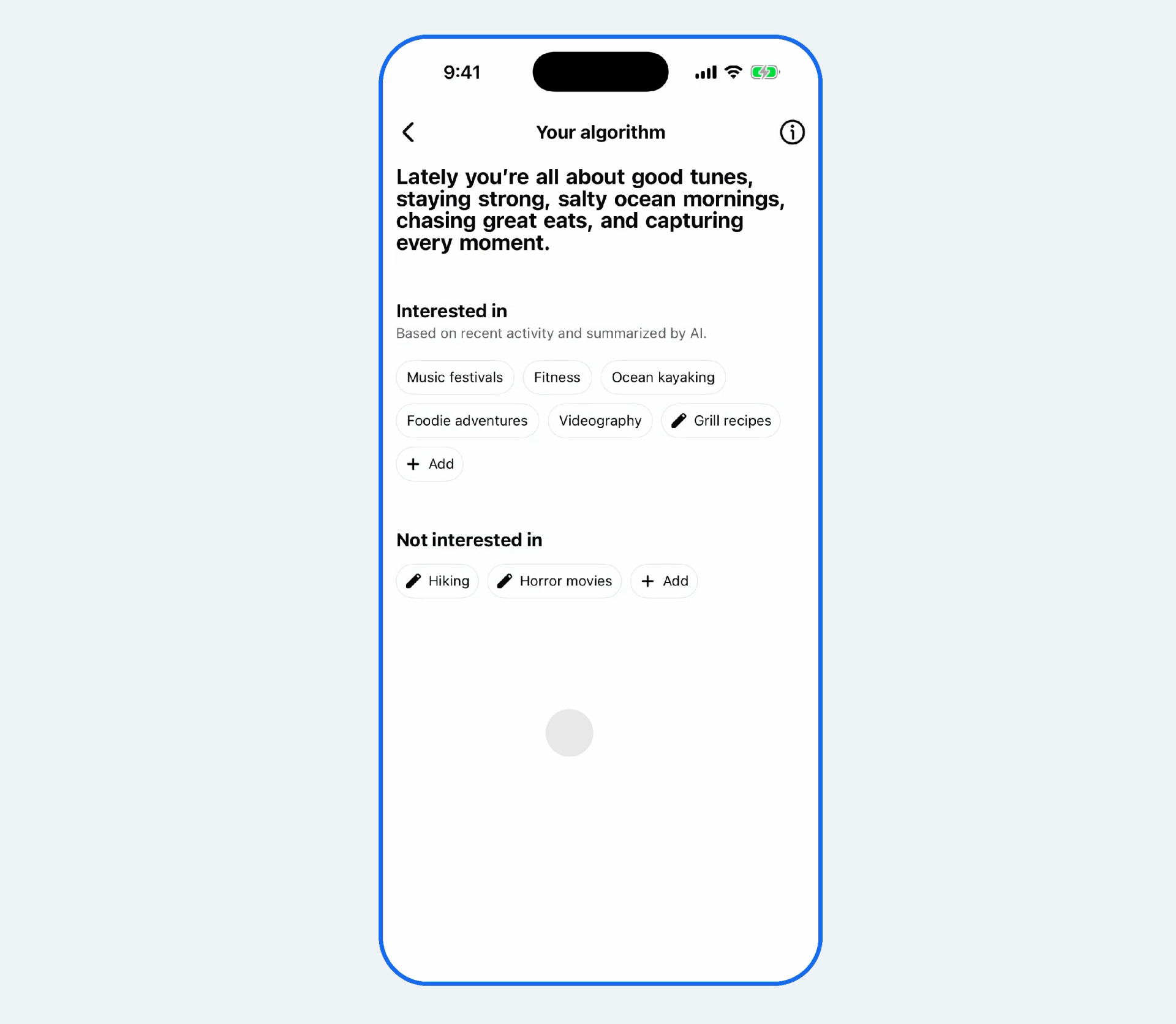
Meta's newsroom announcement contains no figures at all: no user numbers, test results, launch countries, languages or completion timeline. It says only that the rollout has begun. According to reports, the announcement also does not say how heavily a typed request is weighed against thousands of behavioral signals, or how long a request lasts. That contrasts with Threads' Dear Algo, which disclosed a 72-hour limit.
From an engineer's point of view, the core of the announcement is not the menu but the input pipeline. For a recommendation model that has relied on behavioral logs to take declared intent as text and reorder results within the same session, it needs a language model that turns sentences into topic representations and a system that blends them with existing ranking signals in real time. According to reports, Meta said in its first-quarter results that ranking improvements raised time spent on Instagram Reels by 10% and Facebook video watch time by more than 8% globally, and in the second quarter it described a generative recommender that uses LLMs to evaluate ad content and user preferences together. Reports said this is the first time Meta has stated in a consumer announcement that LLMs are now part of organic Facebook Feed recommendations. METAL has reported that Netflix piloted its own language model, GenRec, in its recommendation engine, and the shift of large-platform recommendations from behavioral inference toward language input has now reached Meta.
Gaps remain. According to reports, the announcement does not say whether the text users type is used to select ads, stored, or used for model training. In October 2025, Meta said it would use conversations with Meta AI to personalize content and ads starting December 16 of that year. Because self-declared interests are a more precise signal than interests inferred from behavior, where this data flows is a question for both advertisers and regulators. Creators and publishers face a new layer of opacity as well. Even if part of an audience writes that it wants less news, a page owner cannot see that sentence and will only notice a change in reach.
The timing also overlaps with regulatory pressure. According to reports, the European Commission on July 10 preliminarily found that Meta breached the Digital Services Act over the design of Instagram and Facebook, citing infinite scroll, autoplay and personalized recommender systems; if confirmed, fines can reach 6% of global annual turnover. In California, a court ruled on August 5 that ranking by predicted engagement is not an expressive judgment, and under a consent judgment in youth litigation Meta must offer teens a non-personalized default feed option by late December. The announcement does not say whether the feature is available to teen accounts.
Meta's slogan is that it is putting users in the driver's seat. But Meta still decides how the steering wheel works. Until it discloses how much weight a single sentence carries among thousands of signals, and how far that sentence travels beyond the feed, Your algorithm reads both as a recommendation system that listens to users and as a channel through which the platform collects the most explicit preference data people can give.




Comments