



Image: METAL
Summary
- In an October 14 report, OpenAI said that at the end of September, 55% of output tokens from EU ChatGPT Enterprise and Business customers came from Codex (34%) and ChatGPT Work (21%).
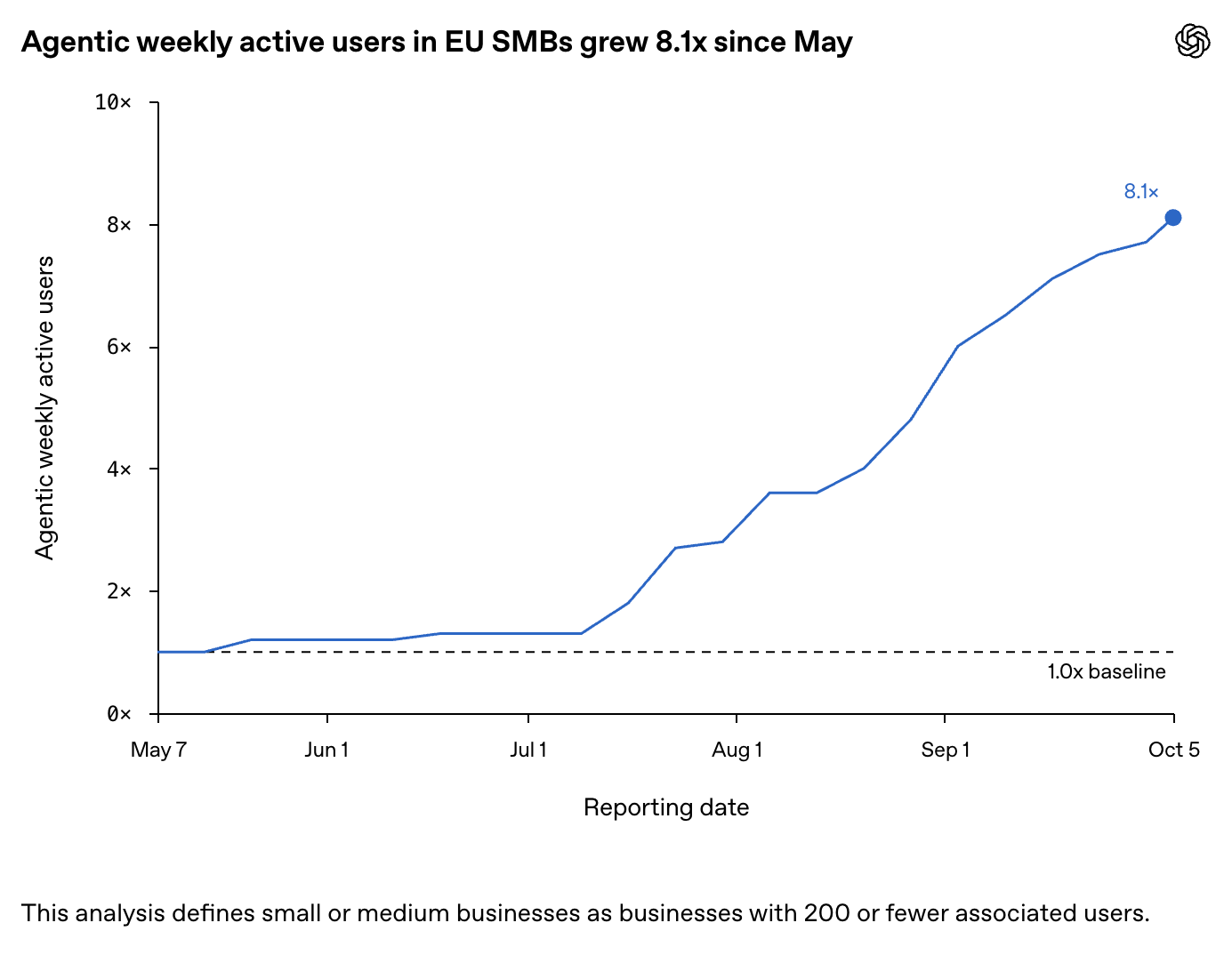
- The agentic share ranged from 85% in Lithuania to 22% in Slovenia, and weekly active agentic users at EU small and medium businesses grew 8.1x since May.
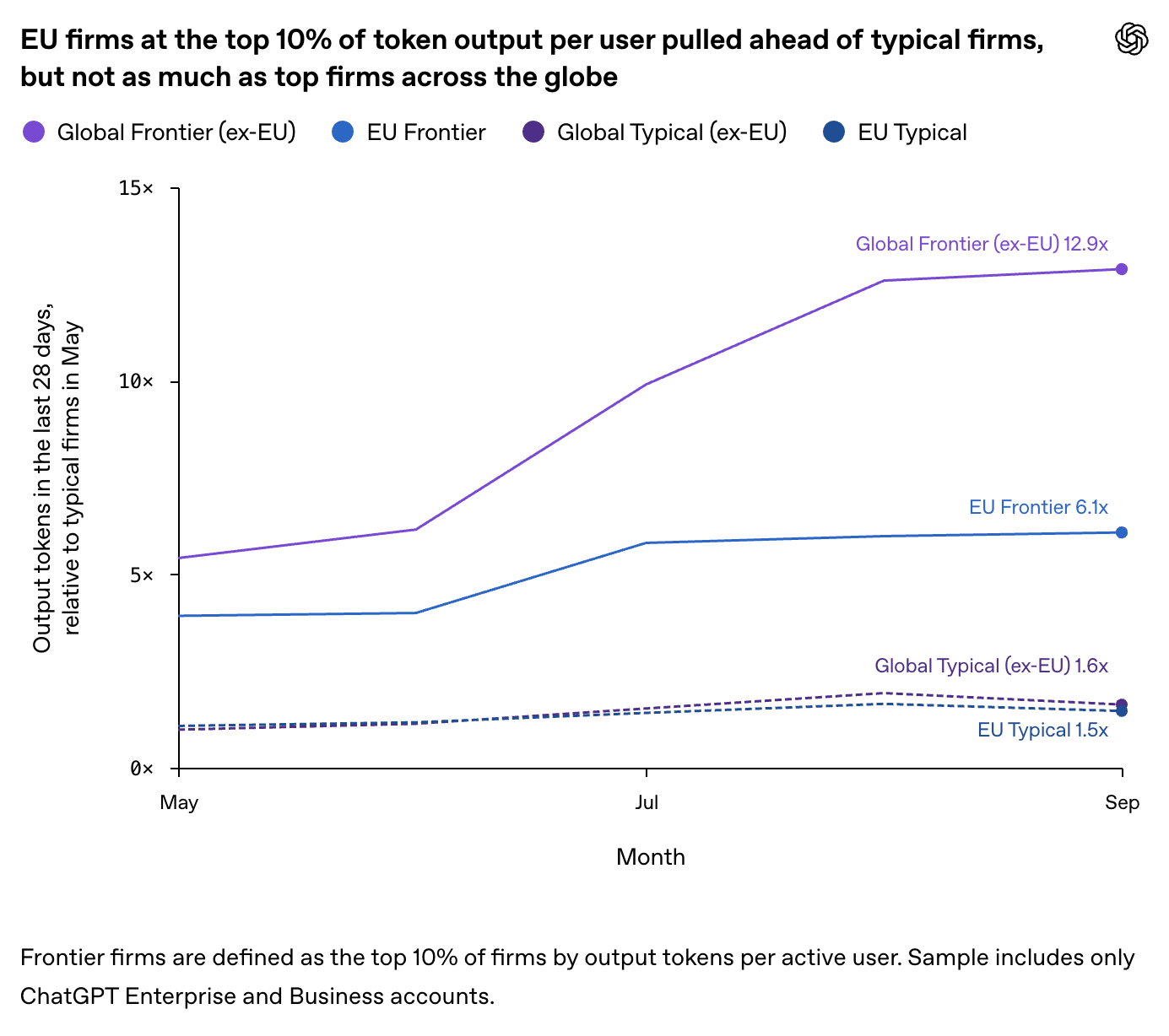
- EU frontier firms used more than four times as many tokens per user as typical EU firms but less than half as many as frontier firms outside the EU, and the EU accounted for 10% of frontier firms worldwide.
OpenAI on October 14 published "Europe's Agentic Opportunity," a report analyzing how businesses in the European Union (EU) use AI agents. The 10-page report from OpenAI Economic Research reaches one conclusion: AI use among EU businesses has broadened, but it is still shallow. At the end of September, 55% of the output tokens generated by EU ChatGPT Enterprise and Business customers came from agentic tools such as Codex and ChatGPT Work. Yet EU firms made up only 10% of the world's top firms by output tokens per user.
The starting point is the rapid rise of agentic tools. According to the report, as of September 30, 34% of output tokens came from Codex and 21% from ChatGPT Work, while regular ChatGPT conversations accounted for 45%. The figures use a 28-day trailing window. After ChatGPT Work launched in July 2026, the agentic share climbed quickly and passed half by the end of September. OpenAI said people are no longer only asking AI questions but handing it tasks from planning through completion.
Differences between countries are large. Lithuania had the highest agentic share of business output tokens at 85%, followed by Cyprus at 81%, Hungary at 79%, Poland at 76% and Sweden at 73%. Italy stood at 65%, France at 55% and Germany at 51%. At the low end were Spain at 30%, Portugal at 29% and Austria at 26%, with Slovenia lowest at 22%. The report noted that larger firms in smaller countries such as Cyprus, Estonia and Lithuania show relatively high agentic use.
Growth among small and medium businesses is even steeper. OpenAI defined small and medium businesses as those with 200 or fewer associated users. Comparing May 1 to 7 with September 29 to October 5, weekly active users of Codex or ChatGPT Work at EU small and medium businesses grew 8.1x. Belgium grew fastest at 12.1x, followed by Italy at 10.8x and Luxembourg at 10.0x. Even the slowest, Finland, reached 5.1x, and all 27 EU countries exceeded 5x. The report stressed this layer of the economy, noting that small and medium businesses account for 63% of EU private-sector employment and contribute more than 5 trillion euros to the EU economy each year.
The depth gap shows up among top firms. The report defined frontier firms as the top 10% by output tokens per active user. In September, EU frontier firms generated more than four times as many output tokens per active user as typical EU firms. But frontier firms outside the EU generated more than twice as many tokens as EU frontier firms. Indexed to typical firms in May, frontier firms outside the EU stood at 12.9x in September and EU frontier firms at 6.1x. By region, frontier firms worldwide were 65% North America, 13% Asia-Pacific, 11% other Europe, Middle East and Africa, 10% EU and 1% South America.
The kinds of work people do with AI also differed by country. OpenAI randomly sampled work messages from Free, Go, Plus and Pro users in the third quarter of 2026 and classified them using the US Bureau of Labor Statistics work activity categories. Tasks that stood out against the EU average were teaching academic or vocational subjects in Germany, explaining financial information in France and Denmark, and preparing legal or regulatory documents in Poland and Romania. The report also included EU-wide adoption figures. According to Eurostat data, 20% of EU companies with at least 10 employees used AI in 2025, up from 13.5% in 2024.
"Europe is now in a new era of AI, with tools that can carry out tasks for people," said Sarah Friar, OpenAI's Chief Financial Officer. "More than half of the AI use among our EU enterprise and business customers now involves these tools, and the number of small business users has grown 8x across the region. Yet there is still plenty of room for AI use to grow across the EU," she said. The report concluded that closing the gap requires helping businesses move beyond experimentation, giving workers the skills and confidence to use AI, and making advanced capabilities more accessible and affordable.
METAL has reported that OpenAI's head of product said ChatGPT Work had passed 20 million users, and earlier this month covered OpenAI's adoption of text watermarking in the EU. All seven figures in the 10-page original PDF that METAL reviewed are based on OpenAI's own customer data. Because tokens measure the volume of generated text, an agentic share of 55% does not mean half of employees use agents; it means more than half of usage among OpenAI's business customers comes from agents. From a journalist's view, the report is also persuasion written in numbers. In an EU where debates over AI regulation and digital sovereignty continue, OpenAI is presenting member-state rankings and small business growth rates to shift the next debate from regulation to depth of use. Whether widely adopted tools translate into productivity is a question the next quarter's data will have to answer.



Comments