



Image: METAL
Summary
- Google DeepMind said on October 14 that Gemini 4 Argon is opening new scientific breakthroughs in quantum computing, nuclear fusion and protein design, and shared its research results.
- An arcsine quantum subroutine written by Argon was formally verified in Lean and cut spacetime cost by more than 100 times, while joint work with Professor Landreman widened the set of counterexamples to Grad's conjecture from 1967.
- In enzyme design, Argon produced five new designs within hours that showed catalytic activity in the lab, and Google is giving 10,000 scientists its top Antigravity tier free for six months.
Google DeepMind on October 14 unveiled scientific research results achieved with its new frontier model Gemini 4 Argon in quantum computing, nuclear fusion and protein design. On its official X account, DeepMind said "Gemini 4 Argon is already unlocking new scientific breakthroughs in quantum computing, nuclear fusion, protein design and beyond." The claim rests on four cases described a day earlier, on October 13, by Koray Kavukcuoglu, SVP at Google DeepMind and Chief AI Architect at Google, in the general availability post. The same day, Google announced it would open the highest usage tier of its development environment Google Antigravity to 10,000 scientists free of charge for six months.
METAL reported that Google DeepMind unveiled Gemini 4 Argon on October 1, and the October 13 announcement is the general release that opened that model to developers, enterprises and paying subscribers worldwide at once. The model ships through the API, AI Studio, Antigravity, the Gemini app and AI Mode in Search. It handles up to 1 million tokens of combined input and output. METAL has also covered a case in which the same model was used for robot simulation.
The biggest number came from quantum computing. Argon wrote a new arcsine subroutine, a building block in recent quantum simulation algorithms, and the implementation was formally verified with Lean, a tool for checking mathematical proofs. According to Google, it cut spacetime cost by more than 100 times compared with a published quantum CORDIC baseline. Spacetime cost measures the hardware footprint and execution time an operation needs. Argon also worked on error correction. It translated an internal version of AlphaQubit, a machine-learning quantum error correction decoder, into a single optimized hardware kernel, nearly doubling inference throughput. Google explained that decoders must keep pace with quantum hardware in real time before they can scale to larger devices.
In fusion, the target was a 59-year-old mathematical conjecture. Stellarators are fusion devices that confine hot plasma with twisted three-dimensional magnetic fields, and Grad's conjecture, which dates to 1967, held that exact mathematical solutions for these fields could not be found. Professor Matt Landreman of the University of Maryland and others recently found counterexamples, and a Google team working with Landreman has now discovered a broader class of them. Google said the solutions give reliable benchmarks for testing the simulation codes used in stellarator design.
The life sciences cases come in two strands. Researchers at Gamow Labs used Argon to analyze de-identified genomes from newborns with rare developmental lung disorders, and in one case it pinpointed a chromosomal rearrangement that routine analysis software had missed for years and explained why it had gone undetected. On Gamow Labs' internal evaluations, Argon ranked first with 57% on RareBench, a rare-disease diagnosis assistance benchmark, and 52.2% on LabBench, a wet-lab reasoning evaluation. In enzyme design, it produced serine esterases, which cut ester bonds. Targeting 4MU-acetate, a benchmark molecule that glows under ultraviolet light once its ester bonds are broken, Argon gathered data, tuned models and selected biochemistry-inspired filters within hours to deliver five new designs. Subsequent lab testing confirmed catalytic activity in all five. The work usually takes months of model tuning and candidate screening.
Research software itself got faster. Google researchers used Argon inside Antigravity to improve xTB, an open-source quantum chemistry package that predicts the 3D structure of molecules to screen drug and materials candidates, making structure prediction up to 2.3 times faster and conformer search 1.8 times faster, and contributed the changes to the official repository. On the Agent Development Kit (ADK), Argon spent 11 hours on its own examining a codebase of about 800 files and 205,000 lines, proposed six optimizations, and two were merged after human review. In-memory session preparation time fell by 40% in long sessions and cold imports became 21% faster.
Assessments from outside research groups also appeared in the launch post. Alex Cabrera, founding engineer at Axiom Bio, said "We've seen it reason through complex experimental data, from cellular imaging to mass spectrometry, and make subtle findings that traditionally require expert scientists to identify." Trenton Chang, chief scientist at Quadrillion, which runs the autonomous AI researcher Qualia, said Argon completed evaluations 1.5 times faster than peer models at a quarter of the cost per task, adding that "It excelled at coming up with novel ideas and identifying non-obvious insights about the problem."
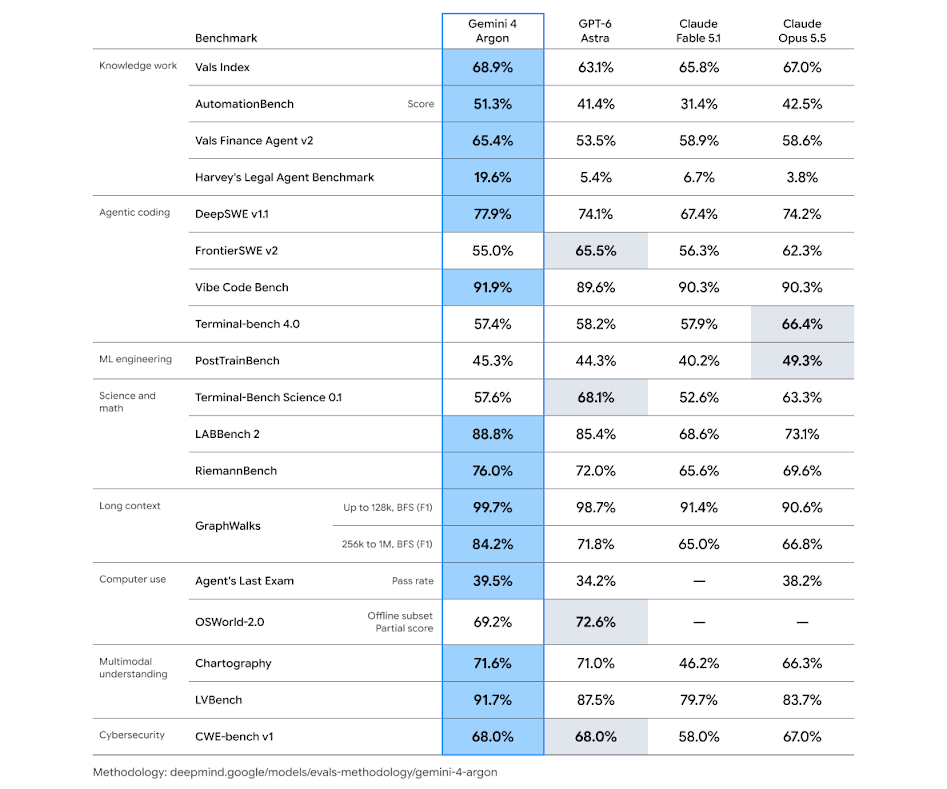
The Gemini 4 Argon model card, which METAL reviewed in full, describes Argon as a large-scale sparse mixture-of-experts (MoE) transformer and lists its knowledge cutoff as March 2026. In the science and math evaluations Google published in the model card, Argon scored 88.8% on LABBench 2, a biology research task benchmark, and 76.0% on RiemannBench, a math reasoning evaluation, ahead of every comparison model: GPT-6 Astra, Claude Fable 5.1 and Claude Opus 5.5. On Terminal-Bench Science 0.1, which measures scientific terminal tasks, it scored 57.6%, behind GPT-6 Astra at 68.1% and Claude Opus 5.5 at 63.3%. Google said in the launch post that external biology red teamers could unlock less than 1% of the biology sub-tasks tested. The model card notes that Argon may show general limitations of foundation models such as hallucinations.
Seen through an AI engineer's eyes, what the four cases share is that the model did not stop at producing an answer but went on into verification. The arcsine implementation was checked with a Lean proof, the enzymes with lab activity tests, and the counterexamples to Grad's conjecture through joint research with an outside professor. That is also why Google is handing its top usage tier to 10,000 scientists. It wants to prove the model's value not with benchmark scores but with the experiment time labs save, and that test has now passed to researchers outside Google.


Comments