



Image: METAL
Summary
- Anthropic said on its engineering blog on October 13 that daily code merges grew from about 2,500 in May to more than 30,000 in September, prompting it to migrate its monorepo from git to the in-house system Scion in five months.
- In Scion the server handles commits, merges and history queries while clients fetch only the objects they need; it needs 200 times less CPU and memory than the previous git mirror fleet, and CI checkouts dropped from minutes to seconds.
- A seven-person team built Scion and the Antique code review tool with Claude, and the company said Scion is not a general replacement for git, pledging to share its design lessons with GitHub, GitLab and the open source community.
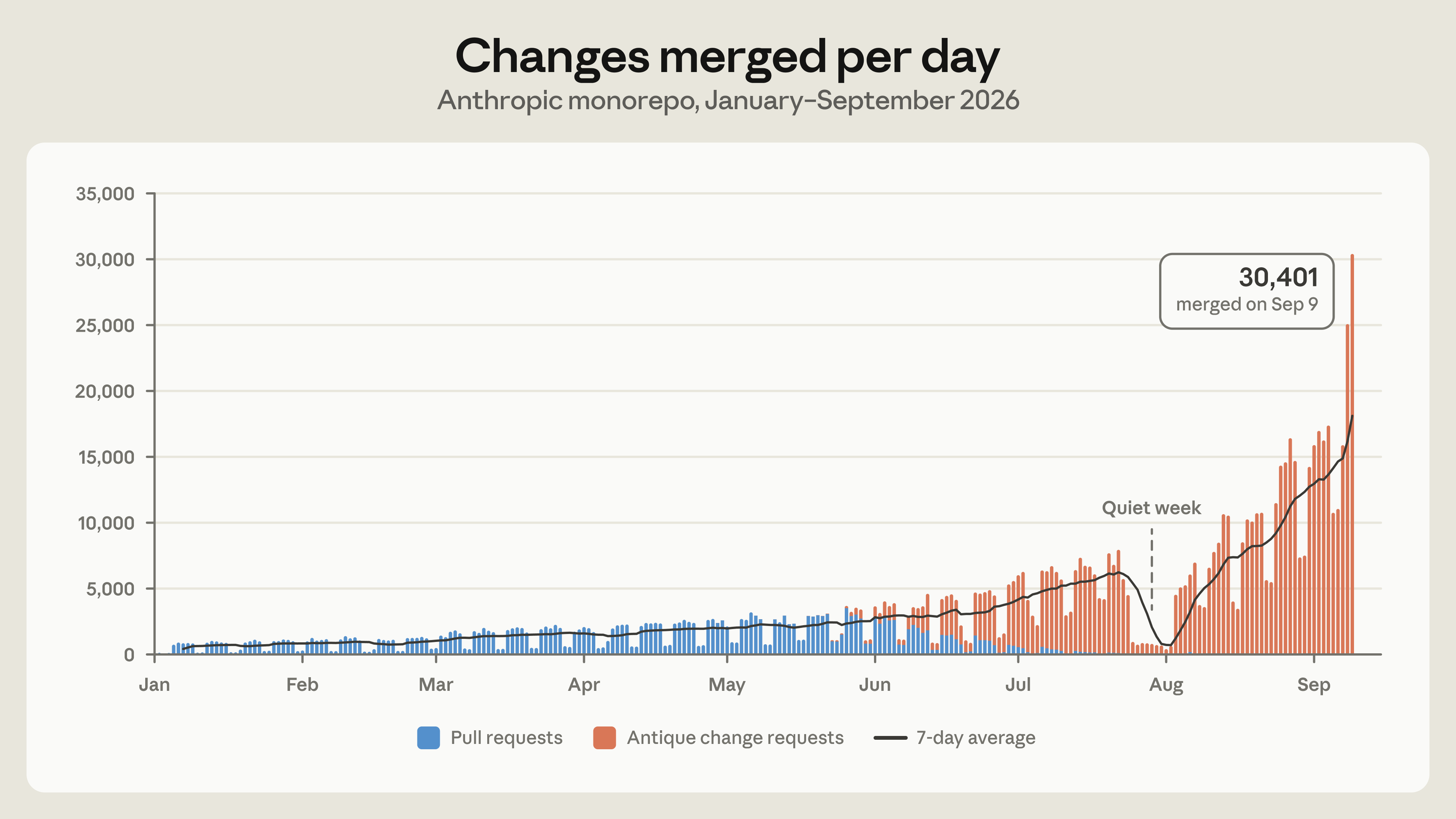
AI company Anthropic unveiled Scion, an in-house version control system, on its engineering blog on October 13. The company said it fully migrated its monorepo, a single repository holding all of its code, from git to Scion in five months. The trigger was merge volume. According to Anthropic, code changes merged per day averaged around 2,500 in May 2026 and exceeded 30,000 in September. A chart the company published shows 30,401 changes merged on September 9 alone. Anthropic's source control team wrote that "coding is no longer the bottleneck to building systems or doing research," diagnosing the new bottleneck as developer infrastructure built for human scale, such as source control, builds and CI.
The repository itself outgrew git's design space first. According to Anthropic, the history of the main branch alone is almost 100 GB, and a compressed working copy is over 25 GB. CI performs around 25 million code checkouts per day, a figure that excludes developer environments, agent sandboxes and research jobs. Fetched naively, that would be more than 600 PB of git traffic per day. The company used shallow clones, sparse checkouts, internal git mirrors and repository snapshots kept in blob storage, and at its peak operated several hundred internal git mirrors. As the merge rate rose, snapshots fell further behind the tip of the main branch, and keeping history and blame working on partial clones became harder.
The change of direction came from an observation about usage. Git is a distributed system in which every clone can read history and check out any revision offline. Anthropic noted that, like most companies, it had been using git as a centralized system with one authoritative copy, and that nearly all of its clients were agents and jobs that are online by definition. The team asked what source control would look like if it were designed from the start around agents being always online, drawing on lessons from Google's Piper and Meta's Sapling.
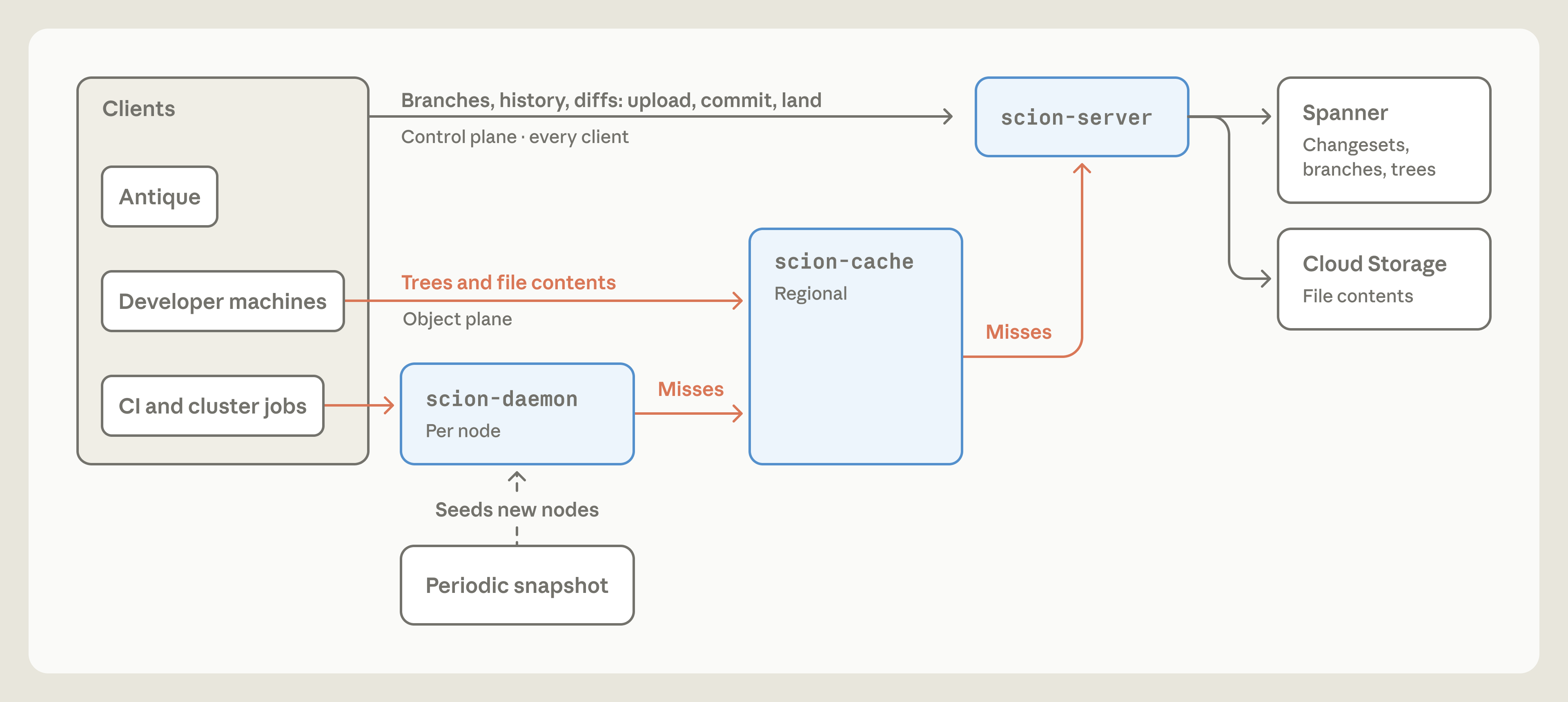
In Scion, the server does most of the work. It answers questions about file history and blame, creates commits, and performs merges and rebases, while the client manages only a bounded local object cache and the working files. The unit of work is a changeset, an entry in a write-ahead log. A changeset stores only the list of files changed relative to its first parent, along with content-addressed pointers to compressed file contents in blob storage. With no git packfiles, no locking and no cross-server coordination, throughput is high. Moving a reference such as a branch is separated out as a compare-and-swap on a single Google Spanner row. There is no fully materialized copy of the repository anywhere, even on the server.
Checkouts run through three tiers of cache. A scion-daemon on each node asks a regional scion-cache for objects, and cache misses go up to scion-server, which reads from Spanner and cloud storage. According to Anthropic, each tier maintains a cache hit rate above 99%. Scion's infrastructure is 200 times smaller than the previous git mirroring infrastructure in CPU and memory. Checkouts for CI and research jobs became about 100 times faster, going from minutes to seconds, and CI alone freed up 25% of its CPU capacity.
Most of the hands that built the system were Claude's. According to Anthropic, a team of seven built Scion, the Antique code review tool and about half a dozen related systems, and completed the migration in five months. Over that period, daily merge volume grew tenfold. The team began building Scion around the time Claude Mythos Preview and Claude Tag became available internally. When the team asked an early internal version of Claude Mythos Preview to rewrite a largely handwritten prototype of the git-to-Scion ingestion pipeline, it produced, with no further instructions, a version that used 20 times less memory and ran 4 times faster. The company said it also preserved the implicit invariants around ingestion ordering and data structures.
The human share of the work has shifted to design and refusal. Every engineer who built the system now rates Claude as better at writing code than themselves, but the engineers still decided the architecture across systems and the design tradeoffs. The team wrote that "very often, we found that the role of the engineers was to tell Claude 'no.'" Several systems tried to find when a change merged to the main branch by reading the commit log linearly instead of asking the code review tool, and in one case an adversarial review was so distrustful of another internal service that Claude added unnecessary validation and complexity. Team members still review every change request, but they examine the intent of a change rather than reading every line. In operations, the team uses Claude instances placed in Slack channels to watch the health of a single component obsessively, which it calls superfans.
The assumptions behind the workflow are changing too. Anthropic could not replicate a merge queue with a global repository lock in an environment where hundreds or thousands of changes can merge while tests are running, and instead invested in post-merge and pre-deploy automated testing. Concurrent changes can conflict, but the company said Claude typically fixes them before humans can even identify them. METAL has reported that Anthropic opened Claude Code projects to everyone on its waitlist, and this post shows what breaks first inside the company that uses that coding agent most. Anthropic's official post on X, which METAL reviewed, summarized the cause as developer infrastructure unable to handle agent rather than human scale, and passed 1.4 million views within half a day of posting.
Anthropic did not announce plans to release Scion externally. The company wrote that "Scion is by no means a suitable replacement for git for general use," saying it only makes sense for enormous monorepos with tens of thousands of engineers or swarms of agents writing code. It also noted that adopting it would mean migrating the entire development lifecycle, including code review, code search and CI. Instead, expecting this class of problems to become common within the next six to 12 months, the company said it would work with GitHub, GitLab and the open source community toward git servers that offer comprehensive server-side RPCs like Scion and refine the negotiation protocol and sparse features. In an era when agents push 30,000 changes a day, the ceiling on productivity is set less by how fast code is written than by how the infrastructure that holds and moves it is designed.



Comments