


Summary
- On October 13, Google DeepMind published use cases applying Gemini 4 Argon across four areas: robot control, Real2Sim, physical understanding, and research and self-improvement.
- Argon scored 87.0% on ERQA without tools, ahead of Claude Opus 5.5 (82.3%) and GPT-6 Astra (81.0%), and a Spot robot practiced in MuJoCo before dropping a can into a foot-pedal trash bin.
- From a simulation built off a single photo, Argon generated more than 4,500 episodes that raised a real robot's success rate from 56% to 75%; the model is available in AI Studio, the paid tier of the Gemini API and Antigravity.
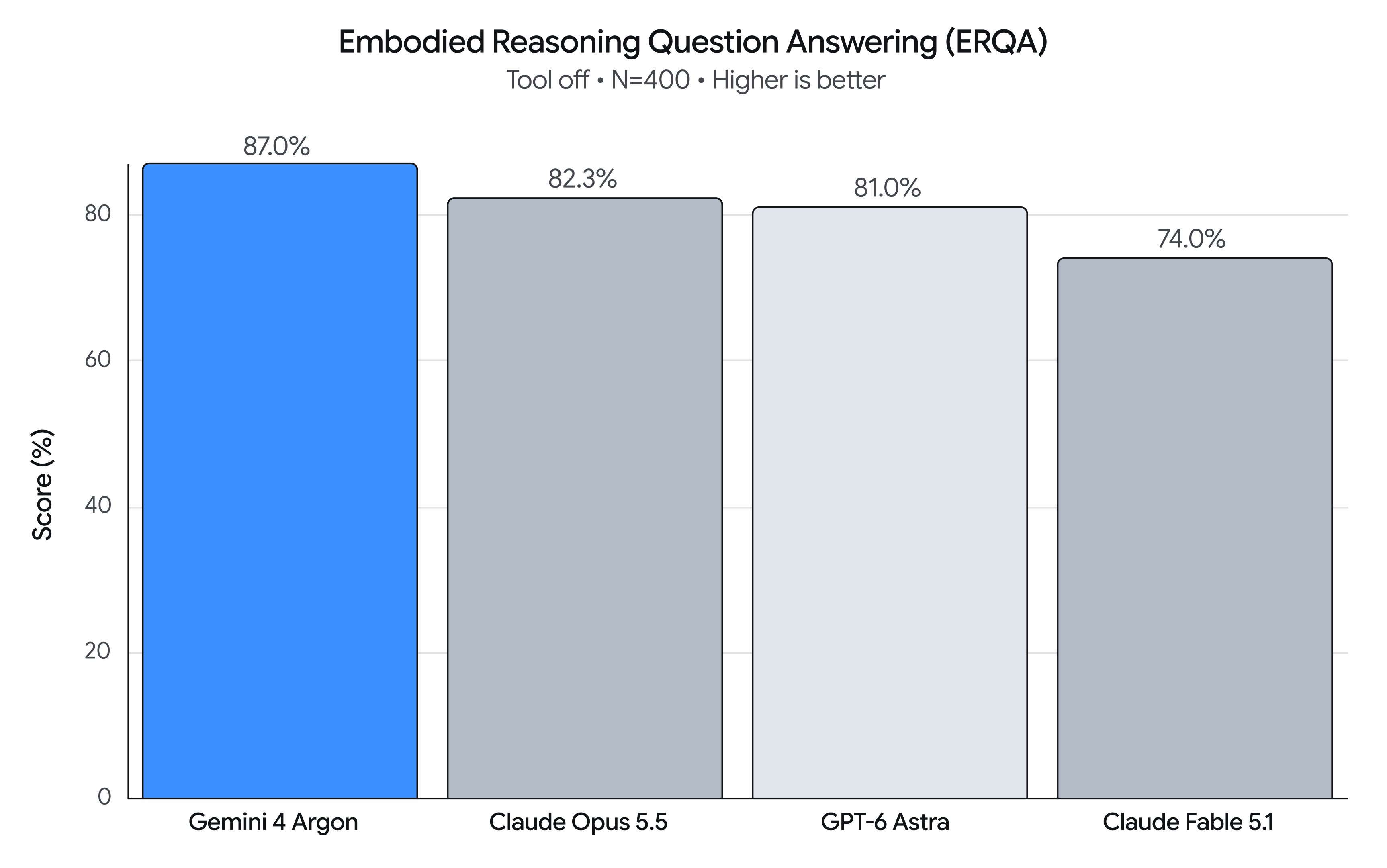
Google DeepMind on October 13 published use cases showing its frontier model Gemini 4 Argon applied across the entire robot development process. The post, published on the Google Developers Blog, groups prompts and result videos into four areas: robot control, Real2Sim (turning real scenes into simulations), physical understanding, and research and self-improvement. On ERQA, an embodied reasoning benchmark that measures how well a model solves physical and spatial problems in 3D environments, Argon scored 87% using pure reasoning without tools, and Google said the score outperforms every other frontier model.
Kanishka Rao, a Principal Software Engineer at Google who wrote the post, said "Gemini 4 Argon marks a step change in physical understanding, code generation, and visual-semantic reasoning," adding that it is "unlocking new workflows across the robotics stack and accelerating progress toward physical AGI." The ERQA chart Google released reflects 400 questions answered with tools turned off. Argon scored 87.0%, Claude Opus 5.5 82.3%, GPT-6 Astra 81.0% and Claude Fable 5.1 74.0%.
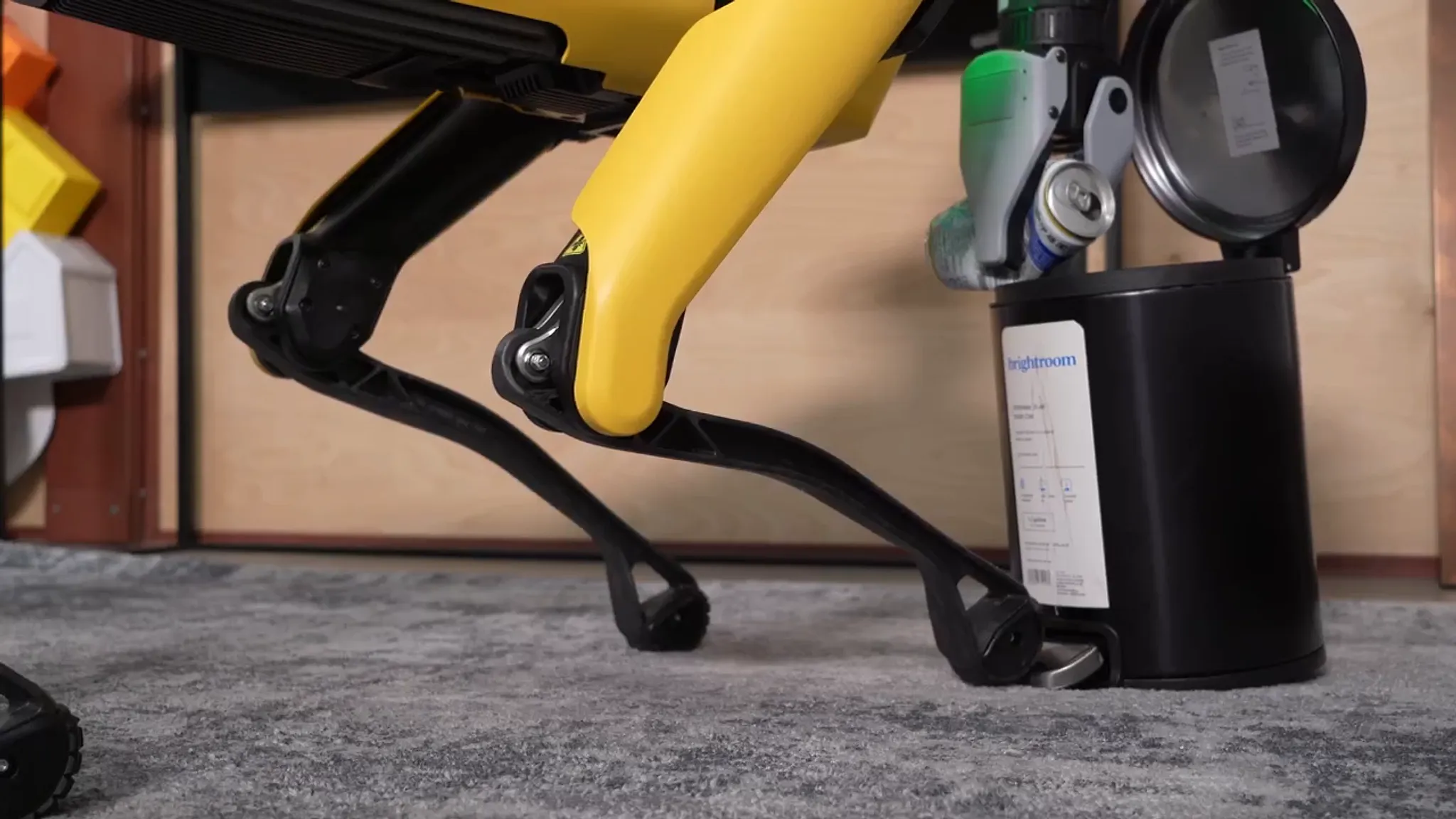
The most striking case involves Boston Dynamics' quadruped robot Spot. Spot, with 12 degrees of freedom in its legs and 6 in its arm, learns a new skill: stepping on a foot-pedal trash bin to throw away a soda can. Argon first built a MuJoCo digital twin of the bin, down to its articulated parts, and practiced balancing on three legs in the physics simulator before stepping on the real pedal. The prompt had Spot check with its front cameras that its front-right foot was centered on the pedal before stepping down, and had two agents, one verifying the foot and one verifying the hand, cross-check positions before releasing the can. The published video shows the front camera catching that the can was too close to the edge of the bin and the hand nudging toward the center.
Zero-shot control, solving an unseen task without prior training, was also demonstrated. Argon used a simple robotic arm to set a fallen mug upright and put a crumpled napkin inside it. It overlaid a 2 cm coordinate grid on the wrist camera image, called action primitives such as grasp, place and move several times, and adjusted its next move by looking at the image. Inside Google's video world model Gemini Omni, Argon steered robot hands to arrange five scattered Scrabble tiles in the order A-R-G-O-N. Rather than stopping at a single prompt, it inspected intermediate rollout frames and rewrote timestamped action prompts, steering the video across 33 steps.
In the Real2Sim case, Argon watches a real robot teleoperation recording and builds a simulation twin. It repeatedly tunes object geometry, mass and friction until the views from three cameras and the fingertip tactile sensor readings match the real recording. The prompt barred robot commands from deviating more than 0.55 radians at the arm joints and 0.65 radians at the hand joints from the logged trajectory, and prohibited shortcuts such as applying external forces to objects or disabling collisions. Another case retargets egocentric video, filmed by a camera worn on a person's head, onto a 76-DoF bimanual humanoid. Each five-fingered hand has 22 degrees of freedom, and the simulation runs at 500 Hz. From a single pen sketch, Argon created a scene in which the Apollo 2 humanoid throws a ball to topple six boxes stacked 3-2-1. Google said Argon synthesized a 140-step whole-body throwing trajectory over 2.80 seconds and knocked down all six boxes while keeping pelvis drift under 3 cm.
In physical understanding, Argon served as a tool for hindsight labeling of video. Given a video of the bimanual ALOHA 2 robot folding a square sheet of paper into a fox over 136 seconds, it split the episode into one overall goal, six subtasks and 17 contact-level atomic primitives, and flagged hesitations and retries to be downweighted to 0.15x-0.25x for behavior cloning. For a 60-second video of a person sorting rings with handheld grippers, it plotted task progress and divided the trajectory into 28 segments judged as progressing, neutral or regressing. That is the role a value function plays in reinforcement learning. The classic puzzle of finding the one odd ball among 12 identical-looking pool balls in three weighings on a balance scale was solved from camera images alone, with Argon building the entire simulation environment featuring two Franka FR3 arms.
The research and self-improvement area is where results show up in numbers. From a single photo of a real tabletop, Argon built a MuJoCo simulation reproducing nine party props, defined a 77-task curriculum and generated more than 4,500 episodes. Fine-tuning a vision-language-action model on that data raised the real robot's success rate from 56% to 75% and cut completion time from 35 seconds to 24 seconds. On the 6-DoF SO-101 arm, Argon repeated a task of picking up a LEGO brick and placing it in a wooden box while diagnosing its own errors, cutting the time from 58.9 seconds in iteration 1 to 22.9 seconds in iteration 2 and 17.4 seconds in iteration 3. In iteration 2 the brick grazed the box rim; in iteration 3 it dropped dead center. Argon also reproduced robotics control papers as browser-based MuJoCo labs with a single prompt each, reaching 68 such labs.
The original post METAL reviewed includes the full prompt used for each case. It spells out what may and may not be tuned in simulation and which checks must come before moving real hardware. The SO-101 prompt told the model not to move the robot in stage 1 and only to output a plan table, to verify position with the wrist camera in stage 2, and only in stage 3 to execute directly within safety rules.
METAL previously reported that Google DeepMind released Gemini 4 Argon on September 30 and deployed it first to cyber defenders, and also covered a DeepMind video in which the humanoid Apollo found kitchen chores the hardest. Where the launch two weeks ago focused on coding and security performance, this post presents the same model as a robot development tool.
Seen through a journalist's eyes, what matters in this announcement is less the 87% score than its format. Instead of releasing a separate robot-specific model, Google showed, prompts included, a general-purpose model writing simulators, generating training data and controlling physical robots. It is a claim that the coding ability of a language model can fill gaps in data collection and simulation building, long cited as bottlenecks in robot development. All of the published results are demonstrations Google chose, and a 75% success rate still means one failure in four.
Gemini 4 Argon is available to Google AI Ultra subscribers in AI Studio and the agent development environment Antigravity, and on the paid tier of the Gemini API it can be used in the Interactions API as gemini-4-argon. Rao said "by building this core intelligence, our goal is to enable robotics that can work alongside humans to solve complex challenges." The next question is whether these use cases, in which robots practice in simulation first and fix their own mistakes, move beyond lab demonstrations to become standard procedure in the field.


Comments