


Image: METAL
Summary
- Sakana AI announced on September 24 that Jürgen Schmidhuber has joined as Chief Scientific Advisor. He keeps his current positions, will help guide the research direction of the company's Recursive Self-Improvement (RSI) Lab, and will visit Tokyo regularly.
- The RSI Lab builds on LLM², the Darwin Gödel Machine (a 30-percentage-point gain on SWE-bench), ShinkaEvolve (150 samples), ALE-Agent (1st of 804) and The AI Scientist, published in Nature.
- Sakana AI says it will pursue self-improvement through sample efficiency rather than hyperscale compute, publish its results openly including failures, and build verifiable safeguards in from the start.
Japanese AI startup Sakana AI announced on September 24 that it has appointed Jürgen Schmidhuber as Chief Scientific Advisor. Schmidhuber joins alongside his current positions and will help guide the research direction of the company's Recursive Self-Improvement (RSI) Lab. The company said he will travel to Tokyo regularly to work with the team.
In its announcement, Sakana AI introduced Schmidhuber as a figure widely recognized as the father of modern AI. The contributions it highlighted were world models, meta-learning, the Gödel Machine, and the 1991 deep learning techniques that underpin much of today's AI boom. The announcement on the company's official X account passed 300,000 views in less than a day.
In his statement on joining, Schmidhuber said "the future of intelligence is not just language; it is physical AI powered by World Models." Calling Japan a birthplace of foundational neural network architectures and advanced robotics, he added that "it is a privilege to join Sakana AI to help bridge these two worlds." The company said that, building on his research, it is developing agent-native world models that simulate the physical consequences of actions before they happen.
The RSI Lab he will help guide is a dedicated research group inside Sakana AI tasked with redesigning the AI development process itself with AI. According to reports, Sakana AI announced the lab's launch in early June. The company wrote that the lab's ultimate objective is to trigger a compounding cycle in which scientific discoveries that improve machine intelligence lead to further discoveries.
The lab does not start from scratch. LLM², built with Oxford and Cambridge in 2024, let language models find better ways to train language models, and produced DiscoPOP, a preference optimization algorithm written entirely by a language model. The Darwin Gödel Machine, built with the University of British Columbia in 2025, maintains an evolving lineage of agents that rewrite their own code, and more than doubled its baseline software engineering performance on SWE-bench. In absolute terms that is a 30-percentage-point improvement.
ShinkaEvolve, released the same year, solved complex optimization problems with only 150 samples and produced a new load-balancing loss function that improves Mixture-of-Experts (MoE) models. ALE-Agent took 1st place out of 804 human participants in AtCoder Heuristic Contest 058. In 2026 the company released Digital Red Queen with MIT, in which language models compete by writing code inside the Core War sandbox, and its research on The AI Scientist, which automates research from ideas to finished papers, was published in Nature on March 26.
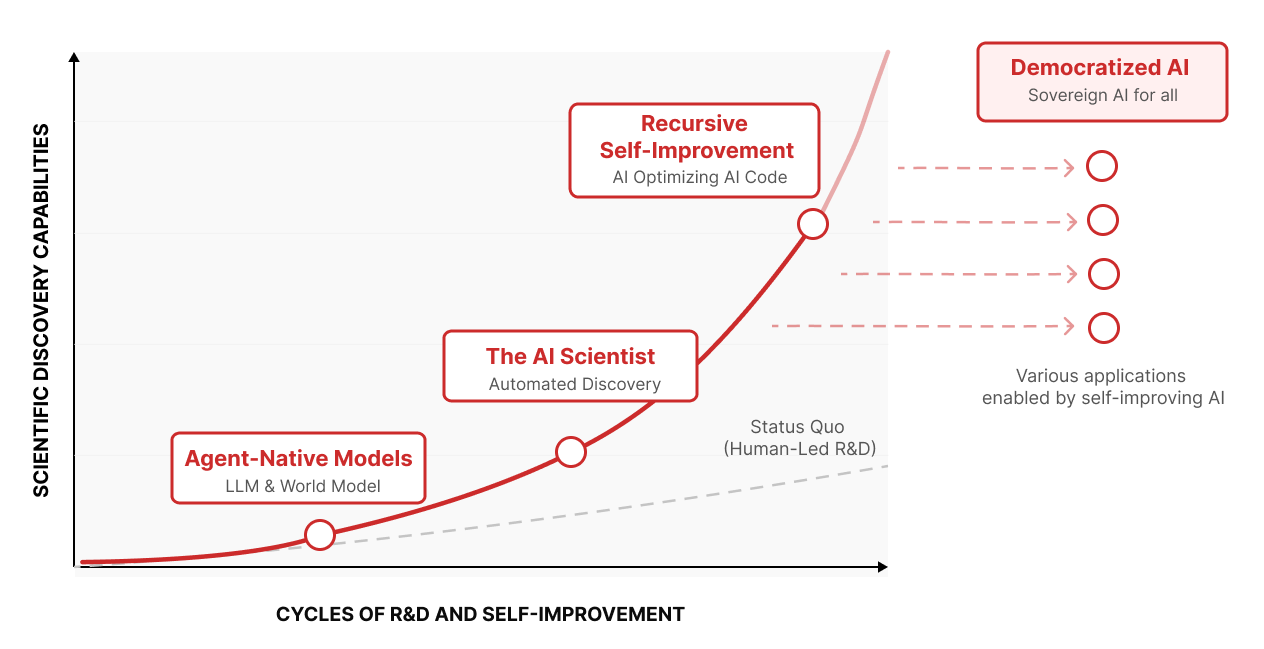
The roadmap Sakana AI has drawn has four stages: models and world models designed from the start for agents, an AI scientist that carries out research automatically, recursive self-improvement in which AI writes, benchmarks and verifies the code of its own underlying architecture, and a democratization stage in which anyone can build frontier AI. The company describes the end of this curve as the point where self-improvement becomes a public good rather than a winner-take-all asset.
The original PDF of Schmidhuber's 1987 diploma thesis at the Technical University of Munich, which METAL reviewed, runs to 64 pages; it is titled Evolutionary Principles in Self-Referential Learning and dated May 14, 1987. Its abstract argues that the essence of learning cannot be captured by a small number of algorithms, and proposes as the remedy "giving a system the ability to learn the methods how to learn, too." In the same abstract he wrote that available machine capacity was clearly below the level needed, so the paper was closer to an inspiration than a practical guide.
Seen through the lens of social history, the announcement is also a text about who wrote the history of AI. It names Kunihiko Fukushima, whose 1979 Neocognitron was the original architecture of convolutional neural networks, and Shun-Ichi Amari, whom it presents as the true pioneer of Hopfield networks. It notes that Schmidhuber has long championed both researchers, and the same text states that Japan did not merely participate in the AI revolution but sparked it.
The geography of compute is another thread of the announcement. The RSI Lab's introduction points out that frontier RSI is being attempted almost exclusively inside the world's two largest compute clusters. Japan has deep scientific talent and engineering culture but a compute envelope modest next to the hyperscalers, so, in the company's argument, sample efficiency is not a preference but a structural necessity. Sakana AI wrote that advances in self-improvement should compound on national rather than hyperscale compute budgets. METAL has previously reported on Sakana AI's plan to extend recursive self-improvement to physical AI that lets robots learn on their own.
Debate over the risks is growing alongside. According to reports, Anthropic has warned that full recursive self-improvement has not yet been achieved, but that once it is, AI could drive its own development faster than institutions can keep up. Sakana AI said that over two years of building such systems it has seen their failure modes directly: evolutionary loops that drift off-distribution, self-modifications that pass benchmarks but fail in deployment, and agents that find shortcuts around the constraints they were given. The company said it will publish openly, including negative results, and design verifiable safeguards from the start, arguing that "responsible RSI is not a constraint on capability; it is what makes capability sustainable."
Sakana AI said it is aggressively scaling research and engineering at its Tokyo headquarters and is hiring two profiles, frontier research scientists and advanced core engineers, from both domestic and international applicants. METAL has previously taken apart how Sakana AI, founded by Transformer paper author Llion Jones and David Ha, is built. An idea that a 1987 diploma thesis said could only be an inspiration, for lack of machines, has moved to the center of one company's research roadmap 39 years later. Whether an AI can improve itself more cleverly while using less compute is now a question a lab in Tokyo has to answer with experiments.
Sources
- Sakana AI — The Next Frontier: Welcoming AI Pioneer Jürgen Schmidhuber to Sakana AI →
- Sakana AI — Introducing Sakana AI’s Recursive Self-Improvement (RSI) Lab →
- THE DECODER — Sakana AI bets AI that improves itself can break the compute arms race of frontier labs →
- Jürgen Schmidhuber · IDSIA — Evolutionary Principles in Self-Referential Learning (Diploma Thesis, 1987) →

Comments