


Summary
- OpenAI unveiled Astra for Law, a legal configuration of GPT-6 Astra, on September 17.
- At its center is an in-house legal search index covering US case law, statutes, and regulations across more than 230 million URLs.
- In OpenAI's own evaluation it passed the overall correctness check on 54.0% of questions, against 38.7% for GPT-6 Astra using web search alone.
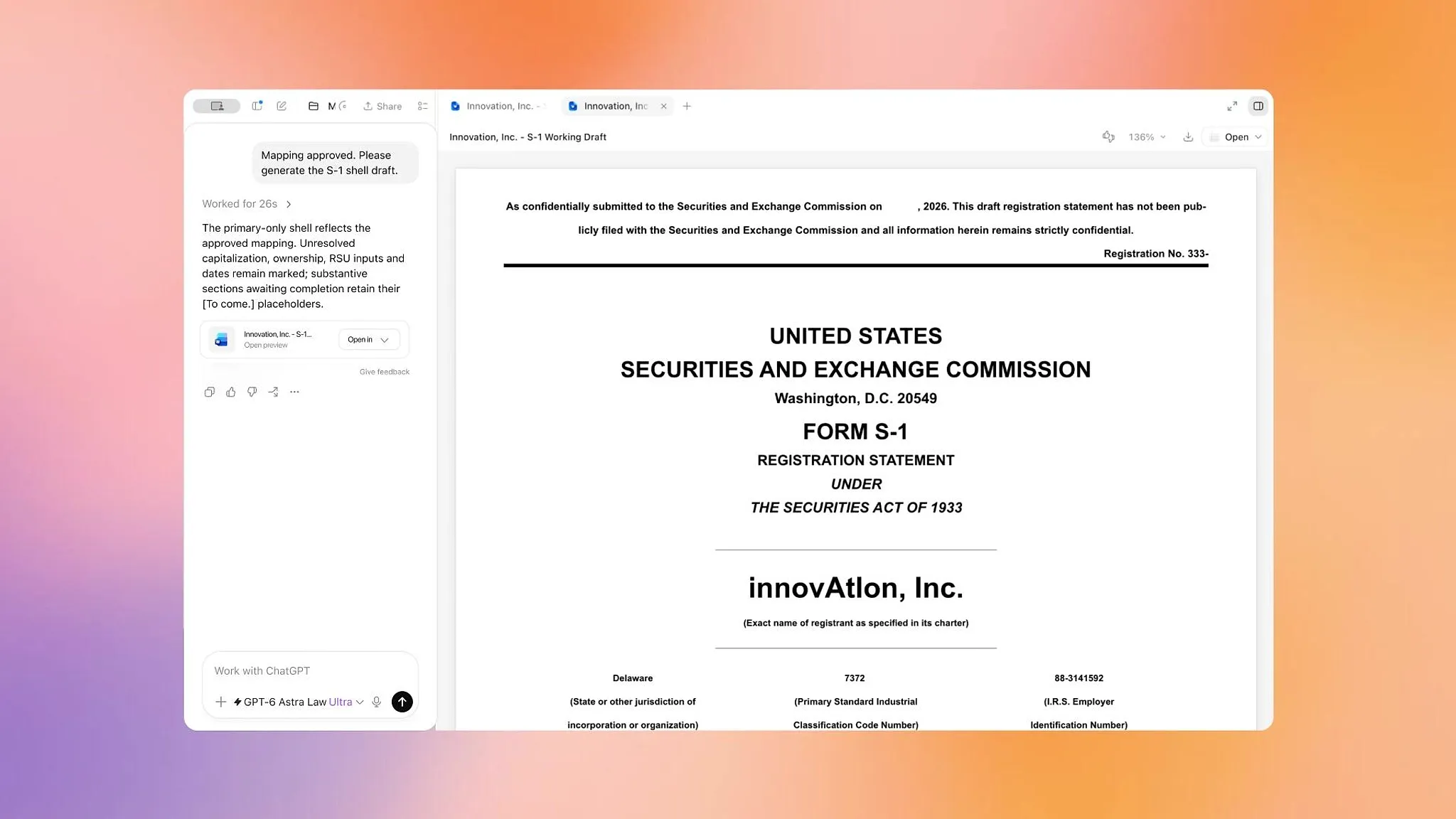
OpenAI released Astra for Law, a configuration built for legal work, on September 17. It is not a new model. It takes GPT-6 Astra, the company's most powerful model, and adds a legal search index, instructions for legal analysis and writing, and controls aimed at law firms. It appears in the model picker as GPT-6 Astra Law and in the API as gpt-6-astra-law, the announcement says. Selected firms get it first through a Trusted Access program in ChatGPT and Codex, with the API to follow.
Read the way a lawyer reads a contract, the thing being priced here is not the model but the index. OpenAI built its own legal search index spanning US case law, statutes, regulations, court rules, and administrative decisions across more than 230 million URLs, with sources added daily. The case law comes from the collection maintained by the Free Law Project, the nonprofit behind CourtListener, which the announcement says covers more than 99.9% of published US precedential case law. The company describes the index as complementing, not replacing, the licensed content firms rely on from specialist providers.
The performance case rests on one test the company chose itself. OpenAI drew 200 US legal research questions from the private validation set of Vals AI's Legal Research Bench and ran them with both systems at their highest reasoning effort, reporting that Astra for Law passed the overall correctness check on 54.0% of them. GPT-6 Astra with web search alone passed 38.7% of the same questions. That is a 40% relative improvement, and it also means the configured system fails the correctness check on nearly half the questions. On case-law questions it found 24% more reference cases, and on a separate audited set of target passages it retrieved up to 54% more relevant passages from the correct opinions.
The announcement also carries a side-by-side comparison with a rival model. The prompt asked for the closest factual precedent in a misrepresentation claim, brought by a client who had been told a historical average order figure before signing a five-year manufacturing agreement. Astra for Law built its memo around Oliver Wyman, Inc. v. Eielson, while Fable 5.1 cited a holding that had been reversed on appeal, OpenAI wrote. In the transactional example, it said, Fable 5.1 reported finding no such case. Both the testing and the comparison are OpenAI's own, and according to reporting neither result has been audited by an independent party.
Assessments from firms that saw it early appear in the announcement as quotes. John Savva, a partner at Sullivan & Cromwell, said, "Across both litigation and transactional matters, the models demonstrated impressive research depth and sensitivity to authority." Niko Grupen, head of applied research at Harvey, said, "In our early testing, Astra for Law showed strength across key aspects of legal research: grounding answers in on-point authorities, citing with precision, and offering practical, advisory guidance."
What has held law firms back was never capability but confidentiality, and this announcement aims straight at that. OpenAI created a separate Trusted Access Program for eligible firms so that lawyers and the people working under their supervision can use it for professional legal work. Eligible firms get Zero Data Retention on the API, and ChatGPT Enterprise usage is excluded from human review by default. The company says it is working with Latham & Watkins on information permissions, ethical walls, client instructions, and firm oversight.
Michael Rubin, chair of Latham's AI Strategy Committee, said, "As AI becomes more capable, so too does the ability to deploy it in environments that demand rigorous governance, oversight, and accountability." An ethical wall is the mechanism that keeps one team inside a firm from seeing another matter's files. What a model may see, and when, has to be written into permission design for any of this to work, and that is the part firms have put a price on.
Tools built inside firms by OpenAI's forward-deployed engineers were published alongside the model. Sullivan & Cromwell built an agreement analyzer that pulls the firm's negotiating playbooks and selected precedents into the review of a new deal, spotting risks that emerge when provisions are read together and turning them into proposed redlines and draft client advice. Ropes & Gray built a diligence system around how its lawyers work through a data room and decide what matters to a deal. Cooley built GO Public for IPO preparation, which the announcement says carries a change across the whole filing when the deal changes.
Twenty-six partner-built plugins opened the same day. With iManage a negotiation brief drafted in ChatGPT can be saved to the matter file, Intapp surfaces activity that may need a time entry, and DeepJudge brings prior deals in for comparison. Relativity and Clio are on the connection list too, and nine community plugins built by lawyers and legal engineers carry 47 custom skills that practitioners can adapt or extend. ChatGPT for Word reached general availability the same day.
How the ecosystem gets described is the most carefully written passage in the announcement. "Building on OpenAI should mean getting more from the ecosystem, not replacing it," it reads. Yet within the same announcement OpenAI has taken hold of the model, the research index, the distribution surface, and the plugin directory at once, while the specialist vendors are left defending their own data and workflows. According to reporting, six vendors issued releases between 4:00 and 4:15 p.m. New York time, and five of them carried the same quote from OpenAI's general manager for the legal industry, word for word.
Harvey and Legora, named as API customers, are the leading companies selling legal AI as a destination in its own right. According to reporting, Harvey was valued at $15.6 billion this month and Legora has been chasing a $10 billion valuation. Both will now build products on the infrastructure of a company that also sells legal research directly to law firms. In the full announcement METAL reviewed, OpenAI calls this relationship open and composable, writing that partners can keep developing their own applications and workflows while firms choose how those capabilities fit together.
The design itself is a shape OpenAI has repeated lately. METAL reported that GPT-6 Astra arrived with both improved alignment and a critical risk rating, and two weeks later that model has come down into one industry's default configuration. Another company is already working the same ground. METAL reported that Google is automating contracts and research with Gemini Enterprise for Legal.
What remains open is price, roster, and jurisdiction. The announcement gives no pricing, no list of which firms are inside Trusted Access, and no date for Europe. The index covers US law only, and a lawyer handed an answer still has to examine the authority personally. Even so, the position that decides which precedent gets seen first has shifted a step toward whoever holds the index. The next fight in the legal market will not be over model scores but over who owns that index.




Comments