


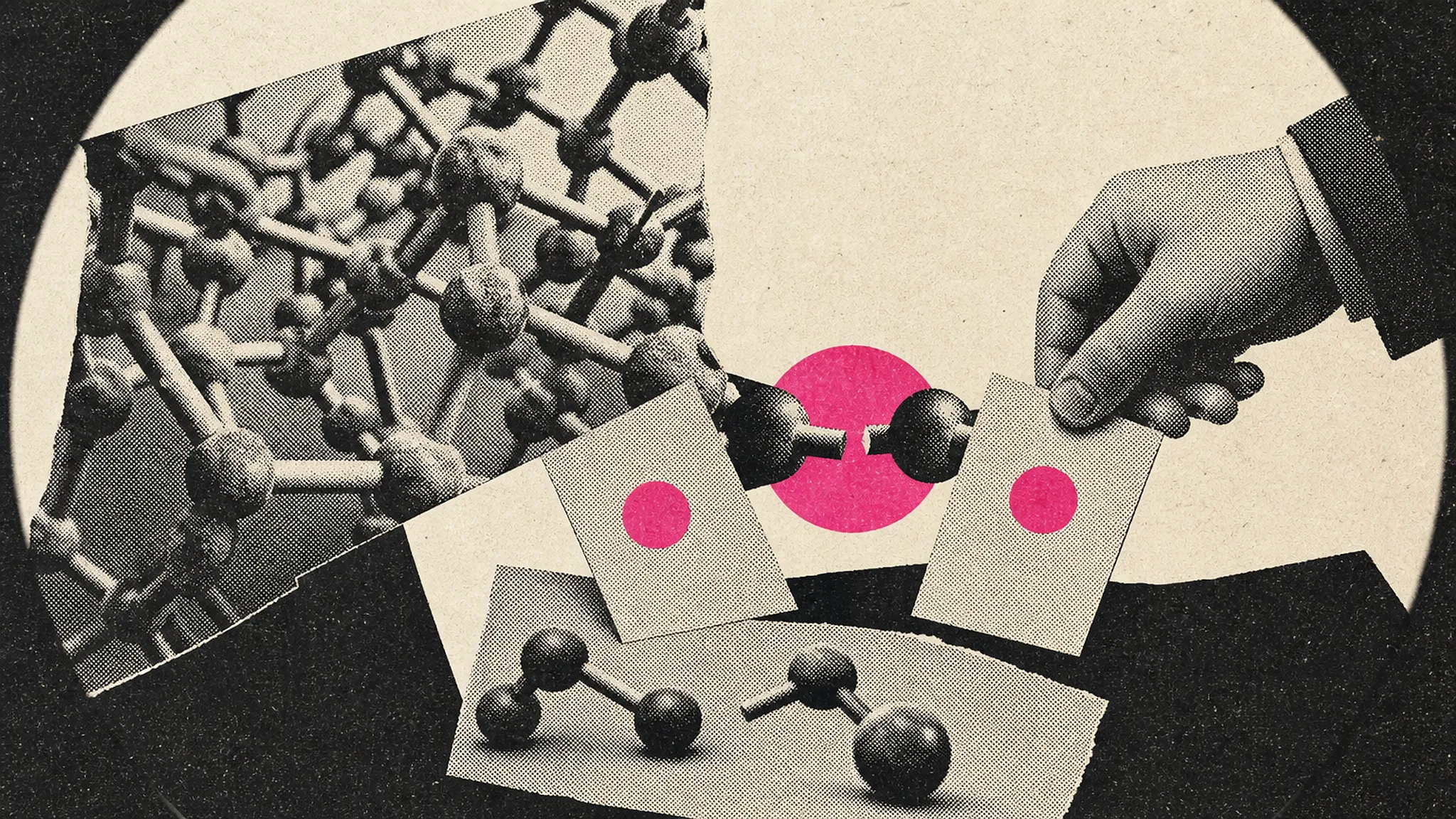
Image: METAL
Summary
- Microsoft released the retrosynthesis model RetroChimera as open source under the MIT license and published the paper in Nature.
- It combines predictions from the Transformer-based R-SMILES 2 and the graph neural network NeuralLoc through learned voting.
- In blind assessment by PhD chemists, complete routes passed for nine of ten challenging targets.
Microsoft has released RetroChimera, an AI model that breaks a target molecule down backward to plan a synthesis route, and opened its weights and implementation as open source under the MIT license. The paper describing the work appeared in Nature. In blind tests, where PhD-level organic chemists did not know which system produced which proposal, the model's suggestions were preferred over existing models and even over reactions already recorded in the literature.
Retrosynthesis starts from the molecule you want to make and works backward, splitting it into simpler precursors one step at a time until it reaches purchasable starting materials. The researchers compared the task to strategic games like chess and Go while marking the decisive difference: the number of possible moves is far larger than in board games, and which moves are even available for a given molecule is not obvious. For that reason this combinatorial explosion was long treated as a domain that could not be automated.
Rather than growing a single model, RetroChimera joins two with different inclinations. R-SMILES 2 is a Transformer-based generative model working in a notation that writes molecules as text strings, producing precursors directly from the input molecule. It has the flexibility to learn reaction patterns straight from data, but generating without constraints also widens the room to invent things that are not there. NeuralLoc is built on a graph neural network, encoding both the target molecule and reaction templates as graphs, and predicts which template to choose and where on the molecule to apply it. Bound to reaction patterns extracted from training data, it is more accurate and stable, but it has less room to move in front of reactions absent from the template library.
That difference is the axis of the design rather than a weakness. The two models are strong on different reaction types. R-SMILES 2 fits especially well when molecular structure changes substantially over the course of a reaction, while NeuralLoc leads on low-precedence reactions and those with localized changes. RetroChimera merges the ranked predictions of both through a learned ensembling strategy. Each model casts a learned vote on every predicted reactant set, weighted by rank, and when both models propose the same reaction those votes are added. It is a structure that learns how much to trust which model at which rank.
The paper also notes that other proposers can be fitted into the same voting frame. Adding reaction-database lookups or human-in-the-loop queries as further inputs lets model predictions, in-house institutional data and expert judgment combine in one place.
The numbers came in two strands. On public benchmarks RetroChimera set new state of the art on both USPTO-50K and USPTO-FULL, pushing top-10 accuracy up by 1.7 and 1.6 percentage points respectively. The more striking side is the score people gave. Against ten difficult targets, under a standard where every step had to pass expert review for a route to count, RetroChimera earned complete routes on nine. Under the same conditions the de novo model managed five, the editing model four, and the NeuralSym baseline two. Nine PhD-level organic chemists from Microsoft and major pharmaceutical companies, asked to choose between the model's top suggestion and an existing documented way of making the same molecule, picked the model roughly 64 percent of the time.
What catches in industrial practice is that the data is different. Pharmaceutical companies work with their own chemistry data, unlike the public datasets. The researchers showed the pre-trained RetroChimera can be adapted to GSK's internal data without much trouble, and the Nature abstract states that zero-shot transfer and fine-tuning were both confirmed on internal datasets from two major pharmaceutical companies. Moved to a new dataset with no additional training, it still outperformed both sub-models. Five researchers affiliated with Novartis Biomedical Research also appear on the author list alongside the Microsoft Research AI for Science team.
METAL downloaded the preprint file (arXiv:2412.05269) directly from arXiv and counted its PDF pages: 28 in total, including the main text, references and extended data. The first authors, marked as equal core contributors, are Krzysztof Maziarz and Guoqing Liu. Authors affiliated with the University of Cambridge and Jagiellonian University are included as well. The main checkpoint was trained on Pistachio, better curated than the public datasets, which holds 3.5 times the samples of USPTO-FULL.
The conditions the company attached for users are specific. The repository documentation states this checkpoint was trained on reaction data available through 2023 and so does not contain chemistry after that. Pistachio itself carries some noise, so predictions should be checked against relevant literature, and performance can fall on chemistry far from the training distribution. Because reactions ranked lower are increasingly likely to be invented, the recommendation not to request more than five to ten per input sits in the same place as the advice to pair the model with a reaction-feasibility model and to turn on consensus mode. The researchers wrote in the repository: "Before using any of the predictions in a real-world setting, they must be risk-assessed and verified independently by chemistry experts."
The manner of release is itself a message. The model went up on GitHub under the MIT license and is also reachable through Microsoft Foundry. The authors, among them senior principal research manager Marwin Segler, wrote on the blog: "we hope you try to break it in any way possible and share the results back to us." They put a request for failure cases in the same place as the performance claims.
METAL reported that prediction and actual results diverged for AI-designed proteins. That gap is also where this announcement should be read. This evaluation gathered expert judgment; it is not the result of actually synthesizing anything in a lab. Proposed routes still have to pass feasibility review and experimental validation, and a sample of 10 targets does not speak to performance across all of chemical space. That published reaction data leans toward successful, well-documented experiments remains true as well.
Still, what this paper moved is clear. Whether a chemist nods at a model's output was long an item absent from the scorecard, running separately from accuracy figures. RetroChimera puts that item on the scale at the same weight as the benchmark and reports beating human choices recorded in the literature head to head. From an engineering view, the part worth watching more closely is that it got there not through the size of one model but through a vote between two with different inclinations. A design that has models fill each other's blanks, instead of growing one bigger, was the path that reached further in this area right now.
Sources
- Microsoft Research — Improving synthesis prediction of small molecules at scale with RetroChimera →
- Nature — Chemist-aligned retrosynthesis by ensembling diverse inductive bias models →
- Microsoft Source — RetroChimera: New research advances AI-assisted molecule synthesis →
- Microsoft — microsoft/retrochimera — GitHub 저장소 →
- Microsoft Research — Microsoft Research 공식 X 게시물 — RetroChimera →

Comments