


Image: METAL
Summary
- Alibaba's DAMO Academy published the abdominal CT vision-language model RADAR in Science and released its code and weights.
- It was trained on 424,911 contrast-enhanced abdominal CT examinations without manual annotation and scored an AUC of 0.913 on an internal cohort of 39,160 examinations.
- It outperformed most of the 26 radiologists in a reader study, and sensitivity rose about 10% when used together.
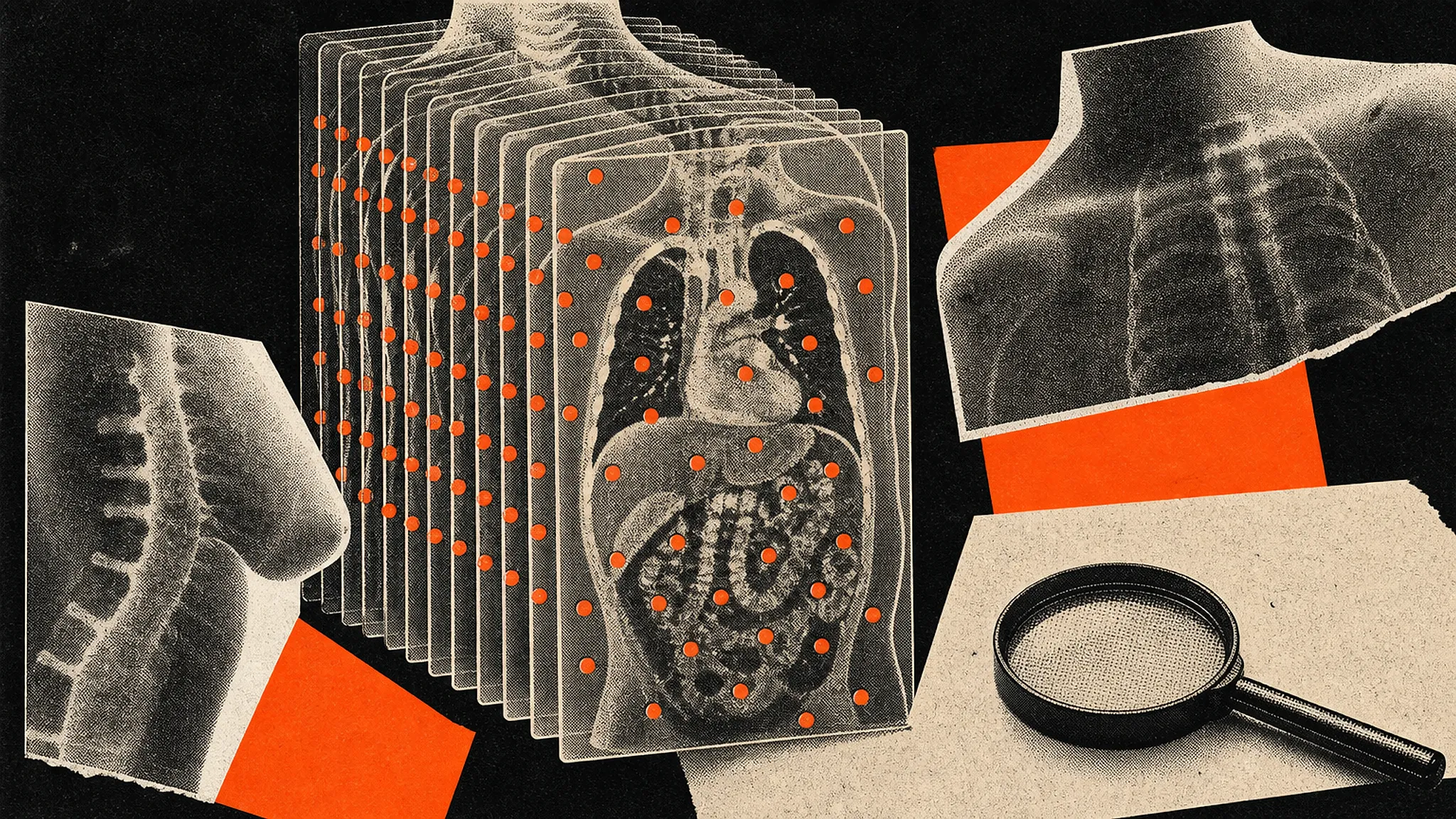
Alibaba's DAMO Academy has released RADAR, a vision-language model that reads 146 findings from a single abdominal CT study. The paper appeared in the journal Science, the code went up on GitHub under the Apache 2.0 license, and the trained weights went up on Hugging Face under CC BY-NC-SA 4.0. The citation information in the GitHub repository that METAL checked lists it as Science volume 393, issue 6817, article eaec6129, with 40 authors.
Abdominal CT sits among the harder studies to read. Yevgeniya Nusinovich, an editor at Science, wrote in the editor's summary that abdominal CT is "one of the more difficult to evaluate because of the number of anatomical structures in the abdomen and the fact that clinically important findings can present as subtle abnormalities that are easily missed." AI systems until now leaned on supervised learning and human-applied annotation, which made training costly and narrowed the range of conditions they could handle.
The route RADAR took runs through the radiology reports hospitals had already accumulated. The researchers trained the model on 424,911 contrast-enhanced abdominal CT examinations and 15 million anatomy-wise image-text pairs, having it learn directly from clinical reports without attaching any separate manual annotation. The dataset was named RAD-CT. The method decomposes a CT volume into anatomical units and matches each one against the corresponding sentences in the report, and the problem of reports being worded differently each time was handled with adaptive contrastive learning.
Performance comes with figures measured across several cohorts. Across 18 anatomical structures and 146 imaging findings, it recorded an AUC of 0.913 on an internal cohort of 39,160 real-world examinations, with a 95% confidence interval of 0.911 to 0.915. At eight external centers it ranged from 0.874 to 0.912. AUC is a measure on which 1.0 means perfect discrimination.
The numbers ran higher on pathology-confirmed cancers. Evaluation across four types, liver, pancreatic, stomach and colorectal cancer, recorded between 0.891 and 0.984. On a cohort from a different population not used in training it reached 0.883 without fine-tuning, and it held 0.904 on acute abdominal conditions that had been excluded from training in the first place. How far performance falls in situations a model never learned is the real proving ground for anything claiming to be generalist.
The comparison against people is the center of this paper. In a reader study with 26 radiologists from 14 centers, RADAR outperformed most participants, and when physicians used RADAR alongside their own reading, diagnostic sensitivity rose about 10%. According to reports, its mean accuracy exceeded that of 23 of the 26, and the time each reading took fell by more than 30%. The paper's abstract states that the work is "demonstrating that generalist AI can match human experts in general and complicated radiology tasks."
The model marks the regions that grounded its judgment on an attention map. That means where it looked in order to decide stays on screen, and the paper counted this feature as one of considerable value in clinical practice. According to reports, the research team believes this training approach can extend to other imaging modalities and claimed RADAR is "the world's first expert-level generalist medical imaging model." Several institutions took part in the research, including a hospital affiliated with Zhejiang University.
Outside the numbers, what this announcement touches is how the labor of reading is arranged. What a radiologist does is not only reading one study accurately but clearing a backlog within a fixed time, and expertise is largely concentrated at large hospitals. A tool that raises sensitivity and cuts reading time shifts that arrangement before it shifts the quality of any single reading. Where a physician early in their career lands while working with the tool is what will decide what this model becomes inside a hospital.
The scope of application is exactly what the paper validated. What RADAR learned and was evaluated on is one imaging protocol, contrast-enhanced abdominal CT, and the performance figures were obtained on data gathered at clinical centers in China. The eight centers that took part in external validation are within the same country. According to reports, the model has not gone through the US Food and Drug Administration's review for software as a medical device, and the CC BY-NC-SA 4.0 license attached to the weights permits research use while separately barring commercial use.
The way it was released is worth recording too. The code sits on top of LAVIS, nnU-Net, MONAI and 3D-ResNets-PyTorch and came out under Apache 2.0. The repository also contains the procedure for measuring performance on the external test set MERLIN along with training and preprocessing documentation, and the code is separately archived on Zenodo. The weights and supporting files were made downloadable from the radar-generalist account on Hugging Face.
This is not the first time Alibaba has left a model open. METAL has reported that Alibaba's Qwen released a real-time simultaneous interpretation model. According to reports, DAMO Academy also released the Coca model this past April, which finds early-stage colorectal cancer in CT, and before that had been building screening tools for pancreatic cancer, stomach cancer and aortic dissection.
What this paper set is a reference point. In the place where several tools each finding one condition used to be bolted together, a model that reads 146 at once from a single study now sits alongside figures that cleared review. The remaining question is not accuracy but procedure. Even after the cost of downloading falls to zero, the validation and approval that model has to pass before it stands in front of a patient remain exactly where they were.
Sources
- Science — An expert-level generalist AI for abdominal CT diagnosis →
- Alibaba DAMO Academy (GitHub) — RADAR: An Expert-Level Generalist AI for Abdominal CT Diagnosis →
- South China Morning Post — Alibaba open-sources medical AI model that can detect cancer and nearly 150 conditions →
- Tech Times — Alibaba Radiology AI Outperforms 23 of 26 Radiologists Across 146 Diseases in Science →



Comments