


Summary
- Anthropic released all of the code Claude produced while optimizing open-source biology models on September 17.
- Thirteen structure prediction models ran 4.1x faster on average in Fast mode, and fourteen ran 1.6x faster in Exact mode, which reproduces the original outputs.
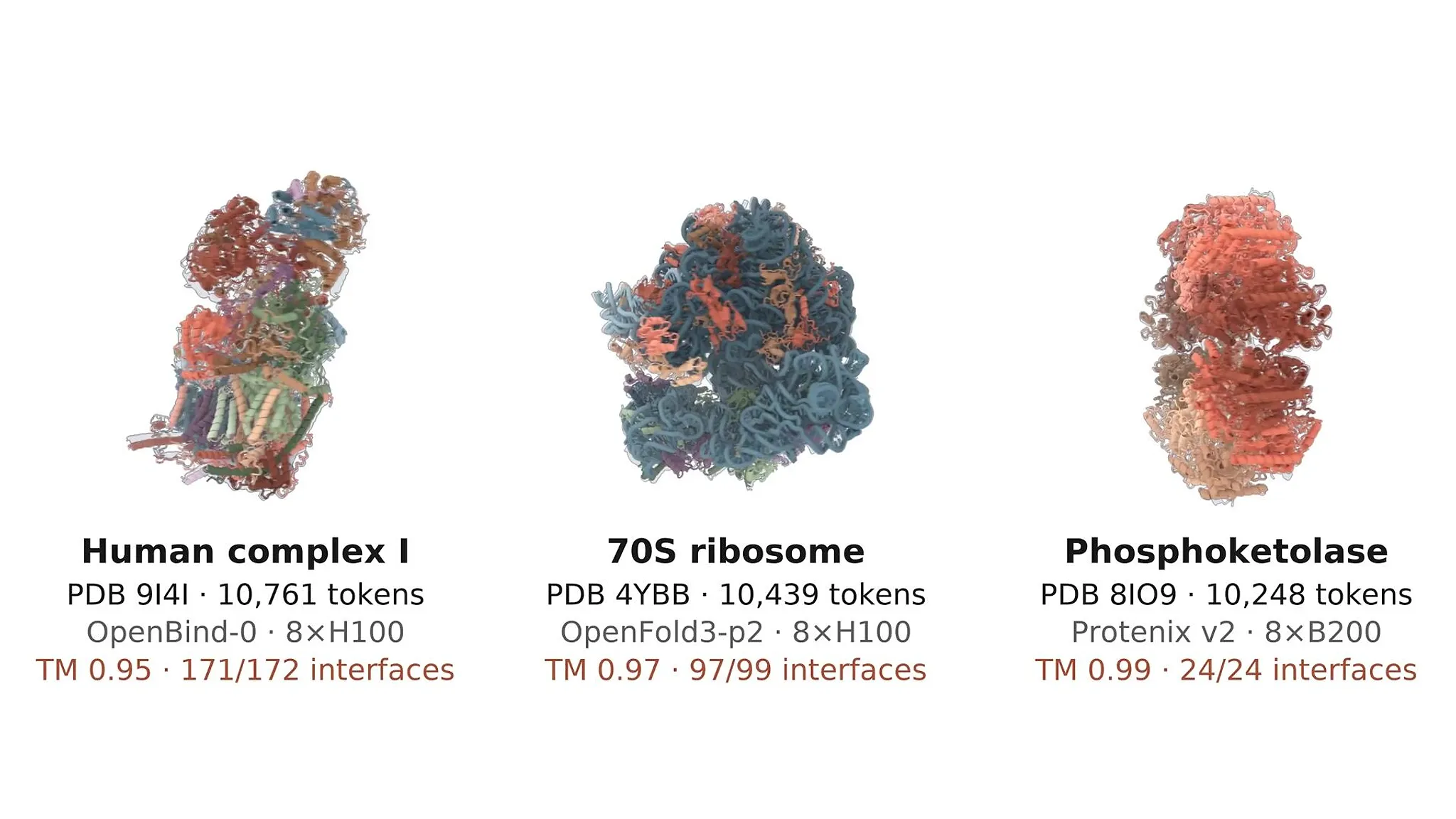
- A low-memory Big mode accurately predicted molecular machines larger than 10,000 tokens on a single GPU node.
Anthropic asked Claude to make other people's biology models run faster, and in just under four weeks 36 open-source model implementations were rewritten. The company published the results on September 17 in a Science blog post and a technical report, and released all of the optimized code as open source. More than 30 models are covered, spanning protein structure prediction, protein design, genomics, and protein language models, and the announcement says they run roughly 4x faster on average.
To read the numbers you have to separate the modes first. Each package runs with the original weights and offers up to three modes: Exact, which reproduces the unmodified outputs bit for bit; Fast, which gives up a little numerical precision for speed; and Big, which cuts memory use so larger inputs fit. According to the technical report, on NVIDIA H100 GPUs Exact mode ran the forward pass of 14 structure prediction models 1.6x faster on average, Fast mode ran the 13 models that have one 4.1x faster on average, and Big mode averaged 3.4x.
The speed came out of the triangle operations. Modern structure prediction models such as AlphaFold3, OpenFold3, and Boltz-2 spend much of their runtime and memory on triangle attention and triangle multiplication. These act on triplets of tokens, so the cost is cubic in the token count: double the size and time and memory rise eightfold, triple it and they rise twenty-sevenfold. Claude built FlashPairformer v1, a set of GPU kernels aimed at exactly that, and the report says its triangle attention was 2.7x faster on average than the field-standard kernels at pair width 128, the setting most of these models use.
On top of the shared kernels came work specific to each model. Intermediate values the original code recomputed were memoized, branches whose output never changes were folded into constants, CUDA graphs were captured, and kernels were fused. Fast-mode speed-ups for the structure prediction models ranged from 2.3x for OpenDDE to 6.4x for Chai-1, while genomics and protein language models gained 1.2x to 5.0x in Exact mode.
Whether the faster code changed the answers was measured separately. On a pooled benchmark of 1,925 model-target pairs across 13 model configurations, the share of interfaces judged acceptable was 54.8% at default, 55.0% for Exact, 54.5% for Fast, and 54.2% for Big. The three shifts were 0.2, minus 0.4, and minus 0.6 percentage points, all inside one percentage point, and none was distinguishable from zero, the report says. An interface counted as acceptable at a DockQ score of 0.23 or higher.
The memory side is the more striking half. The work inside a cell is done by large molecular machines: ribosomes that build proteins, respiratory complexes that power the cell, chaperones that help other proteins fold. Predicting structures at that size has generally required several GPU nodes. The low-memory Big mode Claude created folded systems larger than 10,000 tokens accurately on a single GPU node. Human mitochondrial complex I, the TRiC chaperone complex, a proteasome, and a bacterial 70S ribosome each came close to its experimentally determined structure, with TM-scores between 0.92 and 0.997 according to the report. The 40S ribosome the AlphaFold3 paper highlighted as an accurate prediction was 7,663 tokens, and the models that follow that architecture were trained on crops of at most 768 tokens.
At the other end of the same experiment, the failures are recorded in numbers too. On a node of eight B300 GPUs, viral capsids and protein compartments from 31,000 up to 70,320 residues all ran to completion across seven attempts, but every prediction collapsed into a compact ball about a quarter of the real assembly's diameter, with TM-scores of 0.08 to 0.14 where scored. The report attributes this to a failure to generalize, noting that these assemblies are 40 to 90 times larger than AlphaFold3's largest training crop. What widened was the size that can be computed, not the range the models have learned.
The design results show what the optimization is worth. METAL reported that half of the twelve proteins Claude designed autonomously over 24 hours bound in the lab; that campaign spent up to $10,000 per target within the same 24-hour window, roughly 2,500 NVIDIA H100 GPU hours at list prices, along with a 16,000-word prompt and sub-agents. This time a single Claude model got one H200 and 24 hours of wall time, a prompt of about 1,100 words plus a tool reference sheet, no sub-agents, and no human steering.
Running Mythos 5.1, Mythos 5, and Opus 5 against the same 16 targets, the report says the median design score after 24 hours was 0.785 for Opus 5, 0.781 for Mythos 5.1, and 0.739 for Mythos 5, against 0.749 for the earlier campaigns. The best designs scored 0.833, 0.825, and 0.813, against 0.817 before. The GPU budget was 24 H200 GPU hours, about one hundredth of the earlier one, and the announcement says roughly $150 of combined GPU and token spend reaches the earlier campaigns' computational performance. The score used, ipSAE, is an in silico measure known to predict binding in the lab, and these designs have not yet been tested experimentally; METAL reported on cases where prediction and experiment diverged for AI-designed proteins.
For anyone planning to use the code, the release terms matter. The repository holds 36 drop-in optimization kits, one per upstream tool, with the original code under Apache License 2.0. The kits share the same off, exact, fast, and big vocabulary, the reference configuration is NVIDIA H100 80GB on Linux x86-64, and some kits also ship A100, H200, B200, and B300 configurations. Every run prints one line identifying which optimization is active, and if a mode cannot engage on the machine it prints NOT ACTIVE and exits with status 3. That is a deliberate guard against silently falling back to the stock implementation.
The repository describes itself as an unmaintained reference release. Upstream versions are pinned and shipped as-is, pull requests are not accepted, and there is no plan to track upstream projects. Apache 2.0 does let anyone who needs to fork and maintain it. The technical report METAL reviewed runs to 139 pages, with Richard Shuai, Rohil Badkundri, and Vincent Fan of Anthropic, Kilian Fatras of Biohub, and Lukas Jarosch of Columbia University among the authors.
How the work ran is set out in a single sentence of the abstract. Amir Shanehsazzadeh of Anthropic, the corresponding author, and his co-authors wrote, "Supervised by two scientists experienced in biomolecular modeling but not in inference optimization or kernel engineering, Claude produced optimized packages for 36 model implementations, covering more than 30 open-source models, in just under four weeks." In the announcement Anthropic said, "Our results suggest that frontier AI models will help others in the field build scientific tools with greater speed and ease."
Anthropic also opened a protein design competition co-sponsored with Adaptyv Bio the same day. The two jointly selected five problems at the frontier of today's capabilities, including species cross-reactivity, pH-sensitivity, peptide-MHC specificity, and difficult targets such as GPCRs. Up to $1 million in Claude credits and up to $250,000 in Modal compute credits are committed, Twist Bioscience is supplying DNA, and more than 5,000 designs submitted by the community will be validated experimentally. According to reporting, participants keep ownership of their designs, all experimental results including negative ones will be published, and there is no cash prize.
Seen through an engineer's eyes, the biggest number here is not 4.1x but four weeks. Work like this normally takes an experienced team of engineers weeks per model, and it does not transfer well between models. This time two supervisors with no kernel experience and one model did it across 36 implementations, and what came out is inspectable kernels and benchmark configurations. What remains is the wet lab. However high an in silico score goes, binding is confirmed in a test tube, and that answer arrives at the end of November, when the competition's validation finishes.



Comments