


Image: METAL
Summary
- The Information reported a $12.9 billion agreement, but a conflicting report saying no contract has been signed — plus the absence of any official statement from either company — needs to be weighed alongside it.
- The price looks less like a multiple of Hugging Face's roughly $150 million in annualized revenue and more like a bet on its model distribution network and its role as an optimization pipeline for NIM.
- Even if the deal closes, the value of the asset falls if NVIDIA can't preserve multi-cloud neutrality and developer trust.
Let's start by getting the facts straight. The Information reported that NVIDIA agreed to buy Hugging Face for $12.9 billion, but Business Insider reported that no contract has been signed and that talks could still fall apart. Neither NVIDIA nor Hugging Face has made an official announcement. So what's confirmed right now isn't "the acquisition is done" — it's that a report of a $12.9 billion agreement and a conflicting report saying nothing has been signed exist side by side.
This piece cross-checks official documents from Hugging Face and NVIDIA, NVIDIA's earnings disclosures, the joint open-weight letter, and the text of the EU AI Act. The bottom line: $12.9 billion isn't a price tag based purely on Hugging Face's current subscription revenue. It looks more like a price on the expectation that the "gateway" through which models get published, discovered, and deployed to enterprise servers can be wired directly into NVIDIA's GPUs, networking, and software.
$12.9 billion is 86 times revenue
Hugging Face's most recently reported annualized revenue is roughly $150 million. Simple division against the reported $12.9 billion price puts the multiple at around 86x. That's 2.9x the $4.5 billion valuation from its 2023 funding round, and it's well above the $7 billion valuation the Financial Times reported NVIDIA had proposed in a late-2025 investment offer.
| Comparison point | Known figure | Meaning |
|---|---|---|
| 2023 funding round | $4.5 billion valuation | Led by Salesforce Ventures, raised $235 million |
| Late-2025 NVIDIA investment proposal | $7 billion valuation | FT reported Hugging Face turned down a $500 million investment offer |
| Recent annualized revenue | ~$150 million | Up from roughly $100 million two months earlier, per reports |
| Reported acquisition price (The Information) | $12.9 billion | About 86x recent annualized revenue |
That multiple is hard to justify on subscription revenue alone. Which is why the real asset NVIDIA is after has to be found in the position Hugging Face occupies, not in its revenue line.
Hugging Face's real asset is distribution, not the models themselves
Hugging Face gets called "GitHub for models" for a reason that goes beyond simple storage. When a lab publishes a model and dataset, developers download it, quantize it or fine-tune it for specific tasks, and companies deploy it on their own servers or in the cloud. Discovery, version control, access approval, demos, training, and inference deployment all happen in one place.
As of August 28, Hugging Face's live listings showed 3,026,737 models and 1,021,364 datasets. But official Hub documentation cites different figures elsewhere on the same page — 2 million models, 1.5 million datasets, and 1.5 million Spaces at the top, but 500,000 public datasets further down — making it hard to treat any single number as a reliable current count.
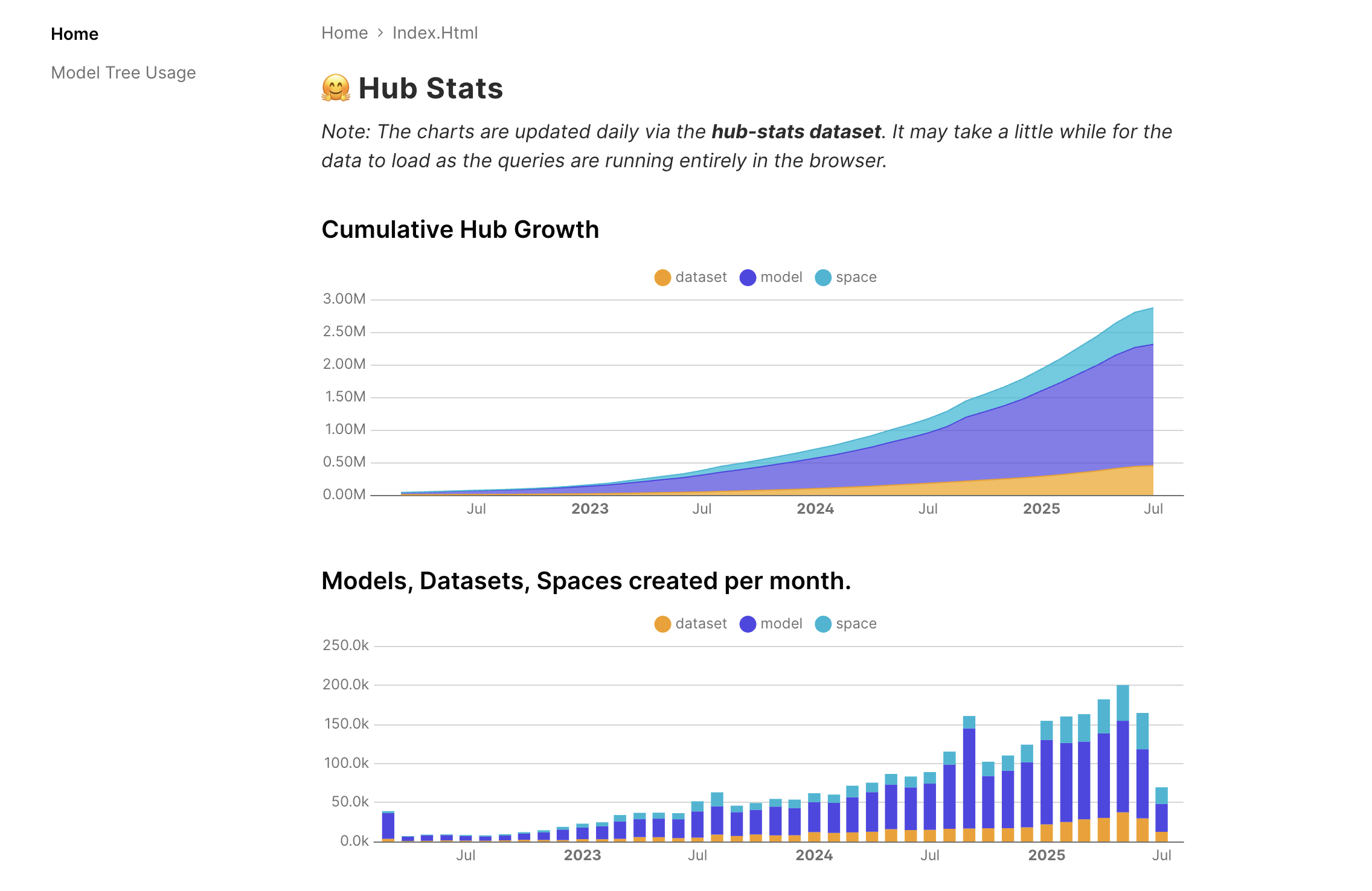
Image: Hugging Face official blog, July 15, 2025. This is a snapshot from that date, not a live count.
Hugging Face's business model sits on top of this distribution layer. It aggregates public models for free, then charges once companies need the security and management features that come with enterprise use.
- Team and Enterprise plans start at $20 and $50 per user per month respectively, offering basic SSO, audit logs, and granular access control. SCIM is available on Enterprise through invitation, while full user lifecycle management is an Enterprise Plus feature.
- Inference Endpoints and Jobs bill by the minute for CPU and GPU usage.
- Inference Providers, which bundles multiple inference vendors behind a single API, currently charges the same rates as the underlying providers with no added margin from Hugging Face. That said, the company noted on its official blog that it could pursue revenue-sharing agreements with providers down the line.
- Gated Models manages individual access requests and approvals, and Team/Enterprise customers can bundle access permissions across multiple models and datasets.
In other words, more free users doesn't just mean rising storage and search costs. Revenue kicks in when organizations that have tried out a model move to private repositories, access controls, audit logs, and dedicated inference or training. If regulation tightens, this enterprise management layer could become even more valuable.
The number NVIDIA is looking at isn't Hugging Face's revenue
NVIDIA's fiscal Q2 2027 results showed revenue of $96.2 billion, with $89 billion of that from data centers. Hugging Face's annualized revenue of roughly $150 million doesn't even reach 0.2% of NVIDIA's quarterly data center revenue. Read as a straightforward acquisition of software revenue, the numbers simply don't add up.
NVIDIA's business gets better as model usage grows. Cheaper open-weight models drive more enterprise AI adoption, and as more companies run models themselves, demand grows for GPUs, networking, and inference software. Even if a handful of frontier labs build their own chips, having a huge number of open models running on NVIDIA infrastructure widens the customer base.
Viewed this way, Hugging Face isn't a $150-million-revenue SaaS business — it's a developer distribution network that shows which models attract attention and downloads and which derivatives get built from them. That said, Hugging Face doesn't have visibility into the actual hardware running models once they're downloaded and deployed outside its platform; operational-level data is limited to workloads that pass through Hugging Face services like Inference Endpoints or Inference Providers. The idea that using these signals to accelerate NVIDIA optimization of popular models could benefit the data center business is a strategic interpretation, not a confirmed acquisition rationale.

NIM is the execution layer connecting the two companies
NVIDIA's official NIM documentation makes the connection more concrete. NIM is a microservice that packages a model's API, inference engine, CUDA, monitoring, and deployment configuration into a container so it can run directly on a server.
NIM currently pulls Hugging Face models via hf://, but it also supports s3://, gs://, modelscope://, and local://. According to Hugging Face's official NIM guide, safetensors checkpoints can be deployed without complex conversion, and HF tokens can be used for gated models or private repositories. Not every model works automatically — it needs supported architectures and profiles from backends like vLLM, SGLang, and TensorRT-LLM.
Owning Hugging Face could shorten the time it takes to build NIM profiles and quantized checkpoints so a newly released model runs efficiently on NVIDIA GPUs. It essentially shortens the distance between the model repository and the execution container.
The DGX Cloud integration announced in 2023 launched in 2024 and was shut down in 2025
The two companies announced in August 2023 a partnership to connect DGX Cloud to Hugging Face and a "Training Cluster as a Service" plan. That announcement explicitly said the service would launch within months, not that it was already available.
The resulting product, Train on DGX Cloud, launched in 2024 for Enterprise Hub customers, but according to Hugging Face's official blog, the service has been discontinued as of April 10, 2025. At the time of the 2023 announcement, Hugging Face hosted more than 250,000 models and 50,000 datasets, and more than 15,000 organizations were using the platform — but this collaboration should be viewed as a past technical partnership between the two companies, not a currently operating product.
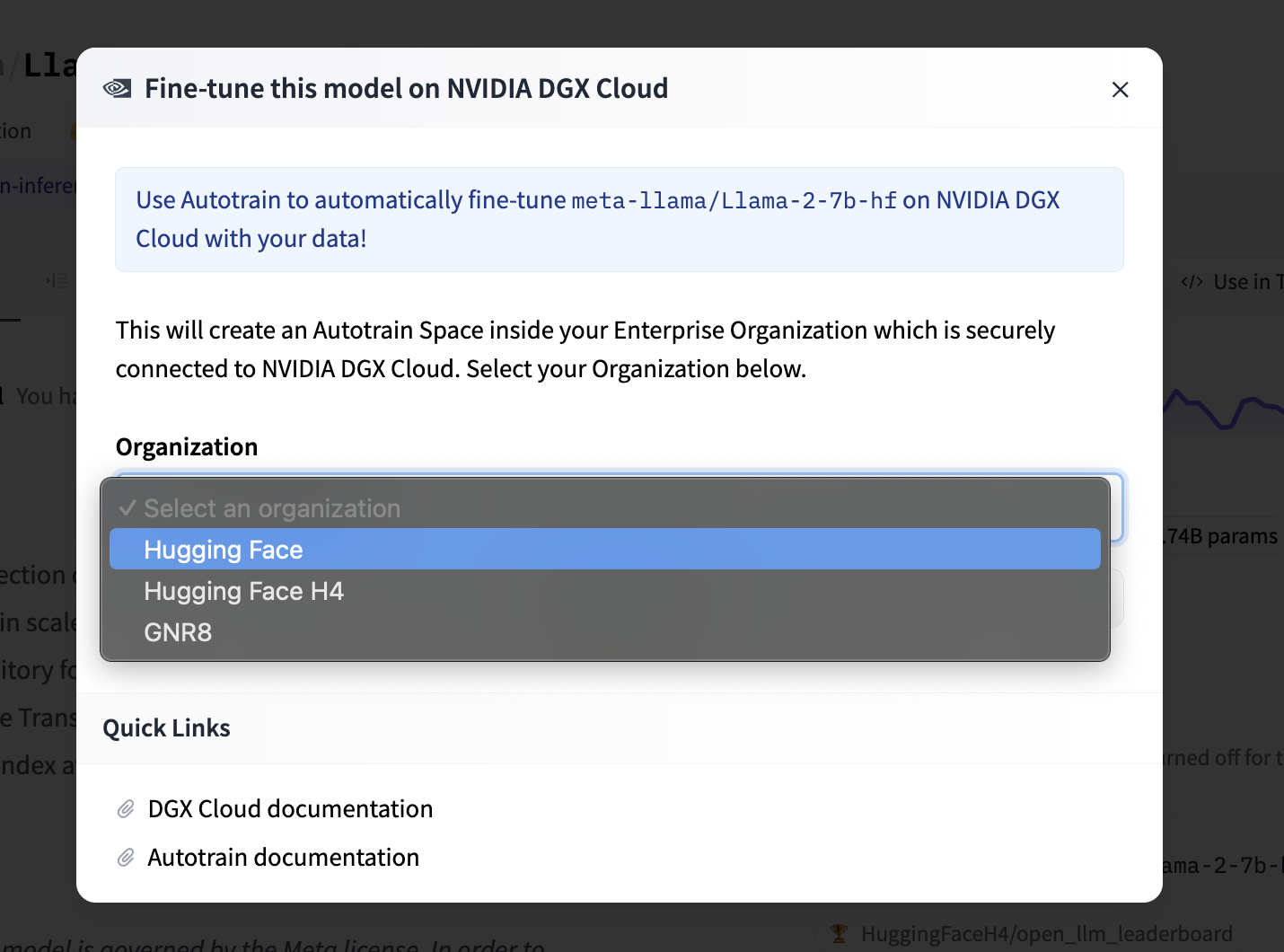
Image: Hugging Face official blog. This service was discontinued on April 10, 2025.
If the deal closes, the path from model discovery and fine-tuning to active NIM deployment could get shorter. But re-establishing a DGX Cloud training pipeline would require a fresh relaunch or new integration — not reviving the discontinued service.
Cloud neutrality could actually work in NVIDIA's favor
Hugging Face's multi-cloud nature is confirmed by actual product integrations. Its official documentation covers deployment paths for Google Cloud's GKE, Vertex AI, and Cloud Run, AWS's SageMaker, Bedrock, ECS, EKS, and EC2, and Microsoft Foundry and Azure ML. Cloud providers care about usage of their own services, but NVIDIA's math is different — it earns revenue whenever its GPUs and networking are used, regardless of which cloud they run on.
So it may actually benefit NVIDIA to keep Hugging Face connected to multiple clouds rather than locking it into one. Compute that happens on a competing cloud can still generate revenue for NVIDIA.
At the same time, this is also the biggest risk in the deal. If search visibility, default runtimes, pricing, and optimization support all start favoring CUDA and NIM, AMD, Intel, and non-NVIDIA inference providers — along with enterprise customers — could start questioning Hugging Face's neutrality. The $12.9 billion valuation grows in value only as long as Hugging Face remains a shared ecosystem used by many companies together; if NVIDIA undermines that neutrality, the value of the asset it just bought shrinks along with it.
Selling chips to China and using Chinese models are separate issues
NVIDIA's fiscal Q3 2027 outlook doesn't include China data center compute revenue. Unless U.S. export controls ease, buying Hugging Face wouldn't grant NVIDIA permission to sell high-performance GPUs to China.
Chinese open-weight models make up a large share of Hugging Face's global activity metrics. Hugging Face's 2026 open-source report found that Chinese models accounted for 41% of all downloads in 2025, surpassing U.S. models, with more than 110,000 derivatives of Qwen alone. NVIDIA itself warned in its fiscal Q1 2027 10-Q that regulations preventing support for Chinese models like DeepSeek, Qwen, and Kimi could materially affect its business. In practice, NVIDIA has already released an NVFP4-quantized checkpoint of Z.ai's GLM-5.2 using Model Optimizer, making it runnable on SGLang and vLLM. This shows optimization work on Chinese open models is already underway — but it doesn't prove a direct causal link to the rumored acquisition.
Put together, this suggests a possible NVIDIA strategy: separate from trying to revive chip sales inside China, make sure that when Chinese models run in data centers across the U.S., Europe, and the Middle East, they run on NVIDIA GPUs. As new Qwen, DeepSeek, and Kimi-family models land on Hugging Face, NVIDIA could track which versions gain traction and quickly add NIM and CUDA support.
But from here on, this is a scenario, not a confirmed causal chain. If post-acquisition search and deployment defaults tilt too heavily toward CUDA, or if U.S. regulations specifically target Chinese-made models, Chinese labs could start publishing to Alibaba's ModelScope or their own platforms first instead. Rather than NVIDIA expanding overseas serving of Chinese models, Hugging Face itself could lose influence inside China.

Open-weight regulation is both a cost and a new revenue opportunity
NVIDIA and Hugging Face both signed the joint letter "Open Weights and American AI Leadership," published July 24. The letter argues that the U.S. should lead on open-weight AI and that hasty restrictions could hurt competition and innovation, but it doesn't mention China or the Hugging Face acquisition. U.S. pre-screening policy also isn't a finalized public regulation yet. Reuters reported on August 4 that the administration planned to exclude open-weight models from voluntary safety reviews, while WIRED later reported that models could be included once they reach frontier-level capability. So any connection to China strategy or acquisition strategy is an interpretation based on conflicting reports, not a settled policy.
Article 53(2) of the EU AI Act exempts qualifying free and open-source general-purpose AI models only from the technical documentation and downstream information obligations under Article 53(1)(a) and (b) — it does not exempt them from copyright policy or training content summary requirements. This exemption also doesn't apply to general-purpose models with systemic risk. Systemic risk classification criteria are set out in Article 51, while model evaluation, risk mitigation, serious incident reporting, and cybersecurity obligations fall under Article 55.
This shift could grow Hugging Face's enterprise business. The official Gated Models documentation confirms per-model access requests, automatic and manual approval, user identity verification, and the ability to block EU users. Enterprise audit logging is covered separately in the Team/Enterprise plan documentation. As pre-release evaluation and user verification become more important, the value of a management layer that lets labs release models incrementally while keeping records could grow.
That said, Hugging Face isn't a single switch that can turn off models worldwide. Once weights are published, they can be copied and moved to other repositories. Regulation is likely to focus less on fully controlling what happens after download and more on managing which models get reviewed before release and who gets access first.
Why would NVIDIA want Hugging Face this badly
The sequence of events hints at intent. On July 24, NVIDIA and Hugging Face both signed a joint letter arguing that "the U.S. should lead on open weights." A month later, on the night of August 26 local time, The Information reported the acquisition agreement. Whether it's actually signed remains unconfirmed, but if this timeline holds up, NVIDIA is moving from spokesperson for the open-weight camp to its owner.
The more U.S. policy tilts toward "American-led open weights," the more weight is added to the fact that an American company owns the global distribution hub for that ecosystem. As shown earlier, Hugging Face already has product-level switches built in — per-model access approval, blocking EU users. If restrictions on Chinese models become real, whether through policy or contract, NVIDIA would be holding the switch that controls them.
In the open-weight world, companies and governments download models directly and run them on their own infrastructure. That means this market moves along a chain: silicon → systems → model distribution/developers → policy. NVIDIA makes the silicon (Blackwell, Rubin), reaches into systems through partner products like Dell AI Factory, and has been vocal on policy through joint letters. The missing piece was model distribution and developers — and Hugging Face fills exactly that gap.
Put simply, this is a picture of NVIDIA holding both ends of the open-weight value chain. If server partners like Dell are the exit point where NVIDIA chips physically reach customers, Hugging Face is the entry point where the models and developers that will run on those chips gather. Seen this way, the rumored acquisition looks less like a passive bet and more like NVIDIA directly growing the demand structure for distributed, on-premise AI. Instead of waiting for a server supercycle, it's buying the entry point where that demand originates.
Of course, this picture only holds if the deal closes — and the neutrality problem discussed earlier comes right back into play here. The moment a company that owns the entry point tilts it toward its own chips, developers start looking for other entry points, and the value of the $12.9 billion asset drops right along with it.
What regulators will look at isn't price, it's control
The key question for antitrust review isn't "is $12.9 billion too high" — it's "what control does NVIDIA gain."
- Do AMD, Intel, and non-NVIDIA inference services get equal treatment in search and deployment?
- Is enterprise data on private models, downloads, and deployments kept separate from NVIDIA's sales operations?
- Is there a guaranteed right to move models and datasets to other hubs?
- Are search, ranking, and safety policy on Hugging Face operated independently?
- Are access approval and regulatory compliance features decoupled from specific hardware purchases?
If regulation tightens, the combined NVIDIA-Hugging Face business of bundling evaluation, security, and audit features together could grow. But if the same features become barriers to entry for smaller labs and competing chipmakers, regulatory scrutiny will grow too.
Editor's take
I don't think the point of this deal is to turn Hugging Face into an NVIDIA-only site. Doing so would undermine the very neutrality and developer trust that supports the $12.9 billion price tag in the first place. The more realistic picture is one where model search and multi-cloud support stay intact, while the speed at which new models get optimized for NIM, DGX Cloud, and CUDA after release increases. As regulation tightens, access management and evaluation could turn into enterprise revenue, and while the China chip market stays closed off, NVIDIA could pull overseas execution of Chinese models onto its own infrastructure.
There's a clear checklist for domestic companies right now. Check how deeply Hugging Face model IDs are embedded in deployment code and contracts, whether original weights and datasets are kept in separate storage, and whether serving layers like vLLM and SGLang are locked to a specific GPU vendor. If you're running a multi-vendor strategy, it's worth actually testing paths to other accelerators and model migration procedures, not just CUDA optimization.
$12.9 billion is priced less on current revenue and more on "the right to sit inside the pipeline through which millions of models get published and deployed to enterprises." But that right is worth the most only as long as Hugging Face stays an entry point for everyone, not just for NVIDIA. Closing the acquisition and preserving neutrality afterward are not the same problem. The real challenge in this deal isn't buying the company — it's turning the entry point it just bought into NVIDIA revenue without ever closing that door.
Sources
- Techmeme — Source: Nvidia has been in talks to acquire Hugging Face for more than $13B; Microsoft also met with Hugging Face, but talks are not ongoing (Business Insider) →
- Bloomberg Technology — Nvidia Discussed Buying AI Startup Hugging Face, Insider Says →
- businessinsider.com — Nvidia agrees to buy Hugging Face for $12.9 billion, The Information reports →
- TechCrunch AI — Nvidia closes in on Hugging Face acquisition →
- The Decoder — Nvidia snaps up Hugging Face for $12.9 billion as closed AI labs pull away →


Comments