


Summary
- After going public, Z.ai covered every tab at Beijing's AGI Bar for five straight days and donated the gong rung at its listing ceremony to the venue.
- People from rival companies, universities, and investment firms all pass through the Beijing location; a Shanghai branch five times its size has since opened, and a party during WAIC drew 300 attendees.
- Two Nvidia DGX Spark units power free access to DeepSeek V4 Flash, with the founder designing AI as a public utility anyone can use, much like Wi-Fi.
 An IPO celebration that went to a bar instead of a ballroom
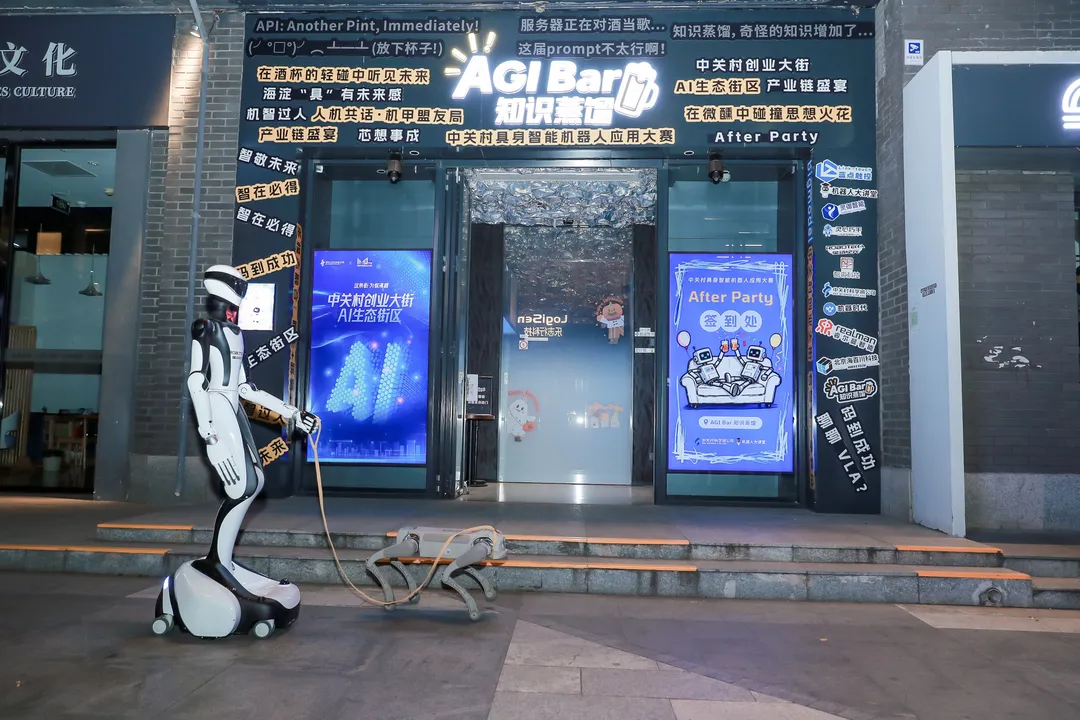
When Z.ai became the world's first publicly listed large language model developer in January 2026, the celebration didn't happen in a hotel ballroom. The company picked up the tab at Beijing's AGI Bar for five days straight, buying drinks for coders, researchers, and engineers. It also handed over the gong rung at its listing ceremony, which now greets visitors at the entrance.
Z.ai wasn't a first-time customer for the occasion, either. Bloomberg reports that word of mouth, early regulars like Z.ai, and the bar's location in Zhongguancun all fed its growth. The IPO celebration the original reporting captured sums up what AGI Bar has become: not a place people scatter to after a company's official event wraps up, but the next stop where they regroup, titles and affiliations set aside for a while. Over pints, founders trade industry gossip, scout for talent, and meet investors. How many of those conversations actually turned into hires or funding deals hasn't been disclosed.

Song De built the neutral ground he couldn't find
Founder Song De dropped out of Rose-Hulman Institute of Technology in the US, launched several internet ventures, and returned to China during the COVID-19 pandemic. After ChatGPT launched, he built WebPilot, an early plugin that gave chatbots web-browsing capability. Working on projects with China's major AI labs and writing about the industry made him a known name in developer circles.
But he found it hard to locate neutral ground where people from competing companies could mingle comfortably. He comes here "to share information or stress-test ideas," Song told Bloomberg. So in 2025 he opened a bar directly on Chuangye Street in Beijing's Haidian district, a corridor dense with Tsinghua and Peking University, AI startups, and venture capital firms.
AGI Bar's official website describes itself as an AI studio by day and a bar by night, built around product launches, cold starts, industry networking, and after-parties. The line "launching your product here means you've cleared the industry's threshold" is the venue's own marketing copy, but Bloomberg's reporting confirms that early regulars like Z.ai and the location itself are what actually drives foot traffic.

A 9.9-yuan foam and free DeepSeek turn the theme into reality
The signature drink, AGI Foam, comes in a standard glass for 9.9 yuan, a large for 9.11 yuan, and an oversized version for 19,999 yuan. The menu's "9.11 > 9.9" reads as a jab at the decimal-comparison errors AI models used to make. A drink that's mostly foam pokes fun at inflated expectations and valuations, and the bar's own tagline puts it plainly: "no foam, no hype."
The AI isn't just decoration. Customers can connect to the Wi-Fi and use DeepSeek V4 Flash for free, configuring it for their own coding projects. Two Nvidia DGX Spark units on site run the model. Song sees AI as a future public utility on par with water, electricity, and the internet, telling Reuters that "AI should be like Wi-Fi."
Staff are still on hand, but AI agents handle much of the inventory, reservations, utility bills, and membership system. Lighting, software, and store hardware are all wired into APIs to cut down on repetitive operations. The bar's Chinese registered name, which translates to "knowledge distillation," carries a triple meaning: distilling spirits, the AI technique of distilling knowledge from large models into smaller ones, and a place where knowledge passes between people.

A human layer on top of China's AI infrastructure
Bloomberg didn't treat this bar as just a themed novelty — it read it as a window into China's broader AI ecosystem, and the shift happening in the industry around it. In the US, a handful of frontier labs dominate top-tier models. China has leaned toward releasing cheaper open-weight models widely, letting many teams build agents and consumer apps on top of them. DeepSeek, Z.ai, and Moonshot AI are leading that push.
When Moonshot released Kimi K3 in July 2026, many developers saw it as another "DeepSeek moment." Song De was an early tester and used Kimi K3 to rebuild the bar's own ordering-system software. In March, Chinese models — including DeepSeek — overtook US models on OpenRouter for the first time, accounting for more than half of total token usage, and Bloomberg reports that Airbnb and DoorDash are now testing Chinese models as well.
The official foundation from government and market is already substantial. Per Bloomberg, Beijing is preparing to spend roughly $300 billion on data center buildout over the next five years, while local governments compete for AI companies with subsidies, tax breaks, and incentives for solo-founder businesses. When Tencent announced in March 2026 that it would ship the buzzy OpenClaw framework to desktops, hundreds of people — from students to retirees — lined up to try it. US restrictions on advanced Nvidia chips and capital, combined with China's block on foreign services like ChatGPT, have squeezed domestic companies while also shielding them. AGI Bar isn't a substitute born from a lack of official infrastructure — it's closer to lived-in infrastructure that lets people and ideas actually circulate on top of the dense foundation universities, companies, investors, and events have already built.
The Shanghai branch and a 300-person party showed the network's scale
In June 2026, AGI Bar opened a second location in Shanghai. HSG provided the ground floor of an accelerator building, and the new branch is five times larger than the Beijing original, complete with big screens, cyberpunk neon, and a robot bartender. The fact that a venture capital firm handed over the space is a concrete sign that formal investment circles have started tapping into this informal gathering spot too.
A month later, when the World Artificial Intelligence Conference (WAIC) came to Shanghai, the bar filled with founders, engineers, and investors escaping the 38-degree heat. An opening-day party hosted by AI recruiting firm TTC drew 300 people. A TTC organizer told Bloomberg that events like this usually need a big-name speaker to pull a crowd — this time, AGI Bar itself was the draw. Inside, hiring opportunities, funding pitches, and the just-released Kimi K3 all became topics of conversation at once.
One founder's 100-day party happened here too
Bloomberg cited software engineer Bruce Tan, 38, as another scene from this ecosystem. In September 2025, he stepped down as co-founder of a mobile OS company that was headed toward an IPO, giving up his potential payout. Three months later he launched Floatboat, an agent startup that merges the browser and file manager into a single AI workspace.
When Floatboat hit its 100-day mark, Tan invited dozens of early users to Beijing's AGI Bar. He served spicy crawfish and pizza on boat-shaped plates — a nod to both the company's name and the crustacean mascot associated with OpenClaw. He said he doesn't buy the narrative that a wave of AI will sweep humans aside, and that he'd rather stand on the side of human value. A moment where a sweeping industry strategy turns into an actual startup got marked, in this bar, as a small ritual where product, users, and founder all met at once.
Going global also brings geopolitical risk for Chinese AI companies. Bloomberg also noted the case of Manus, an agent startup that started in China and relocated to Singapore, which received a $2 billion acquisition offer from Meta — only for Chinese regulators to block the deal. It's a constraint easy to miss amid AGI Bar's optimism. Startup energy is aimed at the global market, but chips, capital, and regulation keep drawing borders around it.
Good infrastructure brings people back together
Good industrial infrastructure isn't just data centers and research labs. A repeatable venue where you can try out a new model, launch a product, hear from users, and meet your next colleague or investor — that's infrastructure too. AGI Bar has stacked all of these functions at a single address.
If Zhongguancun's universities and companies, government investment, WAIC, and open-weight models form the technical and financial floor, AGI Bar is the human infrastructure built on top of it, where people from rival companies set titles aside to talk. Z.ai handed off its IPO celebration there, TTC threw a 300-person party, and Floatboat marked its 100th day with early users. Different organizations repeatedly choosing the same venue is what reveals its value.
Specific hiring and funding numbers haven't been made public. But the structure is clear: free AI access, neutral ground for meeting people, product launches, and community rituals, all under one roof. A bar's low barrier to entry lowers the high walls between researchers, founders, and investors. AGI Bar's real story isn't "a bar with an AI theme" — it's a good example of China's AI ecosystem turning even the way people connect into infrastructure.
Comments