


Image: METAL
Summary
- MongoDB launched Atlas Agent Engine in public preview at its New York Investor Day on September 29, a unified runtime, memory, and governance layer built for AI agents.
- The product rests on three pillars — governance that ties every action to a real identity, Voyage AI-powered memory and retrieval, and open standards including MCP and A2A — with usage billed against existing Atlas commitments.
- MongoDB said its internal sales-agent workspace, Holly, built on the engine, cut the time spent researching sales targets by about 95%.
MongoDB launched Atlas Agent Engine, a unified layer for putting AI agents into production, at an Investor Day event held at the Nasdaq MarketSite in New York on September 29. The product bundles the runtime where agents operate, memory, and governance into a single platform, and shipped immediately in public preview. New and existing Atlas customers can start using it right away at agentengine.mongodb.com. The same day, the company also announced MongoDB 9.0, its database engine, and a new deployment model called Atlas Infinite. MongoDB described the architecture as layered: 9.0 lays the foundation, Infinite removes that foundation's scaling limits, and Agent Engine runs agents on top of both.
The gap MongoDB is targeting sits between proof-of-concept and production. According to the company's announcement, agents prove their value quickly in testing, but moving them into production requires accurate retrieval, persistent memory, and enterprise-grade security and governance all at once. Without a unified platform, engineering teams end up stitching together multiple tools by hand, and those connections break every time the underlying model or framework changes. MongoDB summed up the walls enterprises hit as three: agent actions nobody governs, agents that forget conversations, and lock-in to a specific model or framework.
Pablo Stern-Plaza, MongoDB's Chief Product Officer for AI and New Products, said enterprises trying to deploy agents into production are being forced into a false choice. He pointed out that companies either adopt a specific vendor's runtime and get locked into that vendor's model and cloud, or assemble their own framework and have to manage governance and memory themselves. "Instead of asking customers to predict the future, we wanted to build a solution that works perfectly no matter what they choose," he added. In a market where cloud providers bundle their own models with their own infrastructure, a database company is positioning itself as neutral ground.

The first pillar is governance. Until now, most platforms handled identity management, audit logs, guardrails, and cost controls as separate systems that development teams had to wire together themselves. Atlas Agent Engine pulls all of that behind a single control plane. Every action, whether taken by a person or an agent, is logged against a real identity, and policies that can't be quietly switched off govern that action. The way a corporate card statement records who charged what, when, and who approved it, agent actions now carry the same kind of label and sign-off chain. The company said questions about what an agent did and who authorized it can now be answered in seconds instead of weeks.
The second pillar is memory and retrieval. An agent with no memory starts every conversation from scratch, and teams end up rebuilding memory infrastructure each time they create a new agent. MongoDB said it built memory directly into the platform using Voyage AI embeddings and its own retrieval technology, making agents more accurate while using fewer tokens. According to the company, Voyage AI's embedding and reranking models scored near the top on RTEB, a benchmark built to reflect real enterprise search conditions rather than academic datasets. For engineers, the reason this matters is cost: when an agent pulls only the exact piece it needs instead of rereading an entire long context on every request, accuracy and token cost both improve together.
The third pillar is open design. Atlas Agent Engine is built on open standards such as MCP and A2A, so that switching models or frameworks later becomes a configuration change rather than an expensive rebuild, the company said. MongoDB said it plans to make the engine run on any cloud, in self-managed environments, or even on a laptop. The company has also joined the Linux Foundation's Open Secure AI Alliance and the Agentic AI Foundation, to work on open software and standards for agents that are both safe and interoperable.
Adoption can also be split into pieces. Customers can keep the models and frameworks they already use and adopt only the memory or governance layer on its own, or adopt the runtime as well. Pricing is usage-based for Atlas Agent Runtime and Atlas Agent Memory, and that usage is drawn down against commitments customers already have with Atlas. Because it extends existing infrastructure rather than requiring a new contract, it skips a round of procurement review at many companies, lowering the bar for agents that had been stuck in testing to move into production.
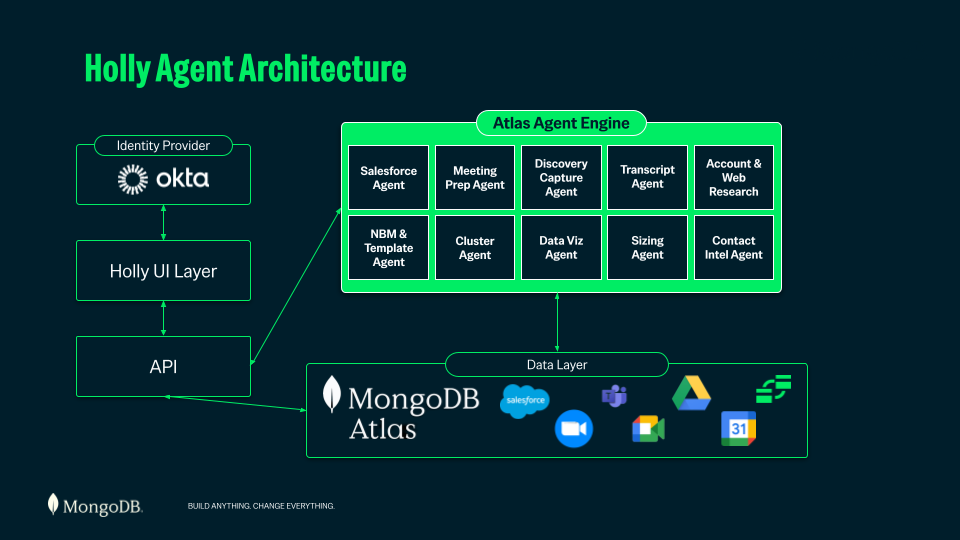
MongoDB tried the engine on itself first. According to a MongoDB blog post METAL reviewed, the company built Holly, an agent workspace for its sales organization, on top of Atlas Agent Engine. Before Holly, a sales rep preparing for a single account had to move between seven tools that shared no context with each other, costing four to six hours per account in every deal cycle. Holly summarizes meeting transcripts, drafts briefings, and flags questions that haven't been answered yet; the company said reps using it cut the time spent researching and building outbound target lists by about 95%.
Holly currently runs on roughly 30 agents. In the architecture diagram MongoDB published, agents split by role — Salesforce integration, meeting prep, transcript summarization, account and web research, data visualization — sit side by side inside Atlas Agent Engine, with Okta handling user identity and MongoDB Atlas plus various work tools handling data. Jack Bunkenburg, who leads strategic accounts at MongoDB, said that before Holly, reps used about a dozen tools for research and outreach, and that having everything land on one screen is the real value.
Payments company Paysafe is the outside customer example. According to MongoDB, Paysafe is building an agent system on Atlas that turns natural-language questions about transaction data into SQL queries, with the goal of replacing its current Snowflake MCP setup with a more reusable pipeline. Paysafe said that investigating anomalies on its payment network currently requires analysts to manually pull together data from multiple systems, often under time pressure. The company added that it expects the agent to shrink the time between an issue surfacing and the team's response, freeing analysts to spend more time on high-stakes judgment calls.
Industry commentary pointed to the same issue. James Governor, co-founder of developer-ecosystem analysis firm RedMonk, said context is the key factor in using agents successfully in application development, and that enterprises are struggling to evaluate, integrate, and manage information scattered across multiple systems. MongoDB said its frontier AI model partners bring models to where enterprise data already lives, while systems-integrator partners contribute deployment experience. Ram Ramalingam, Accenture's global lead for software engineering, said Atlas Agent Engine provides the capabilities, context, and constraints AI agents need to produce real business outcomes.
The timing added weight to this launch. METAL reported that MongoDB CEO Chirantan Desai moved to lead Meta's enterprise AI business, and this Investor Day took place the day right after that announcement. MongoDB brought back Dev Ittycheria, Desai's predecessor, as interim CEO, and the Investor Day went ahead as scheduled. A company with more than 70,000 customers, including roughly 75% of the Fortune 100, shipped its agent-era product roadmap on schedule even with a gap at the top.
Seen through a tech-law lens, governance is the heaviest part of this announcement. Once agents start touching customer data, investigating payment anomalies, and writing sales outreach, who authorized that action becomes a liability question the moment something goes wrong. MongoDB built logging every action against a real identity, controlled by policies that can't be switched off, into the platform as a default, so the answer to that question lives wherever the data lives. Models may change every few months, but the memory, the logs, and the permissions stay in the database — and MongoDB is betting its next phase of growth on holding the ledger of accountability for the agent era.




Comments