


Image: METAL
Summary
- Nolla Health on Oct. 5 (local time) launched a pilot in Utah in which AI directly issues first-time acne prescriptions for adults 18 and older.
- The 12-month agreement with Utah's Office of Artificial Intelligence Policy and Division of Professional Licensing allows only eight topical treatments and sets a three-stage oversight path from physician pre-review to sampled retrospective review.
- The company said physicians agreed with the AI in about 96% of its last 1,000 treatments, and the agreement bans liability waivers and requires adverse events to be reported within 24 hours.
U.S. medical AI startup Nolla Health said on Oct. 5 (local time) that it has launched a pilot program in Utah in which AI directly issues first-time acne prescriptions. Utah residents aged 18 and older scan their faces with the Nolla Derm app, and the AI grades acne severity, selects a drug from a list of topical treatments pre-approved by physicians and sends the prescription to a pharmacy. The company claims it is the first in the United States to receive a state regulator's authorization for AI to issue an initial prescription rather than a renewal.
The basis is a 50-page regulatory mitigation agreement between the Office of Artificial Intelligence Policy and the Division of Professional Licensing, both under the Utah Department of Commerce, and Magic Health, the entity that operates Nolla Health. According to the original agreement reviewed by METAL, Office of AI Policy Director Zach Boyd and CEO Luis Wenus signed it on Sept. 21, and it runs for 12 months from the date the company opens the service and notifies the state in writing. The company may request up to two extensions of up to 12 months each. Within that scope, the Division of Professional Licensing agreed not to enforce state statutes and administrative rules on unlawful and unprofessional conduct against the company and its physicians.
"AI will matter most in healthcare when it helps people get care they otherwise would not receive," CEO Wenus said in a press release. "With Nolla Derm, we are showing how AI can responsibly expand that access and help someone get personalized treatment in minutes instead of long waits or going without care altogether," he added. According to the company, users go through identity verification, informed consent, an intake questionnaire and a five-angle face scan, and receive a treatment plan and prescription in about 10 to 15 minutes.
Physician oversight is relaxed in three stages. Under the company proposal attached to the agreement, in stage one, for at least four weeks and 100 patients, two Utah-licensed physicians independently pre-review every prescription. In stage two, covering 500 cumulative patients over at least eight weeks, the AI sends prescriptions directly and a physician retrospectively reviews every case at least weekly. In stage three, starting at 750 cumulative patients, physicians review a monthly sample of at least 10% of enrollment, while every case involving a side effect or escalation is reviewed in full. Moving to the next stage requires at least 95% agreement with physicians, zero missed hard stops, zero serious adverse events and written approval from the Office of AI Policy.
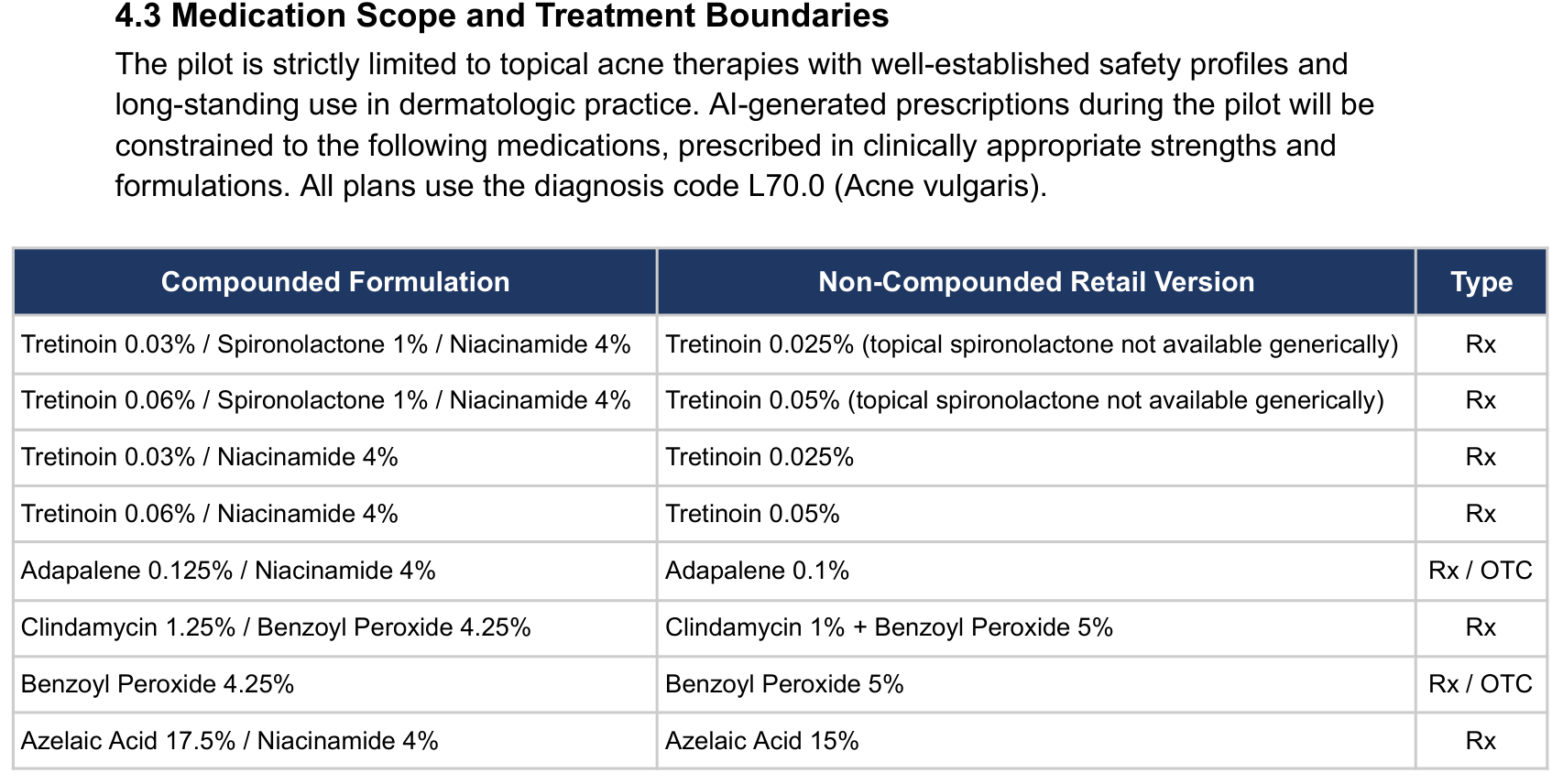
The AI can choose from only eight compounded topical medications. They combine tretinoin, adapalene, clindamycin with benzoyl peroxide, and azelaic acid with ingredients such as niacinamide; oral drugs and isotretinoin are excluded from the outset. Cases with a severity (IGA) score above 3.5 go to a physician for review within 48 hours before any prescription, and severe or nodulocystic acne classified at 4.0 is referred to in-person care. Pregnancy and breastfeeding, immunosuppression, severe kidney or liver disease and age under 18 are hard stops, and identity is verified by matching a government ID with a selfie through Stripe Identity.
The proposal also describes the decision engine. A Vision Transformer (ViT)-based severity model produces a continuous score from five-angle facial photos, and a large language model (LLM) layer combines that score with intake information such as prior treatments and contraindications to choose a formulation from the list. The company wrote that more than 100,000 expert-labeled acne cases were used for training and that on a held-out test set of 10,348 cases the model recorded an R² of 0.947 and a mean absolute error of 0.111. Across the app's last 1,000 treatments, licensed physicians agreed with the AI's recommendation about 96% of the time, and the remaining 4% were one-step strength adjustments within the same drug class.
"The AI can't improvise. It can only choose from a short list of physician-approved topical treatments," said Dr. Zaid Fadul, Nolla Health's chief medical advisor. "The moment a patient falls outside those limits, it stops and hands them to a doctor." He added: "The real test for AI in healthcare isn't how smart it is. It's whether someone other than the company can shut it off. In Utah, the state can, and physicians can."
The agreement spells out a separate liability structure. The terms of service may not disclaim or limit the company's liability for physical, medical or legal harm caused by the AI's outputs, and the company must submit proof of professional liability insurance before launch. Selling or transferring user data, health information or derived metadata to third parties is prohibited. Adverse events such as misdiagnosis, missed diagnosis, recommending a drug the patient is allergic to, or the AI hallucinating facts about a patient's history must be reported within 24 hours of detection; monthly reports are due by the 15th of the following month, and quarterly reports are made public. Pharmacists must be told that a prescription was generated by AI, and prescriptions go out under the overseeing physician's NPI number with the record marked as AI-initiated.
"The Nolla Health pilot program represents a significant step forward in leveraging AI to improve healthcare access for Utahns, while maintaining rigorous oversight and safety," Director Boyd said in the press release. The agreement, however, states that it is a grant of regulatory mitigation only, not an endorsement or approval by the state of Utah, and it bars the company from implying state endorsement in its advertising. Either the Office of AI Policy or the company may terminate the agreement at any time for any reason, after which the company must wind down the service in Utah within a 30-day unwinding period.
Utah first tested AI on prescription renewals. According to reports, the state began a chronic-condition renewal pilot with Doctronic in January, and in April the Utah Medical Licensing Board called for that pilot's suspension, saying it had not been consulted. August AI has also been approved for a renewal pilot. Nolla Health said that this time it met directly with the Utah Medical Board before launch and reflected the board's feedback in the final program. METAL has previously reported on a JAMA commentary arguing that as AI outperforms doctors, regulators should not force a human into the loop.
The company's stated rationale is access. According to the proposal, Utah's average wait for a dermatology appointment is about 61 days, nearly double the national median of 32.3 days, and 11 counties have no dermatologist at all. More than 100,000 Utahns live with active acne, yet only about 10% ever see a dermatologist. The Nolla Derm app launched in the United States in summer 2025 and has been downloaded by more than 175,000 people across 44 states, and the company raised seed funding from General Catalyst.
Next targets are already being discussed. According to reports, Dr. Fadul said that if the pilot succeeds, conditions such as the flu and uncomplicated urinary tract infections, where testing can provide objective information, are worth exploring. He drew a line at stimulants, opioids and benzodiazepines, saying the risk that people might try to manipulate the models means it may take a long time before AI can prescribe them autonomously.
Seen through the eyes of a tech lawyer, the weight of this agreement lies less in AI performance than in how it allocates responsibility. Utah did not amend the statutes that bar unlicensed prescribing; it wrote a contract that defers enforcement for 12 months, for one company and eight topical treatments. In return, the company gave up liability waivers in its terms and took on insurance, reporting and data-sale prohibitions, while the state kept a switch it can flip at any time. Whether AI prescribing expands will depend less on accuracy figures than on whether this contract-based model of regulation can travel to other states and other conditions.
Sources
- Nolla Health (PR Newswire) — Nolla Health Announces Nation's First AI to Issue Initial Prescriptions →
- Nolla Health — Nolla Health Launches the Nation's First AI-Powered Prescriptions, Starting in Utah →
- Nolla Health — Nolla Derm AI Prescription: Now Piloting in Utah →
- The Verge — This startup is issuing AI-generated acne prescriptions →
- SiliconANGLE — Utah gives startup Nolla Health permission to start issuing AI automated prescriptions for acne treatments →
- MobiHealthNews — Nolla Health launches Utah pilot for AI acne prescriptions →
- Utah Department of Commerce — Regulatory Mitigation Agreement — Office of AI Policy, Division of Professional Licensing, Magic Health (Nolla Health) →

Comments