


Summary
- On October 15, Google DeepMind published a case in which a researcher and an AI agent in Google Antigravity scanned millions of uncharacterized UniProt proteins to find a new antimicrobial peptide candidate.
- The agent picked a 97-amino-acid bacteriocin from the Lactococcin 972 family and checked it with BLAST, AlphaFold structural comparison (Foldseek probability 0.855) and gene-neighborhood analysis, then drafted an experimental plan.
- The candidate is in wet-lab validation alongside several others from the same pipeline, and DeepMind added a new 3D tool, the Biomolecular Structure Viewer, to Antigravity.
Google DeepMind on October 15 published a case in which its agentic development platform Google Antigravity was used to find a new antimicrobial peptide candidate. Working in a single session, a researcher and an AI agent scanned millions of uncharacterized proteins in the UniProt database and selected a bacteriocin candidate with predicted activity against pathogens involved in respiratory tract infections. The candidate is now undergoing wet-lab validation. The five researchers who wrote the blog post, Pengfei Tian, Maxwell L. Bileschi, Zoi Tsangalidou, Sukhdeep Singh and Lucy J. Colwell, wrote that the approach turns "days of fragmented database triage into a single collaborative session."
The starting point is antimicrobial resistance. DeepMind cited an estimate that resistance could cause 10 million deaths a year worldwide by 2050 and said new therapeutics are urgently needed. Antimicrobial peptides, and bacteriocins in particular, have evolved to target fundamental vulnerabilities in competing bacteria, from cell envelopes to essential intracellular machinery, which makes it hard for pathogens to develop resistance. The globally used Nisin and recent genome-mined discoveries such as Darobactin, Dynobactin and Lariocidin all came from such natural sequences.
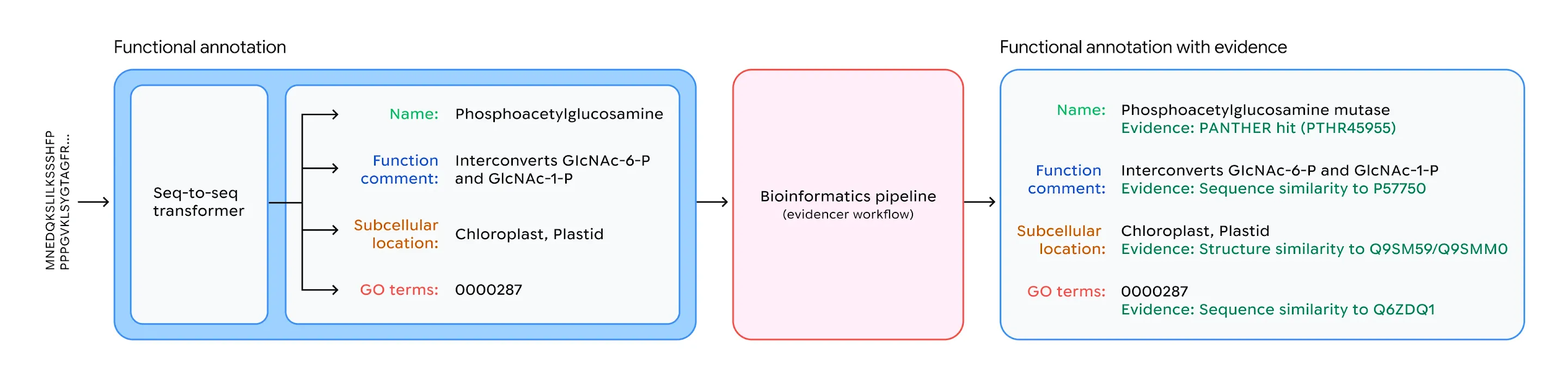
The obstacle is the dark matter of protein databases. UniProt alone holds millions of sequences whose function is unknown because they do not resemble known proteins. According to the ProtNLM preprint, fewer than 1% of known natural protein sequences have experimental annotations, and at least 30% cannot be computationally annotated because they are too distant from sequences with known function. ProtNLM, built by Google, is a transformer model that reads an amino acid sequence and outputs protein names and functions in natural language. According to the 35-page preprint by corresponding authors Lucy J. Colwell and Maxwell L. Bileschi and colleagues, the model predicted names for about 49 million uncharacterized proteins, and the results were released in UniProt.
According to UniProt, ProtNLM-predicted names have appeared since release 2022_04. ProtNLM2, which also predicts function comments, subcellular locations, keywords and GO terms beyond names, was trained on 240 million protein entries from UniProt release 2023_04, and a pilot covering about 26,000 TrEMBL entries from about 400 of the most searched species was released with release 2026_02. Predictions are not shown unless they are corroborated by string matches, sequence similarity or structural similarity. UniProt said that "machine learning AI models do make errors" and asked users to evaluate the predictions carefully.
In this case, the researcher's goal was to find and computationally validate novel antimicrobial peptides in Streptococcus pseudopneumoniae. The researcher decided which questions to ask and what evidence to collect, while the agent handled cross-database queries, structural analysis and literature synthesis. In the published screens, the researcher selected Gemini 3.8 Flash and asked it to find proteins in UniProt. The agent narrowed millions of entries to a handful of candidates and chose a 97-amino-acid bacteriocin from the Lactococcin 972 family. In the public UniProt entry A0A0U0D591 that METAL checked, the protein is listed as unreviewed, with an annotation score of 1 out of 5 and a mass of 10,408 daltons, as a predicted protein.
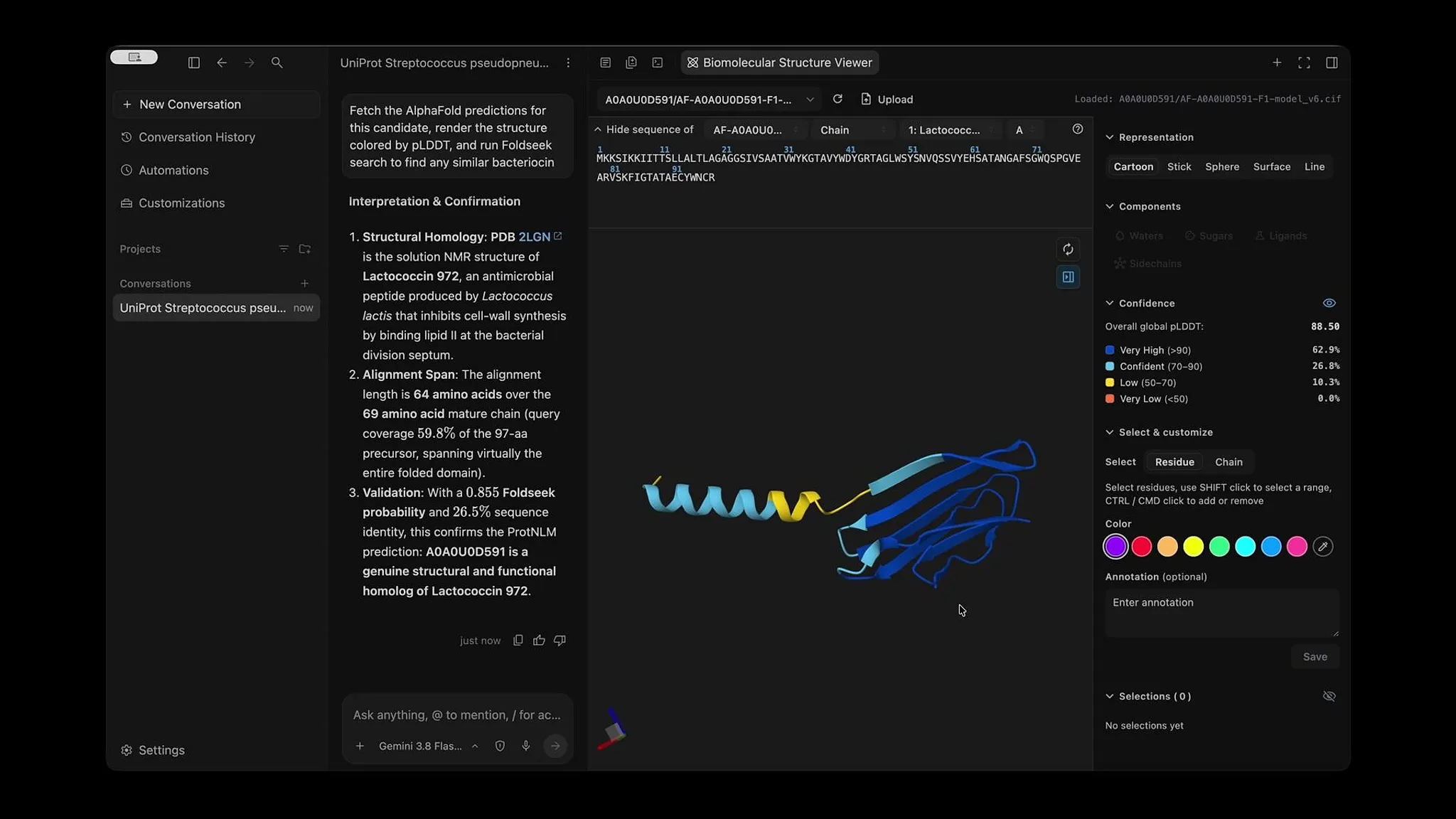
Validation followed three lines. First, the agent used EMBL-EBI's BLAST service to compare the candidate against manually reviewed Swiss-Prot proteins and confirmed it had no meaningful sequence homolog. Next, it retrieved the candidate's 3D model from the AlphaFold Protein Structure Database and superimposed it on experimentally determined structures. In screens published by DeepMind, the agent aligned the candidate with the NMR structure of Lactococcin 972 registered as PDB 2LGN and reported a Foldseek probability of 0.855 and 26.5% sequence identity. The alignment covered 64 of the 69 amino acids in the mature chain, or 59.8% of the 97-amino-acid precursor, and the AlphaFold model's overall pLDDT confidence was 88.50. Lactococcin 972 is an antimicrobial peptide produced by Lactococcus lactis that inhibits cell-wall synthesis by binding lipid II at the bacterial division septum.
The third line was the gene's neighborhood. The candidate gene sat upstream in a tightly coupled operon, just 6 base pairs ahead of an ABC transporter permease, alongside its potential partner ATP-binding protein, another annotated bacteriocin and an XRE transcriptional regulator. The agent read this as strong contextual evidence that the gene is part of a working bacteriocin system. A literature review then suggested a mechanism of action targeting bacterial cell division and a predicted potency spectrum spanning several drug-resistant pathogens, and the agent drafted an experimental plan covering protein expression, antimicrobial susceptibility testing, target engagement and in vitro toxicity testing. The researchers said this candidate and several others found through the same pipeline are in wet-lab validation, where "experimental results will provide the ultimate test of the agent's analysis."
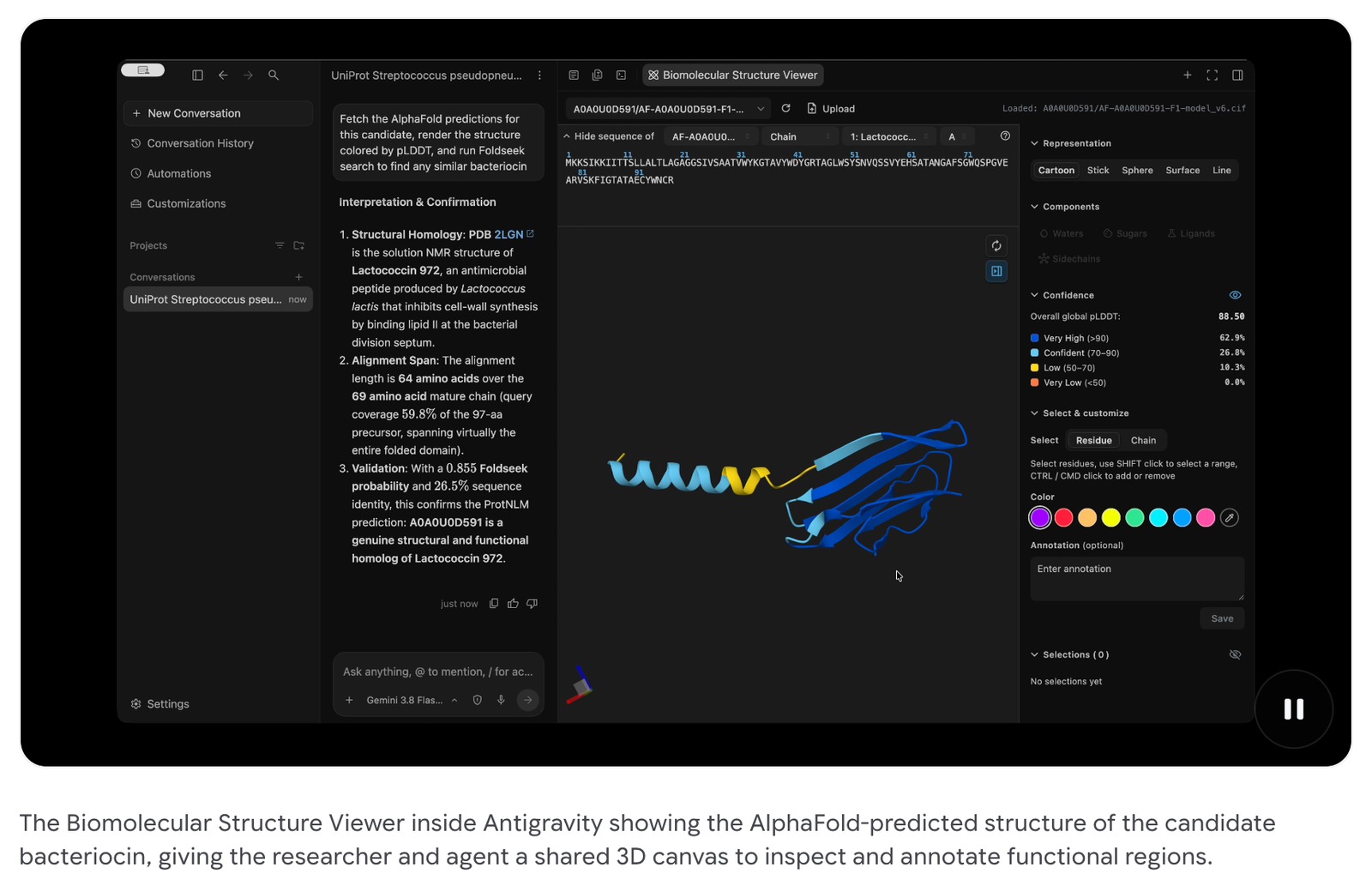
For this workflow DeepMind added a new 3D visualization tool, the Biomolecular Structure Viewer, inside Antigravity. The agent can load structures from the AlphaFold Database or the scientist's own predictions and drive the viewer to highlight key functional regions, while a researcher's highlights of specific residues or notes pinned to a binding pocket are synchronized back to the agent. A researcher can mark a region in 3D space and ask how a β-strand might affect lipid II binding, and the agent reasons over that exact structural context.
Seen from an AI engineer's perspective, the weight of this case lies less in a new model than in the wiring. Previously, researchers had to write custom database scripts, export files into 3D modeling programs, move between disconnected genomic tools and work with multiple experts to design assays. Because wet-lab work is expensive, keeping only high-confidence leads at the front end is the bottleneck, and DeepMind targeted it by combining ProtNLM's domain-specific function predictions with a general agent's tool orchestration in one workspace. METAL has reported that half of 12 proteins Claude designed autonomously over 24 hours bound their targets, and the frontier labs' race in science agents is widening from design to search.
The researchers said this candidate is a biologically plausible lead backed by structural and genomic evidence but still requires wet-lab validation. The session covered only a narrow amino acid length window in one bacterium, and researchers can add filtering criteria, change sequence lengths or target other priority pathogens. DeepMind said that broadening the search from human commensals to environmental microbes could surface new antimicrobial peptide candidates across UniProt at scale. Whether a model that named 49 million proteins can pick out molecules that become real drugs will now be answered by the numbers from the lab bench.

Comments