



Image: METAL
Summary
- On September 30, OpenAI announced a partnership with America's SBDC to train about 150 center advisors and hold in-person AI workshops for at least 1,000 small businesses.
- Advisors and clients who finish the workshops get free access to ChatGPT Plus, and the two organizations will co-develop guides on topics such as marketing, manufacturing, exporting and government contracting.
- According to an OpenAI report, about 4 million small-firm employees used OpenAI tools in one September week, and in August two-thirds of small-business output tokens came from agentic products.
OpenAI on September 30 announced a small business AI training partnership with America's SBDC, the nonprofit association representing the nationwide network of small business development centers in the United States. In the first phase, OpenAI Academy will train about 150 center advisors, who will then hold in-person workshops in their regions to teach at least 1,000 small businesses how to use AI. On the same day, OpenAI released a report on small-business AI use, Small Businesses, Bigger Capabilities. Its conclusion is that the smaller the company, the more it is using AI agents to fill the gaps left by specialists before it can afford to hire.
The partnership is built on training advisors first. According to OpenAI, America's SBDC is a network that serves 1 million entrepreneurs each year, and advisors selected by the association will go through training and credentialing in the OpenAI Academy Community Trainer Program. The workshops, held at least once in each participating network, follow the Academy's three-hour hands-on format, and owners apply ChatGPT to real business tasks and leave with a plan. After the workshops, advisors follow up to see what proved useful.
The association's press release added a condition not in OpenAI's announcement. Advisors and clients who complete the in-person workshops will receive free access to ChatGPT Plus. The two organizations will jointly produce practical guides and industry-specific guides on topics such as marketing, operations, manufacturing, exporting and government contracting, shared through OpenAI Academy and the association's channels. The pilot will roll out in phases over the coming months.
The association framed the partnership as a question of the technology gap. Charles "Tee" Rowe, President and CEO of America's SBDC, said "Small businesses are the backbone of the American economy, and they deserve the same access to AI tools that large companies already have." He added "We're proud to be working with OpenAI to make sure small businesses aren't left behind in this next wave of technology." Chris Lehane, OpenAI's Chief Global Affairs Officer, said "AI can help small businesses punch above their weight and compete," adding that pairing the tools with local advisors who know their communities would help small businesses "get a fair slice of the economic pie."
The association's footprint on the ground is large. According to the press release, America's SBDC is made up of 63 member organizations and nearly 1,000 local centers nationwide, offering free, confidential advising. In its most recent annual report, the network helped clients secure more than $5.53 billion in capital. The association has already trained more than 500 advisors through its own AI certification program, AI U, and recently ran the AI Ready Challenge with Google.
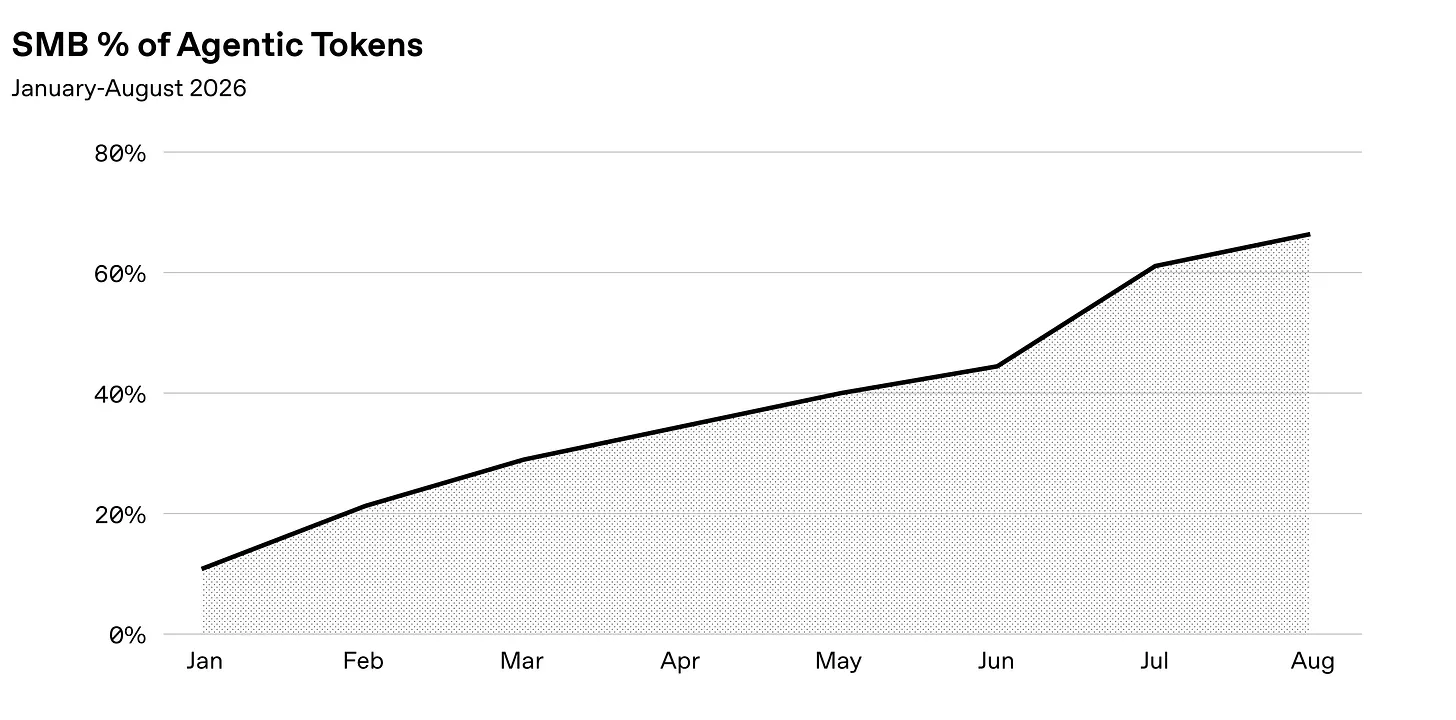
The report's numbers show how widely use has already spread. According to the OpenAI report, in the week of September 9 to 15, about 4 million people working at companies with 1 to 499 employees used OpenAI tools, and nearly one in five of them worked at firms with fewer than 10 employees. The way they use it has also changed. In August, two-thirds of small-business output tokens came from agentic products such as ChatGPT Work and Codex, up from one-third in April.
The work small businesses hand to AI overlaps with work large companies give to dedicated staff. The report said that in its September sample, finance and accounting and supply chain each made up a share of small-business users' interactions with AI agents 3.7 times that of larger-business users, legal and compliance 3.6 times, and marketing and growth 3.1 times. In the small-business cohort OpenAI tracked, weekly active users of ChatGPT Work grew more than 900% over the two months from July 15 to September 15, and Codex grew nearly 300% in the seven months after its desktop app launched in February.
Behind this is a dilemma of money and people. In the Federal Reserve's 2025 survey cited by the report, 57% of small employer firms said they had difficulty reaching customers or growing sales, and 54% said they had trouble paying operating expenses. Growing requires expertise, but paying for expertise requires revenue first. In the same survey, 71% of AI-using small firms reported higher productivity and 31% reported higher sales.
The examples make this structure concrete. Goliath Data, a real-estate software company in Chattanooga, Tennessee, described in one paragraph to Codex a search-by-school-zone feature a prospective customer wanted, and Codex found public school-boundary data and built and tested the filter. By the company's estimate, the work took about a day and roughly $40 in AI computing costs, and six days later the customer who saw the demo signed a $10,000-per-month contract. Teri Moten, who runs a one-person AI training business in Victoria, Texas, asked ChatGPT Work to research nearby school districts, received 48 contacts and tailored email drafts in about ten minutes, and booked a paid training session within ten days.
Ted and Tami Taylor, who run three restaurants in New Mexico, used ChatGPT Work to compare competitors before raising menu prices. They factored in delivery markups and measured value by sandwich weight and drink volume, and as a result avoided price increases that would have made some items uncompetitive. Ted said that without AI they would have skipped the research altogether. It is a picture of work left undone for lack of specialists being filled by an agent.
Through a content marketer's eyes, the core of this partnership is not the tool but the distribution channel. Last November, OpenAI held Small Business AI Jams with DoorDash and SCORE in five U.S. cities, and in July 2026 it launched its ChatGPT for small business program. This time it is using a network of nearly 1,000 centers whose advisors already have the trust of local owners. METAL has previously reported on Meta unveiling Muse for small businesses, and big tech's competition for small businesses is shifting from product launches to securing local training networks.
The OpenAI report METAL reviewed runs 11 pages. It notes that U.S. business applications reached 5.7 million in 2025, and that applications from January to July 2026 totaled 3.9 million, up 14% from the same period a year earlier. OpenAI said it will follow up with owners throughout the pilot to learn what helped and what they keep using, and revise the training accordingly. How much the goal of reaching 1,000 businesses changes the way local businesses work will be told by those follow-up records.


Comments