



Summary
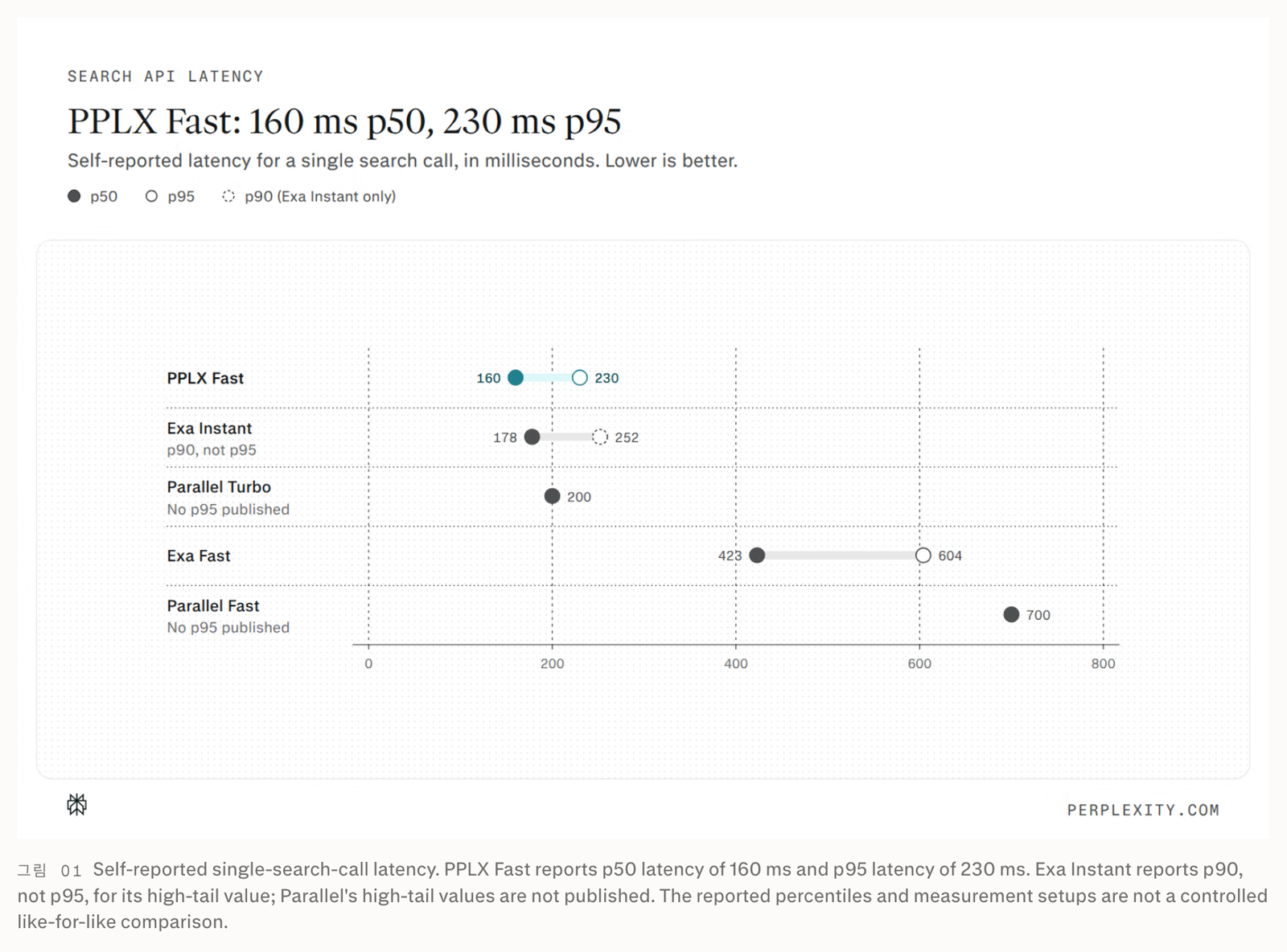
- Perplexity released Fast Search, an agent-focused Search API preset with a single-search latency of 160 ms at the median and 230 ms at the 95th percentile.
- Nous Research made Fast Search the default search in Hermes Agent and offers it free on every Nous Portal tier.
- The underlying engine, Photon, is a retrieval and ranking engine rewritten in Rust that cut 99th-percentile response time from about 800 ms to 65 ms.
Perplexity has released Fast Search, a Search API preset built for AI agents. A single search call takes 160 milliseconds at the median and 230 milliseconds at the 95th percentile, the point below which 95% of calls finish. On the same day, Nous Research switched the default search in its open-source agent Hermes Agent to Fast Search and made it free on every Nous Portal tier. Nous Research wrote on X that "web search in Hermes Agent is now fast and free," and the post passed 150,000 views in less than a day.
Behind Fast Search sits Photon, a search engine Perplexity built from scratch. According to an announcement on Perplexity's API forum, Photon is a Rust-based retrieval and ranking service built by a small team of engineers together with hundreds of agents. The engineering blog describes a small engineering team working alongside a swarm of persistent coding agents. The announcement says it returns 95% of search results in 230 milliseconds or less.
Speed matters for agent search because of call volume. A person runs one or two searches per question, but a research agent may chain dozens of searches to finish one task. Add a few hundred milliseconds to each call and the delay piles up across the whole task. In a self-reported chart Perplexity published, Fast Search's 160-millisecond median came in ahead of the figures rival search APIs report for themselves: Exa Instant at 178 milliseconds, Parallel Turbo at 200, Exa Fast at 423 and Parallel Fast at 700. The company noted in the chart caption that percentiles and measurement setups differ, so it is not a controlled like-for-like comparison.
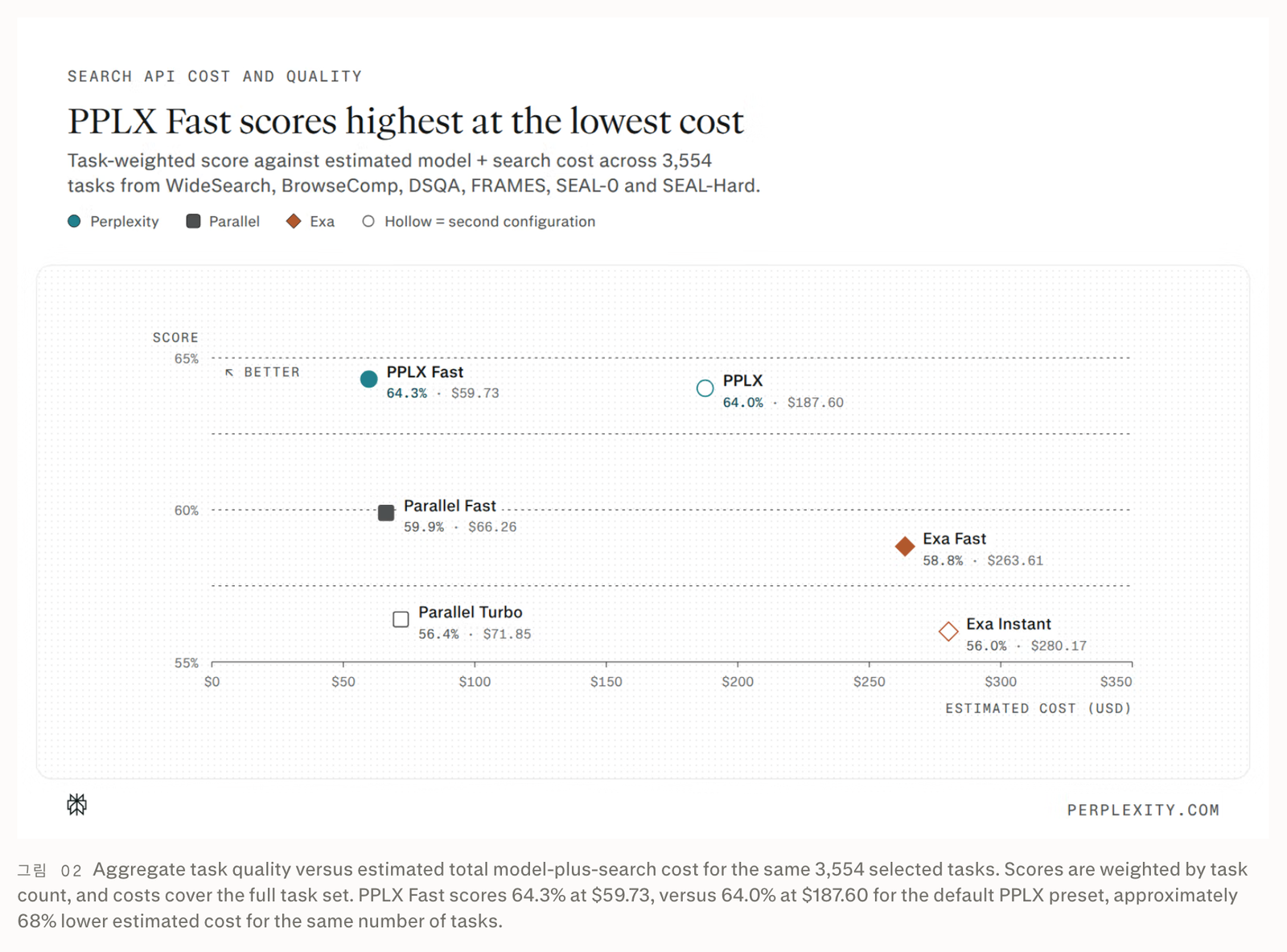
The cost numbers are bigger. Perplexity tested Fast Search on 3,554 tasks drawn from six agentic benchmarks: WideSearch, BrowseComp, DSQA, FRAMES, SEAL-0 and SEAL-Hard. The task-weighted score was nearly identical, 64.3% for Fast Search versus 64.0% for the default preset, while estimated total model-plus-search cost was about 68% lower with Fast Search. The company says it had the highest aggregate score and the lowest cost among the configurations tested.
The speed came from swapping out the engine entirely. Perplexity had been running an open-source search engine through its own fork. As the index and workloads grew, the blog says, it hit hard limits on cost, tail latency and node recovery time. The old system's 99th-percentile response time was about 800 milliseconds, and while the disk index was being merged it spiked to about 1.2 seconds for 10 to 15 minutes at a time. Bringing up a new cluster and synchronizing its data could take more than a week.
After the move to Photon, 99th-percentile response time in production fell to about 65 milliseconds. Photon uses about 20% fewer serving machines than the old system while storing about 2.5 times as much data per document. The company estimates that pinning the same dataset entirely in memory would need about 4.6 times the memory Photon uses today. Rebuilding the full web index now takes a single-digit number of hours, and in search verticals where freshness matters, documents reach the index within minutes.
The design principle is to read only what is needed. Each term keeps a list of the documents that contain it, and the storage format changes with the list's length and density. Ranking opens a single compact per-document record called a docblob and decodes only the parts that match the query terms. Records that must come from disk are requested in batches through Linux's io_uring so the waits overlap. Index building runs on separate machines from query serving, so building a new index no longer competes with live queries for CPU.
The rollout was staged. After load tests that replay search logs and offline quality evaluations, Perplexity sent live queries to both engines at once as shadow traffic to compare results. It then enabled Photon for small groups of users and widened the rollout until it handled all production traffic. The company says the first version passed acceptance testing without quality regressions.
Fast Search spends less compute on ranking than the default preset. On internal evaluations covering long-tail queries, broad coverage and result diversity, its relevance score is 0.24 points lower, 2.21 versus 2.45, and answer availability is about 3 percentage points lower. Perplexity argued that "the model's own reasoning and knowledge can help compensate for the difference, so we believe this is a sensible trade-off for agentic workflows." It added that "for more challenging or ambiguous questions that are less time-sensitive, the default preset offers more robust quality," recommending Fast Search only for day-to-day agent tasks.
The Perplexity Developers announcement METAL checked states that Fast Search is now the default search in Hermes Agent for Nous Portal subscribers. METAL has previously reported on Nous Research launching the Hermes plugin catalog and introducing Hermes Business and Enterprise plans. As the open-source agent grows into an enterprise product, this time it filled a basic capability, search, with outside infrastructure.
In the agent era, the search race is shifting from who finds more to who finds faster and cheaper. Perplexity says it is steadily moving its search infrastructure onto its own Rust-based stack, with Photon following CobbleDB and its Search API. The notable part of this announcement is less the numbers than how they were produced. A handful of engineers rebuilt a core engine from scratch with hundreds of agents, and that engine now supports another company's agents.
Sources
- Perplexity — Photon: Building a Retrieval and Ranking Engine From Scratch →
- Perplexity Developers (X) — Fast Search is now the default search in Hermes Agent for Nous Portal subscribers →
- Nous Research (X) — Web search in Hermes Agent is now fast and free →
- Perplexity API Platform Forum — Introducing Fast Search in the Perplexity Search API →


Comments