


Summary
- On September 28, OpenAI and the Lenfest Institute for Journalism announced the next phase of the AI Collaborative and Fellowship Program, with OpenAI doubling its support through $5 million in cash and up to $5 million in credits.
- Since its 2024 launch, AI engineers embedded at 11 US news organizations have built tools such as the archive search tool Dewey and the lead digest tool Scrape.
- The next cohort will bring in new news organizations and turn the strongest projects into reusable tools and playbooks for hundreds of newsrooms.
At The Philadelphia Inquirer, there was a task that took reporters roughly 15 hours a week: monitoring the newspaper's region for potential stories. That task is now a single daily digest of story leads sent by an AI monitoring tool called Scrape. The tool came out of the fellowship that brought the Inquirer its first full-time AI engineer, and the money for that fellowship came from OpenAI and Microsoft.
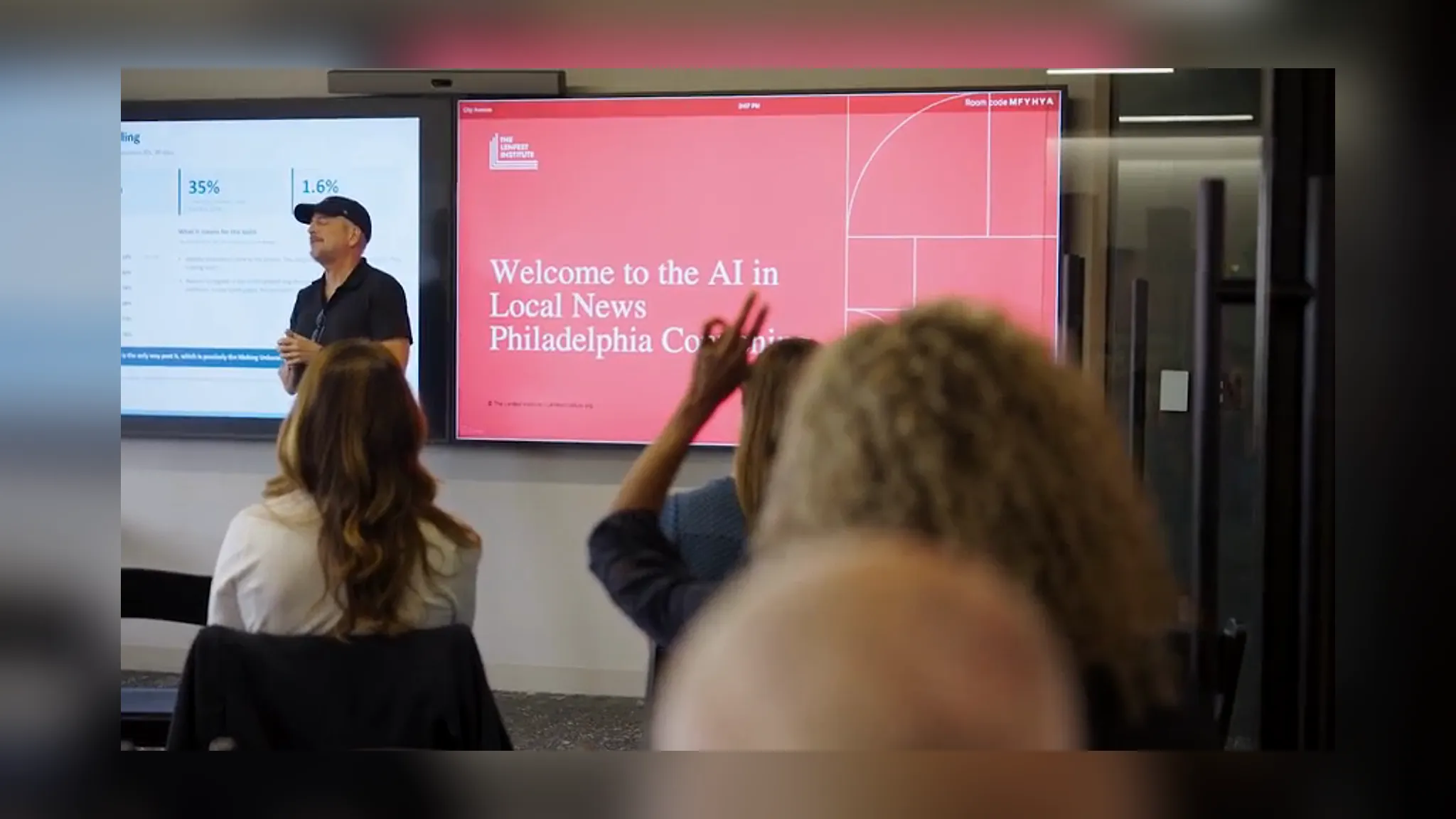
On September 28, OpenAI and the Lenfest Institute for Journalism issued a joint announcement on the next phase of the Lenfest AI Collaborative and Fellowship Program. OpenAI is making a new $5 million commitment in cash, along with up to $5 million in software credits and engineering support. The announcement said OpenAI has doubled its previous support and described the program as the largest AI fellowship program in American journalism.
The structure of the fellowship is simple. At its 2024 launch, it placed one full-time AI engineer at each of 11 major American news organizations for two years, working alongside newsroom leaders, reporters, product teams and revenue staff. According to reports, the first cohort was funded with $10 million, with OpenAI and Microsoft each contributing $2.5 million in cash and $2.5 million in credits. Microsoft began distributing its funds six months after OpenAI and has not yet decided whether to renew once that cycle ends in 2027. In this expansion, OpenAI alone is funding the same $10 million scale as the entire first cohort.
Two years of results span nearly every department of a newsroom. The Inquirer's Dewey is a tool for searching decades of archived reporting. According to reports, it has access to hundreds of thousands of articles dating back to the 1970s and has been used by investigative reporters for historical research, by political reporters to check whether public figures have flipped positions, and by crime reporters digging into a home linked to several missing persons. Chicago Public Media used AI-assisted translation workflows to publish time-sensitive Spanish-language coverage in a fraction of the time it used to take, and transcribed audio archives that had sat in storage for decades. Other participants applied AI to advertising prospecting, donor modeling, audience personalization, subscription growth, public-meeting monitoring and the transition from print to digital production.
"The most valuable lesson of the Lenfest AI Collaborative and Fellowship's first two years is that responsible AI adoption is less about the technology and more about trust," said Jim Friedlich, executive director and CEO of the Lenfest Institute. He added that the fellows drove culture change from the inside through clear guardrails, policy standards and open communication. "Local news plays a vital role in building the human connections that make a neighborhood, town, or city truly feel like a community," said Tom Rubin, OpenAI's Chief of Intellectual Property and Content. According to the announcement, several fellows are expected to stay on as full-time employees at multiple organizations.
Seen through a sociological lens, what this program validated was not a technology but a way of deploying people. The announcement said that rather than acting as outside consultants pushing AI adoption, locally hired engineers lived inside the organizations for two years and first learned how journalists work. As trust grew, journalists began bringing their own problems to the fellows, and the strongest projects started from a clearly defined problem rather than a predetermined technology. According to reports, Friedlich said the fellows are not employees of Lenfest, Microsoft or OpenAI, are free to use any technology they choose, and in every case were the first full-time AI employee at their news organization. The Inquirer also experiments with models not owned by OpenAI.
The tools traveled between newsrooms. The Baltimore Banner drew on the Inquirer team's work to build its own news discovery tools. According to reports, a Banner fellow sat down with the Inquirer engineer who built Dewey, walked through the code and adapted it, and a Chicago Public Media fellow built a version of Dewey for radio transcripts. Dewey is open source, so news organizations outside the program can use the code as well. Matt Boggie, chief technology and product officer at the Inquirer, pointed to processing more than 270,000 images in the photo archive and said, "They're only about five cents each, but that adds up," explaining that credits eased the cost of the prototyping stage.
The next phase changes the participants and turns results into shared infrastructure. Lenfest will invite new news organizations into the cohort and plans to refine the strongest projects into reusable tools, frameworks, plugins, implementation guides and playbooks for hundreds of news organizations. According to reports, at most half of the current 11 will be reaccepted, and the new cohort will also consider local TV news and statewide public service journalism. Lenfest is launching a newsletter called Context Window this week to share what fellows have learned, and has named Chase Davis, formerly of The Minnesota Star Tribune's AI Lab, as technical lead.
It also drew a line. According to reports, Lenfest will not invest in newsrooms that plan to use AI primarily to replace human reporting and writing. In the 5-minute-6-second video on the announcement page, Friedlich repeated the principle that "humans should be in the lead, not only in the loop," and said the 11 newsrooms created 50 AI projects in the past year alone. In the video METAL reviewed, he cited the late 1990s, when most American news organizations were caught off guard by the consumer internet and the economic gains went to non-news companies, and named the risk of history repeating itself as the program's starting point.
OpenAI's support for journalism has branched out this year. According to reports, in July OpenAI renewed its funding of the Product & AI Studio run by the American Journalism Project with $5 million in cash and $3 million in credits, and this month it donated more than 400 enterprise ChatGPT accounts to two journalism schools. METAL has reported on OpenAI supporting 10 Ukrainian media outlets with AI together with WAN-IFRA. Over the same period, American local news has been shrinking. According to reports, McClatchy laid off more than 90 union members across 70 publications this month.
The Inquirer's 15 weekly hours reduced to one daily digest of leads shows what this program is really selling. What mattered more than money and tokens was one engineer sitting next to reporters. According to reports, traffic declines from AI search are part of why American local news is contracting, yet money from the same AI company is also flowing into planting technical talent inside newsrooms. Whether local news can keep that talent will become clear after the credits run out.

Comments