


Image: METAL
Summary
- OpenAI said on X on September 27 that it had fixed an image-encoding bug that was degrading image understanding in GPT-6 Sol and GPT-6 Luna; its API changelog lists the fix under September 25.
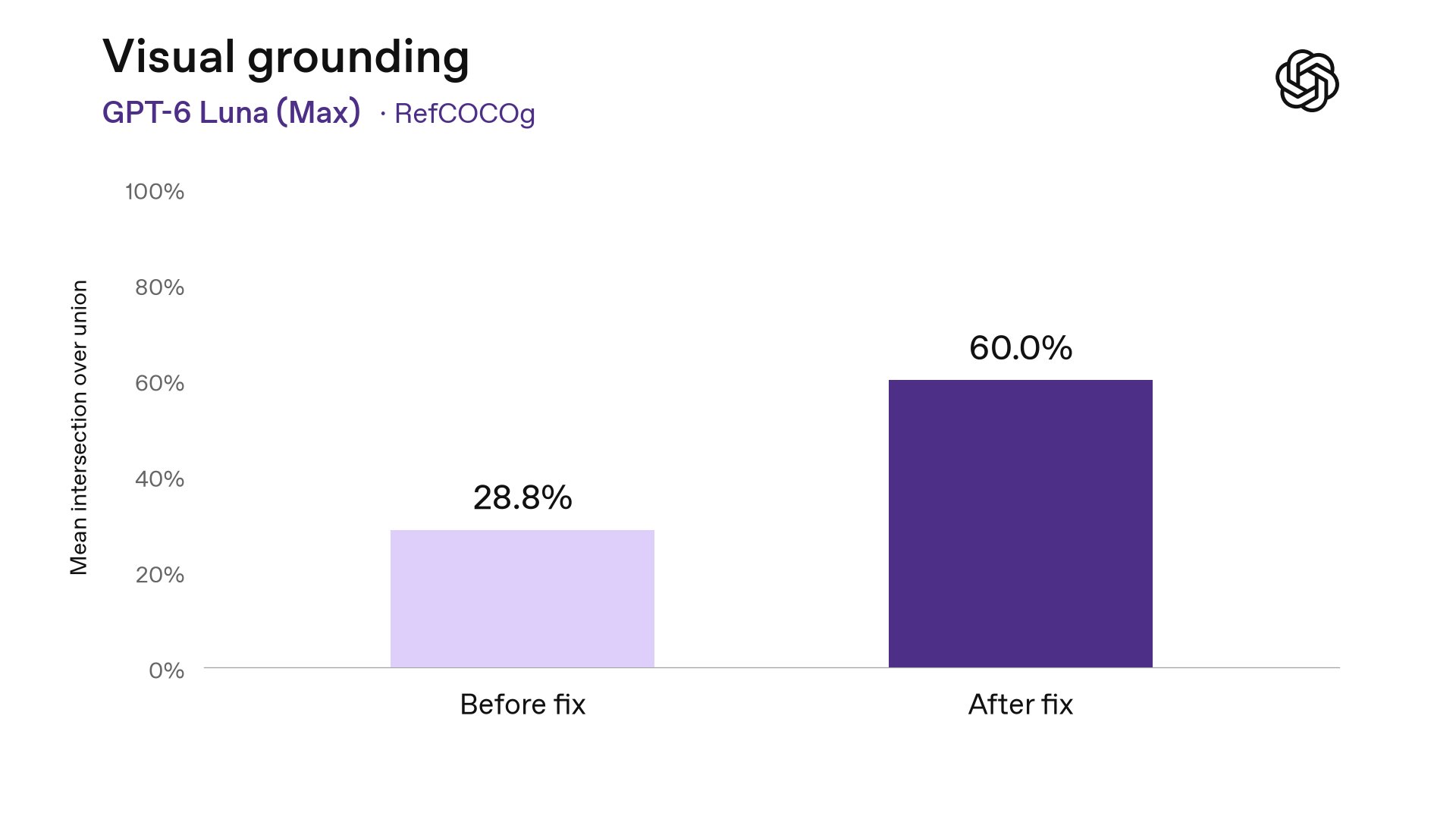
- In the chart OpenAI published, GPT-6 Luna (Max) scored 28.8% on RefCOCOg visual grounding (mean IoU) before the fix and 60.0% after it.
- OpenAI recommended that developers using image inputs rerun their evaluations and retry affected workflows. When it fixed an image-encoder bug in GPT-5.4 in March, it said no action was required.
OpenAI said on September 27 (US time) that it had fixed a bug that was degrading image understanding in GPT-6 Sol and GPT-6 Luna. The company's developer account wrote on X that users "should now see better results on visual tasks in the API and Codex, including computer use." In the chart posted alongside it, GPT-6 Luna (Max)'s visual grounding score more than doubled, from 28.8% before the fix to 60.0% after. The fix came five days after the two models launched.
The problem sat not in the model itself but at the entrance where images go in. OpenAI's API changelog, in an entry dated September 25, described the cause as "a bug in image encoding." The image encoder is the stage that turns pixels into internal representations the model can read. When that stage goes wrong, visual details such as text, buttons and screen layout reach the model already blurred, before any reasoning begins.
According to the changelog, the two models were released to the API on September 22 as gpt-6-sol and gpt-6-luna. They are reasoning models that take text and image inputs and produce text, available through the Responses API and the Chat Completions API. It took three days from launch to the dated fix entry and five days to the announcement on X. METAL previously reported on OpenAI's launch of GPT-6 Sol and Luna.
The chart METAL reviewed shows results on the RefCOCOg benchmark. RefCOCOg asks a model to find an object described in a sentence, such as "the red cup on the left table," and draw a box around it in a photo; the score is mean IoU, which measures how much the model's box overlaps the correct one. Going from 28.8% to 60.0% is a gain of 31.2 percentage points. Luna's result on this single benchmark is the only figure OpenAI disclosed; it did not give the size of the change for Sol.
The score matters because of how computer-use agents work. An agent looks at a screenshot and decides where to click. If its ability to match a sentence to an object's location was running at less than half its real level, it may have clicked the wrong button or confused input fields that much more often. In its launch announcement, OpenAI said GPT-6 Sol at xhigh effort scored 60.5% on the OSWorld 2.0 offline set, similar to Claude Opus 5 at medium effort (60.3%), at roughly 80% lower cost per task. Neither the announcement of the fix nor the changelog says whether those launch figures were affected by the bug.
What OpenAI asked users to do this time also stands out. The changelog says, "If your use cases involve image inputs, we recommend rerunning your evaluations and retrying workflows affected by the issue." A March 13 entry in the same changelog records a fix for a small image-encoder bug affecting input_image inputs in GPT-5.4, and at that time OpenAI wrote, "No action is required." Six months later a bug hit the same component again, and this time OpenAI asked developers to re-verify.
According to reports, the bug did not cause requests to fail. The models kept producing plausible answers, and developers saw lower-than-expected evaluation scores rather than error messages. The fix was made on the server side, so no code changes or model-version migration are needed, but responses, caches and stored evaluation records produced before the fix remain as they were. A post on the OpenAI Developer Community also said the improvements should show up in the API, Codex and computer use in the ChatGPT desktop app.
The two models reach a wide audience. According to OpenAI's launch announcement, GPT-6 Sol and Luna are available in ChatGPT Work and Codex for Plus, Pro, Business, Enterprise and Edu users, and Free and Go users can use Luna in the desktop app. OpenAI said it trained the two models with methods similar to GPT-6 Astra, carrying Astra's advances in professional work, coding and computer use into faster, cheaper models. Reports described Luna as the lower-cost tier built for high-volume work.
Seen through the eyes of an AI engineer, the episode shows that a change in the serving path can shake evaluations as much as a model swap. The model names stayed the same while the route images take into the model changed, so vision evaluations and model-selection decisions made between September 22 and 25 came from different conditions. Teams running agents now need to log run times alongside evaluation records and check them against fix entries in the changelog. That the same encoder component broke twice, in March and in September, is a signal to check the input-processing record in front of the model more often than the model's benchmark table.
Sources
- OpenAI Developers (X) — We've fixed a bug that was degrading image understanding in GPT-6 Sol and GPT-6 Luna →
- OpenAI Developer Community — OpenAI fix for GPT-6 Luna/Sol image understanding →
- AlphaSignal — OpenAI Patches GPT-6 Sol and Luna's Silent Image Understanding Bug →
- OpenAI — Introducing GPT-6 Sol and Luna →
- OpenAI — Changelog | OpenAI API →


Comments