


Summary
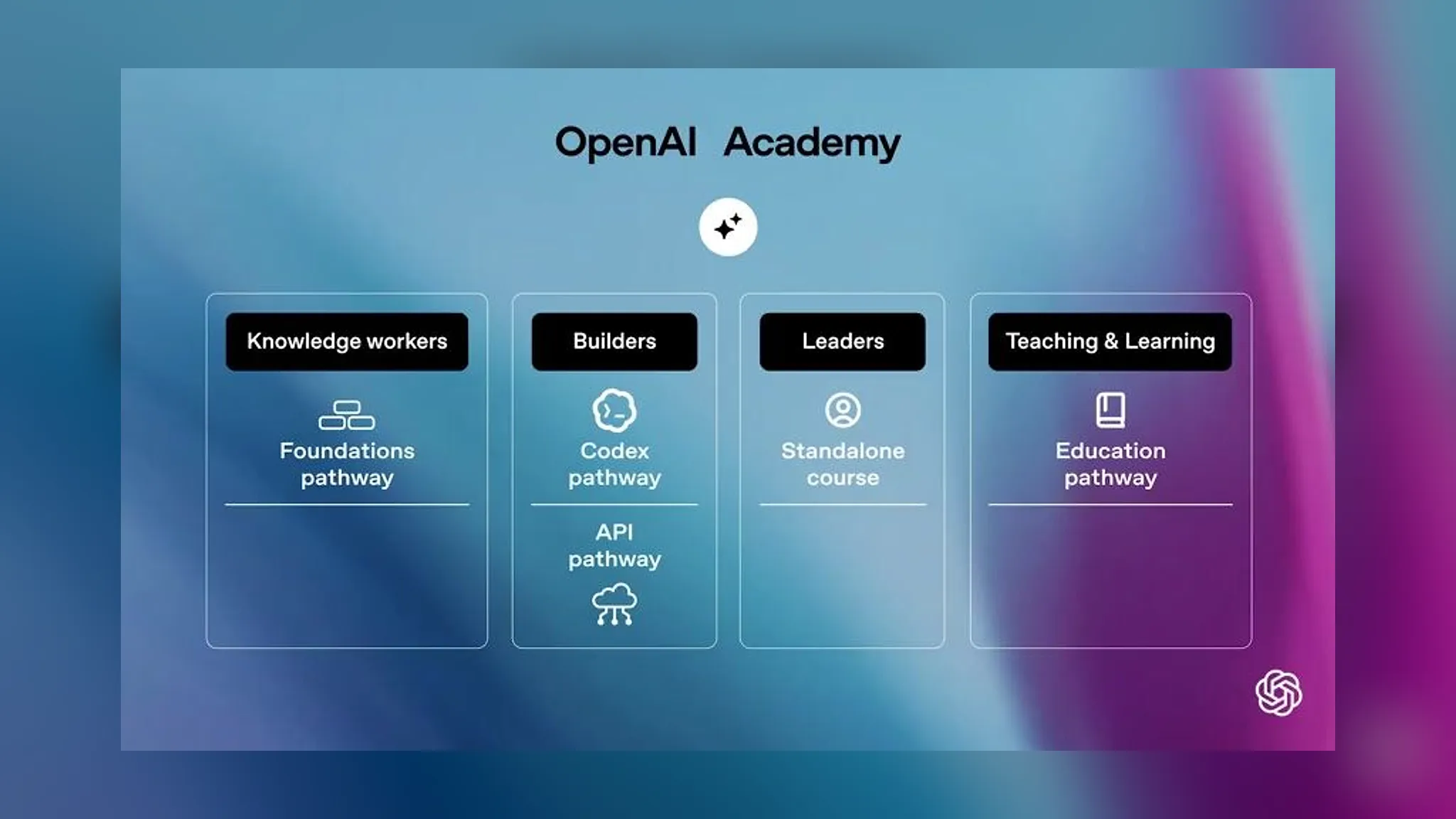
- OpenAI expanded OpenAI Academy courses on September 21 into developer, leader, educator, and college-student tracks.
- The four tracks are Apply AI at Work, Build with AI, Lead AI Adoption, and the educator/student courses, and passing the assessment earns a course badge.
- The company's 24-page enterprise AI report noted a gap in which the top 5% of workers send six times as many messages as the median worker.
OpenAI announced on September 21 that it opened job-specific learning tracks on its OpenAI Academy platform. Courses for developers, leaders, educators, and college students were added all at once, standing alongside the existing Apply AI at Work track. Learners who pass the course assessment earn an OpenAI Academy course badge. The company said in its announcement that it treats learning as part of deployment.
The premise behind the course design fits in one sentence. The announcement said OpenAI Academy courses are built on the idea that learning AI requires using AI. Learners bring real work, practicing by giving instructions, adding context, and reviewing the results. Organizations can mix Apply AI at Work with the developer, leader, educator, and student courses to build a combination that fits their team.
Apply AI at Work, aimed at knowledge workers, starts with the basics. Learners first practice giving clear instructions, adding the necessary context, and reviewing responses against the task, then turn what works into reusable workflows. The next stage hands agents bigger jobs, deciding what to delegate and where to place checkpoints and human review. The company explained that this track helps employees take on more complex work while still holding responsibility for the final result.
Build with AI, aimed at developers, targets technical teams that use Codex or build products with the OpenAI API. For developers, it teaches how to plan and implement changes across the software development cycle while maintaining control over review and quality. For teams building with the API, it covers solution design, evals, agents, relevant information retrieval, and running AI systems in production. The announcement said these courses are designed to move organizations from the experimentation stage to usable, reliable AI systems.
The AI Leadership course within Lead AI Adoption, aimed at leaders, is for people responsible for strategy, adoption, and change management. Learners connect a single project to business priorities, define ownership and governance, and build an initial AI strategy and roadmap for adoption. Where AI creates meaningful value, what to do first, who owns the work, and how to measure progress are the four questions the course poses.
The educator and student courses are the newest addition in this expansion. In AI for Educators, teachers plan lessons with materials they have rights to use, build activities and assessments, or refine guidance they send to students, teaching assistants, and colleagues. They review the responses against learning objectives, source material, and requirements, and teachers decide what goes into the classroom. AI for College Students covers turning readings and deadlines into a study plan, dividing roles on group assignments, checking drafts against assignment requirements, and preparing applications and interviews.
The official introduction video METAL reviewed puts this expansion's premise up front. The narration says, "AI adoption doesn't spread across an organization through access alone," and continues that it spreads when people have the capability to use AI in their work, build something with it, and lead change. The same video locates the bottleneck in people rather than tools, and presents the job-specific courses as the answer.
The company's enterprise AI report holds the answer to why job-specific tracks now. According to that 24-page report, which METAL counted page by page, OpenAI's business customers have topped one million and ChatGPT business seats have passed seven million. But the same report laid out a gap alongside those numbers. Workers in the top 5% of adoption intensity send six times as many messages as the median worker, and in coding, that gap widens to as much as 17 times.
Unused features also show up in the numbers. The report said 19% of monthly active users never used data analysis, 14% never used reasoning, and 12% never used search. Among daily active users, those shares drop to 3%, 1%, and 1% respectively. At the company level, too, the top 5% of companies send twice as many messages per seat as the median company, and seven times as many messages through GPTs. Ronnie Chatterji, OpenAI's chief economist, wrote in the report's foreword that "enterprise AI now appears to be entering this stage, with many of the world's largest and most complex organizations beginning to use AI as core infrastructure."
This expansion is the next step in a certification initiative that began on December 9 last year. At that time, the company launched AI Foundations, which runs inside ChatGPT, and ChatGPT Foundations for Teachers on Coursera, and announced a goal of certifying 10 million Americans by 2030. The pilot included Walmart, John Deere, Lowe's, Boston Consulting Group, Hearst, Upwork, Elevance Health, and Accenture, with Coursera, ETS, and Credly by Pearson handling learning design and measurement rigor. Arizona State University and the California State University system ran certification pilots for students and staff.
According to reporting, Kevin Mills, OpenAI's head of education and government GTM, said at the time, "AI is going to change jobs. Our challenge is to help students learn AI at the pace jobs are changing and be able to signal that capability to employers." In the same report, Leah Belsky, OpenAI's head of education, said the two courses connect learning, certification, and real economic opportunity into a single journey. The announcement also cited a figure that three in five teachers already use AI tools, along with an agreement with the American Federation of Teachers to equip 400,000 K-12 educators with practical AI skills.
The announcement also lays out how organizations can actually put this into practice. A company might add Apply AI at Work to new-hire onboarding, open Build with AI to developers and technical teams, and fold AI Leadership into executive, champion, or transformation programs. Educational institutions can pair AI Foundations with AI for Educators and AI for College Students. The company said its adoption guide, the OpenAI Academy Deployment Guide, includes recommendations on how to introduce the courses, involve leaders and managers, boost participation, and track progress.
METAL has reported that OpenAI, in releasing its second Ways of Working report, is widening the scope of tasks employees handle with AI. This expansion is an attempt to close the bottleneck that report pointed to with curriculum rather than new features. How much weight a single badge carries on a resume depends on whether employers read it as a signal, and Coursera, ETS, Credly by Pearson, and the companies that piloted the certifications stand at the point where that signal gets built. The enterprise AI report's conclusion is simpler still: the constraint on organizations is no longer model performance or tools, but organizational readiness. OpenAI has started filling that readiness gap with job-specific courses.


Comments