



Image: METAL
Summary
- Liquid AI released LFM2.5-VL-3B-DSpark, an experimental draft model for its vision-language model LFM2.5-VL-3B.
- Decoding runs up to 3.13x faster on an M5 Max and up to 2.66x faster on an H100, while the draft model adds only 8.9% more parameters.
- Vision encoding and prefill are not accelerated, so end-to-end gains top out at 2.62x and 2.27x.
Liquid AI has released LFM2.5-VL-3B-DSpark, an experimental draft model that attaches to its vision-language model LFM2.5-VL-3B. With this draft model for the vision model attached, decoding, the stage that generates text, runs up to 2.66 times faster on a single NVIDIA H100 and up to 3.13 times faster on an Apple M5 Max MacBook Pro. Measured end to end, from submitting a question to receiving the full answer, the gains are up to 2.27 times and 2.62 times respectively. The company says the output is the same as what the original model would produce on its own.
The technique is speculative decoding. A small draft model proposes several upcoming tokens, and the main model verifies them together in a single pass. Accepted tokens are kept, and the main model takes over from the first point of disagreement. Liquid AI released LFM2.5-DSpark for its text models in August and has now extended the same approach to a model that also reads images.
Liquid AI explained why handling images did not require a different method. The draft model takes hidden states from a fixed set of layers in the main model and uses them to propose the next block of tokens. Image patches and text tokens are converted into vectors of the same size before they reach those layers. The company wrote on its official blog that "from the drafter's perspective, the input modality is irrelevant," so the exact same inference algorithm used for its text models can be applied.
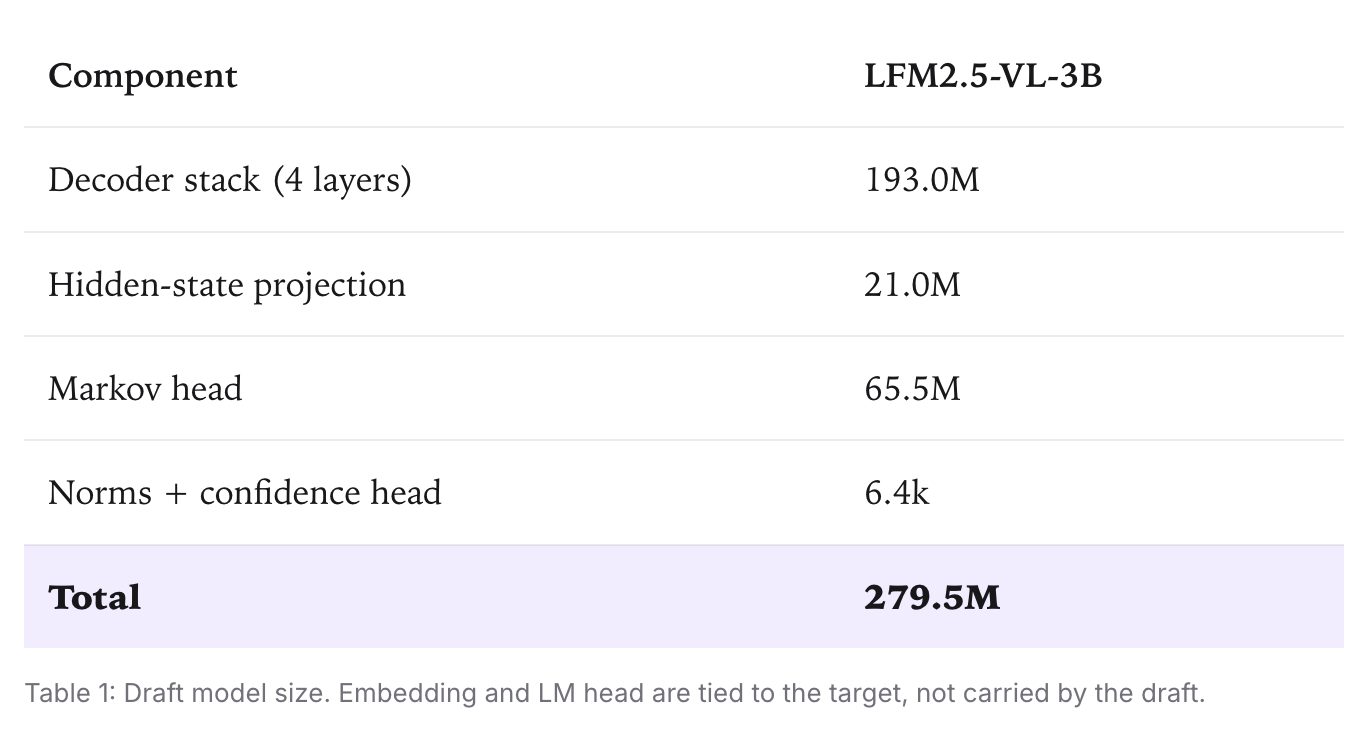
The draft model has 279.5 million parameters, adding just 8.9% on top of the 3-billion-parameter-class main model. The four decoder layers account for 193.0 million parameters, the hidden-state projection for 21.0 million and the Markov head for 65.5 million. The team settled on four layers after comparing three, four and five, and the block of tokens proposed at once during training is nine. Training used a mixture of vision-language supervised fine-tuning data for 10 epochs, and the company says all ablations and training runs were executed exclusively on AMD hardware.
Performance was measured on six tasks following the MMSpec benchmark: general visual question answering, text visual question answering, image captioning, chart question answering, complex reasoning and multi-turn conversation. Runs used batch size 1, temperature 0 and up to 2,048 output tokens, with a median answer length of 90 tokens. With MLX on the MacBook, decoding ran 2.30 to 3.13 times faster by task, and end to end 1.56 to 2.62 times faster. With llama.cpp on an M3 Ultra, decoding improved 1.57 to 2.14 times and end to end 1.30 to 1.77 times. With SGLang on the H100, decoding improved 2.04 to 2.66 times and end to end 1.64 to 2.27 times, with the main model accepting an average of 3.46 to 4.57 draft tokens per verification pass.
The differences by task are clear. In the model card table, the biggest speedup came on the COCO image captioning task: 3.13 times for decoding on the M5 Max and 2.66 times on the H100. Multi-turn conversation was the lowest, at 2.04 times on the H100 and 1.57 times on the M3 Ultra. The company's analysis is that how well the drafts match depends on the drafter and the workload rather than on the hardware or runtime.
There is a structural reason decode gains always exceed end-to-end gains. A vision-language model first passes the image through a vision encoder, then runs a prefill stage in which the language backbone reads hundreds of visual tokens alongside the text. Speculative decoding cannot shorten that stage. On devices with far less compute than datacenter GPUs, it takes up a larger share of the total time. Liquid AI explained this with Amdahl's law, noting that "when these stages already account for a substantial share of wall time, even a large decode speedup translates into only a modest end-to-end latency improvement."
Operating conditions also affect speed. Raising the temperature spreads probability toward lower-ranked candidate tokens where the drafter and main model are more likely to disagree, lowering both acceptance rate and throughput. In tests with higher concurrency, DSpark kept its throughput advantage at every level measured, though the gap narrowed. All figures are for 16-bit processing, and acceleration of quantized models is outside the scope of this release.
According to the Hugging Face model card METAL checked, the draft model is available in Safetensors and GGUF formats and runs from day one in llama.cpp, MLX-VLM and SGLang. SGLang requires v0.5.19 or newer and MLX-VLM v0.7.2 or newer. Measurements were collected with Pipette, the benchmarking infrastructure Liquid AI uses for its public device-performance data. METAL has previously reported on Liquid AI using DSpark draft models to speed up text-model decoding by up to 3.18 times.
For engineers, the value of this release is that a vision model can also produce the same answers faster with only a little more memory. Because the approach attaches a small model alongside the main one without retraining it, services already running LFM2.5-VL-3B can try it with a few lines of launch options. Still, for on-device tasks that give short answers about a single image, the design phase should weigh that perceived speed depends more on image encoding and prefill than on decoding.



Comments