


Image: Anthropic
Summary
- Anthropic has built a biology research team and its own lab, and it's unveiling ART, a new enzyme system Claude discovered.
- About 950 agents spent 21 hours and 210 million tokens combing through 200,000 reverse transcriptases before narrowing the field to 20 candidates.
- The system carries evenly spaced repeat arrays like CRISPR's, but what it actually does remains unknown.
Anthropic announced on September 23 that it has built a new biology research team and its own wet lab, releasing that team's first result alongside the news. A Claude agent searched a massive DNA database on its own and turned up an enzyme system nobody had catalogued before. The only human involvement was a single opening prompt and lab verification afterward — the agent decided on its own what to dig into in between. Anthropic named the system array-associated reverse transcriptase, or ART for short.
To see why this matters, it helps to know how genome mining normally works. Sequence databases double roughly every four years, long since outgrowing what humans can scan by hand, so automated pipelines do the searching instead. The catch is that those pipelines decide in advance what counts as novel. It's like an airport baggage scanner tuned only to spot knife shapes — anything strange that isn't a knife just slides through. So even the most systematic surveys end up depending on a human expert eyeballing results and flagging "that looks odd" — and that step hasn't been able to keep pace with how fast the data keeps growing.
What Anthropic did was hand that final step to an agent. It gave Claude a single prompt — go find interesting new examples of reverse transcriptases — and let it run. About 950 agents spent 21 hours and 210 million tokens combing the database. Along the way they gathered more than 200,000 reverse transcriptases, flagged 3,500 novel candidate systems, and narrowed the field to the 20 most promising, writing each one up in a human-readable report. Anthropic wrote that the same analysis would take a single expert weeks to months.

The pivotal moment came when one agent was reading straight through the raw DNA sequence near an oddly shaped reverse transcriptase, letter by letter. The session log captured the moment in these words: "The DNA next to the reverse transcriptase is incredible. I can see tandem repeats. Isn't that a CRISPR-like repeat array?" What it did next is the more interesting part. The agent counted the repeats, measured their spacing, compared the layout against known reverse transcriptase systems, searched the literature for papers reporting the same pattern, concluded it had found a new biological system, and filed a report for human review.
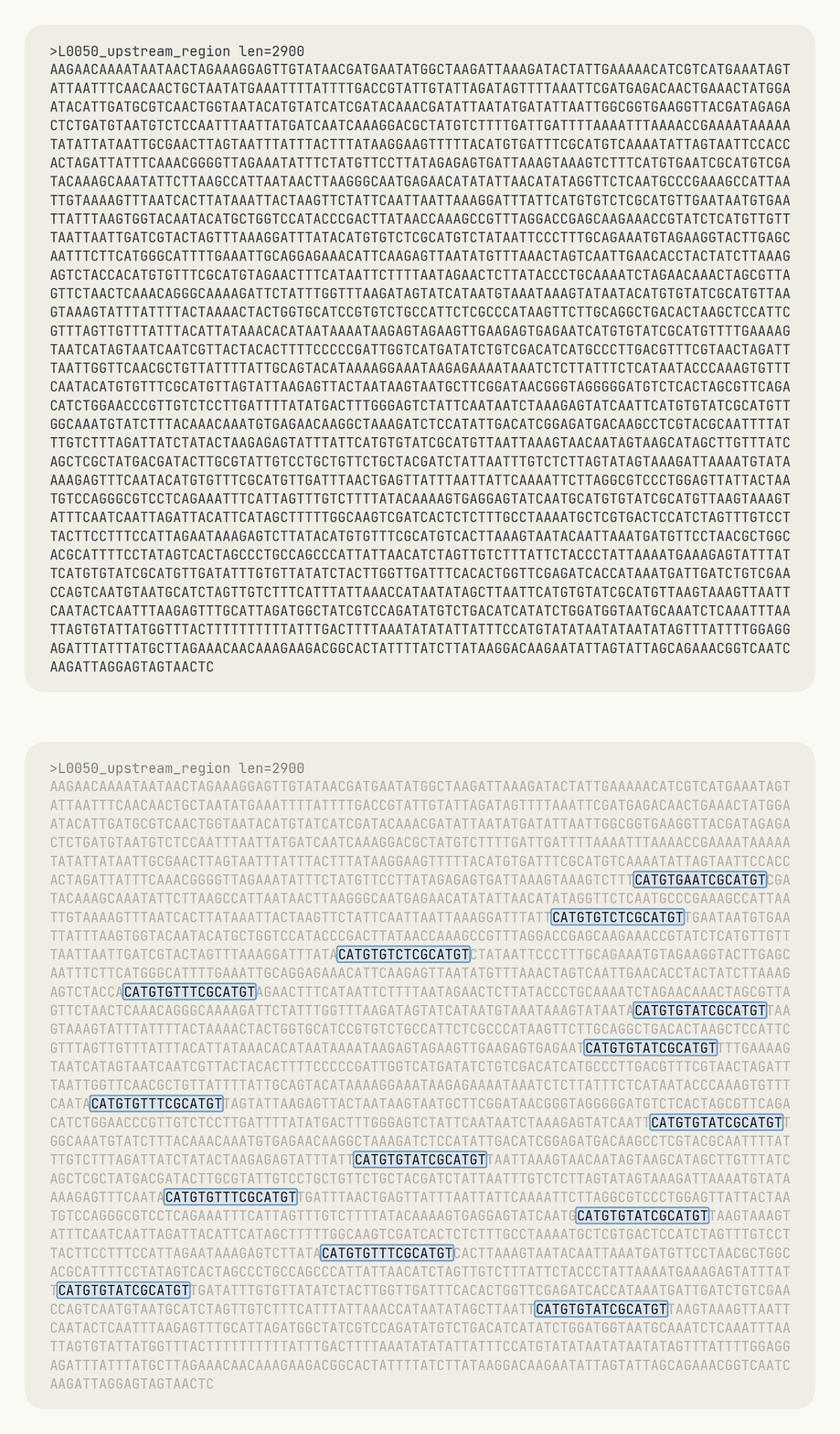
ART has three parts: the reverse transcriptase itself, a partner gene next to it, and a long, evenly spaced array of DNA repeats. It turns up mostly in bacteriophages — viruses that infect bacteria — and the key detail is that the repeat array looks like a CRISPR array. A CRISPR array works like a drawer holding different stored RNA sequences, which is exactly what lets CRISPR-Cas systems be pointed at a chosen target. Anthropic's first experiments confirmed that the ART array is also expressed as several short RNA fragments, and the team left open the possibility that something similar is at work here.
Still, nobody yet knows what this system actually does. Anthropic was explicit that identifying its function is a work in progress, and drew a clear line: the reverse transcriptase itself was already documented in prior research, and what Claude actually spotted for the first time was the combination — the adjacent array plus the extra protein. Feng Zhang, the MIT Broad Institute professor who pioneered CRISPR gene editing, read the preprint and said: "It's an interesting example showing that AI agents can contribute to biological discovery. Finding an RNA repeat array associated with a reverse transcriptase is really interesting and worth a closer look." That's an assessment with one sentence of enthusiasm and one of caution.
The lab itself is worth a look too. Based in the Bay Area, it looks like an ordinary molecular biology lab, working strictly within biosafety levels 1 and 2 and handling no pathogens that infect humans. And every experiment is still run by a human scientist. Anthropic said it did try using AI to speed up lab work, but that it didn't fit well with the improvisational workflow that molecular biology research demands. The agent's job is generating hypotheses; filtering them and confirming them by hand still belongs to humans.
One offhand line from the team sticks with you. Claude generates so many hypotheses that the hypotheses themselves have become an object of study. A single campaign can produce candidate reports numbering in the hundreds or thousands, so the team is now examining what separated the ones judged worth testing from the ones set aside, and feeding those criteria back into the instructions they give Claude. In effect, they're writing down what used to be called a researcher's intuition and teaching it to the model in words. This is the stage of handing over judgment, not just tool use — and that's what will determine what teams like this end up building next.
So what's actually valuable in this announcement isn't the ART enzyme itself. Future experiments will reveal what the enzyme does — or the question may never get fully resolved. What matters is that an agent, in 21 hours, did the thing long thought to require a trained human eye: pausing mid-scan to say, wait, that's odd. Restriction enzymes, Taq polymerase, and CRISPR itself all started the same way — with someone noticing something strange — and that's exactly why Anthropic didn't just build a model, it built a lab to go with it. The bottleneck has shifted from reading the data to how many hands are available to verify what gets found.



Comments