


Image: METAL
Summary
- The paper calls a profession's deep expertise a "cognitive commons": when a company replaces entry-level roles with AI, that company captures 100% of the efficiency gain while the cost of eroding expertise gets spread across the entire industry.
- Properly verifying AI output requires deep knowledge in that field — knowledge normally built during the entry-level years that are now disappearing. This "validation tether" is the paper's central idea, backed by data it cites showing employment for 22-to-25-year-olds fell 16% while employment for 35-to-49-year-olds rose more than 8%.
- Entry-level hiring cuts that began in 2023 won't show their full effect until 2030–2045. Rather than prescribing bans, the paper calls for investment: AI-free training tracks, phased adoption, and certification from professional associations.
When a company decides to skip hiring entry-level workers and hand that work to AI instead, the decision looks flawless — as long as you only look at that one company. Labor costs drop, output speeds up. A paper by Nolan Lovett of NATO's Special Operations University, published in the journal Human Resource Development Review, argues that this flawlessness is exactly the problem. The company makes the decision, but what that decision erodes isn't something the company owns — it's expertise the whole industry shares. Lovett gives this structure a name: the "tragedy of the cognitive commons." The Decoder covered the paper on August 15.
This piece goes a level deeper than that coverage. We'll walk through the four new concepts the paper introduces, the empirical numbers it leans on, the five criteria that separate professions likely to collapse first from those that won't, and its prescription — invest, don't ban. By the end, the question shifts from "is it okay to cut entry-level hiring" to "what exactly do we need to protect once we do."
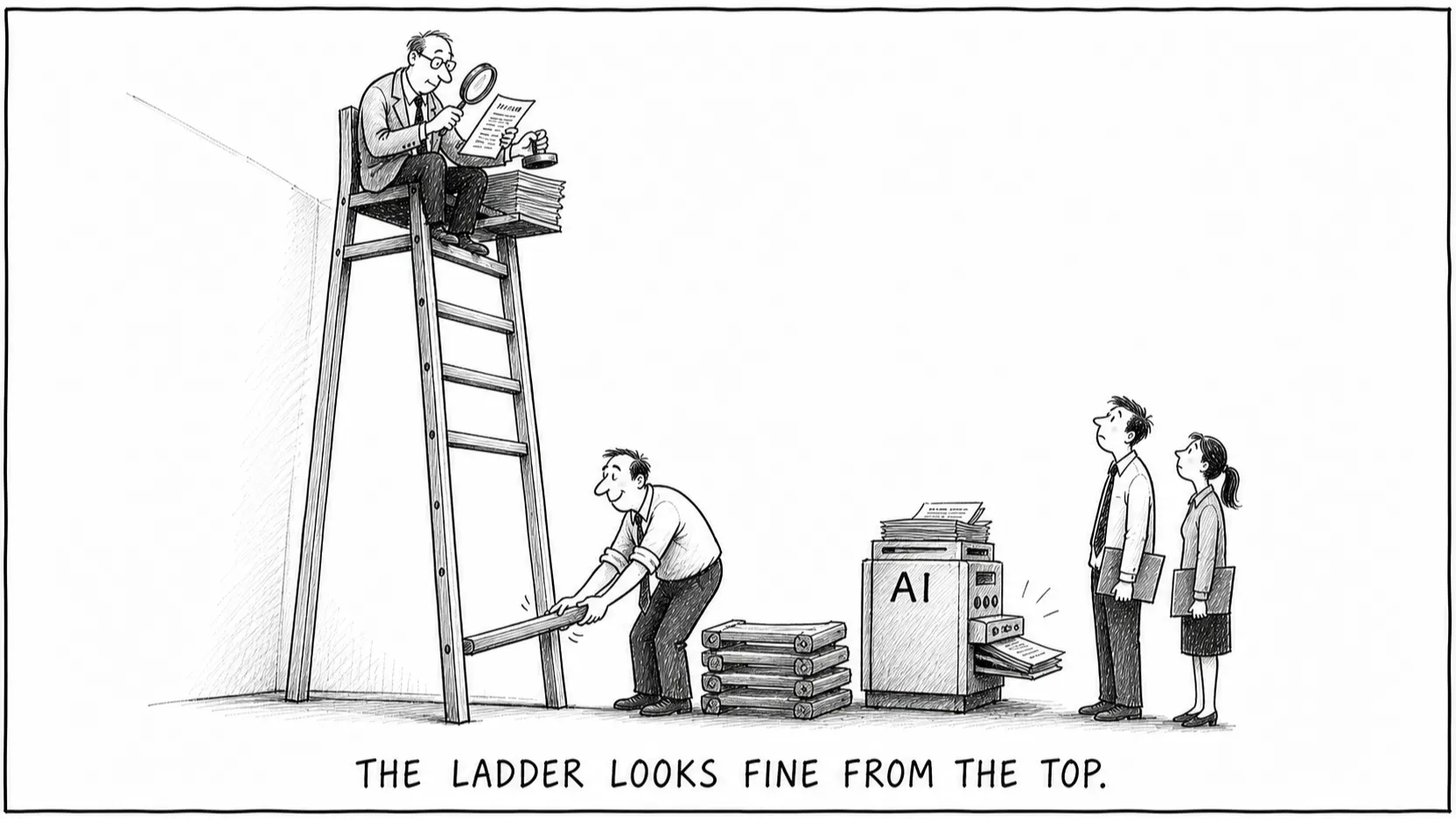
Put simply: the pool of people who genuinely know a profession isn't owned by any single company — it's a shared reservoir the whole industry draws from. Every company saving water by trimming its entry-level intake looks fine today. Ten years from now, there's no senior talent left to draw from that reservoir.
One More Cow on the Pasture, One Fewer Entry-Level Hire
In 1968, ecologist Garrett Hardin described herders each grazing one more cow on shared pastureland as the "tragedy of the commons." The gain from that extra cow goes entirely to the herder, while the cost — depleted grazing land — is shared by everyone. So adding more cattle is individually rational, and the pasture collapses. Lovett maps this structure onto AI adoption without changing a single element. In the paper's terms, companies capture 100% of the efficiency gains — lower payroll, lower training costs, faster turnaround — while the cost of eroding expertise gets distributed across every company that will eventually need experts in that field. The math always tilts toward "take" rather than "contribute."
What the paper calls the "cognitive commons" is the reservoir of people within a profession who hold deep domain knowledge, tacit skill, robust mental models, and the ability to judge independently. Nobody owns this reservoir. The reason a company can hire a professional with ten years of experience today is that other companies gave that person an entry-level job five to twenty years ago and absorbed the cost of their early mistakes. Every expert a company hires from the market was trained by someone else — and the paper's starting point is that this "someone else" is now disappearing.
Two Kinds of Expertise: Internalized Skill and AI-Wielding Skill
The paper's most carefully built section splits expertise into two categories. The first is internalized mastery — deep domain knowledge, diagnostic judgment, and pattern recognition built up through years of hands-on struggle. The second is distributed mastery — the ability to write good prompts, select among outputs, and design human-AI workflows that produce expert-level results. These are different capabilities, the paper argues, and the second cannot substitute for the first.
Why not? Lovett splits verification into two layers. Surface verification checks whether AI output is coherent, properly formatted, and plausible-sounding — something you can do without domain knowledge. Substantive verification catches errors that look plausible but are actually wrong — and only someone who independently knows the field can do that. The ability to properly oversee AI depends on substantive verification. But substantive verification depends on internalized mastery, which is precisely what erodes as AI adoption spreads. Lovett calls this loop the validation tether: the more you use AI, the weaker your ability to supervise it becomes.
The empirical evidence the paper attaches to this is uncomfortable. In a 2023 experiment by Vicente and Matute, 80.7% of participants noticed errors in biased AI recommendations — and followed the flawed advice anyway. Noticing a mistake and acting on it are different skills. A 2025 survey by Niederhoffer and colleagues found that 40% of full-time employees had received substantively wrong AI output in the past month, and fixing one such error took an average of nearly two hours. A separate 2025 survey by Benzing and colleagues found that 60% of employees trust AI answers enough that they don't routinely check them for accuracy. Fewer people are left to verify, while the habit of not verifying is spreading.

Two Paths to Disappearing Entry-Level Jobs
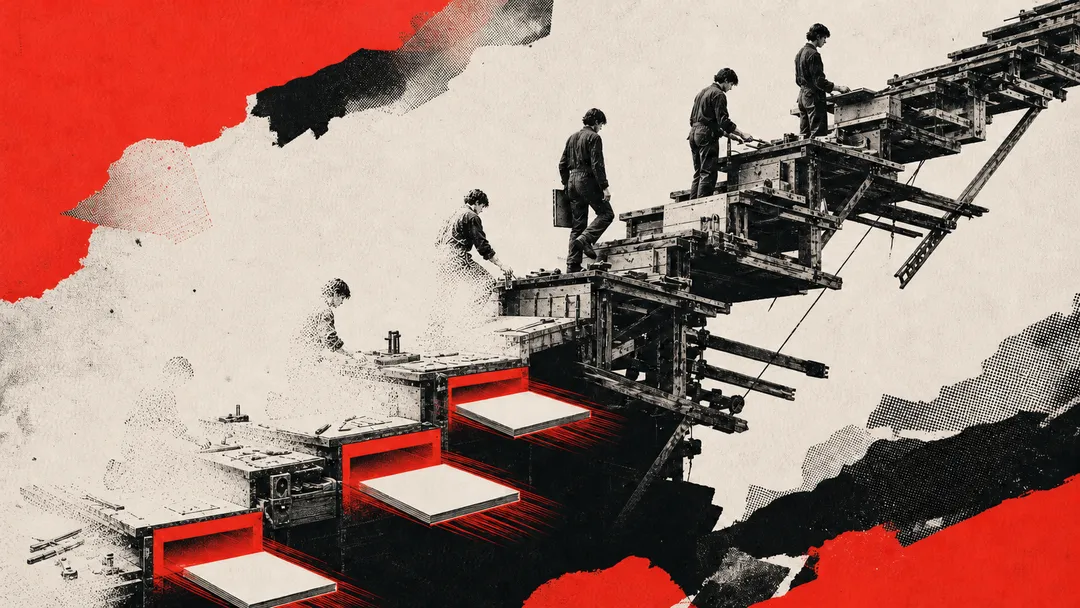
Lovett splits the erosion of expertise into two paths. The first is visible: AI absorbs the tasks that used to go to entry-level hires, and the job itself disappears. The second is subtler. Entry-level positions may still exist, but if a new hire using AI can immediately hit the productivity level that used to take years of experience, the company can do the same work with fewer entry-level hires. More importantly, that new hire becomes skilled at wielding AI while skipping the years of struggle that build internalized mastery. The paper calls this "augmentation without internalization."
For the first path, the paper cites a 2025 study by Brynjolfsson and colleagues. Analyzing payroll data for more than 25 million U.S. workers, they found that between October 2022 and September 2025, employment for 22-to-25-year-olds in AI-exposed occupations fell 16% relative to the baseline, while employment for 35-to-49-year-olds in the same occupations rose more than 8%. In occupations with low AI exposure, all age groups grew at similar rates. Hampole and colleagues found the same pattern using 58 million LinkedIn profiles. In other words, while the market for experienced workers looks healthy, the entry point is quietly closing.
Evidence for the second path comes from medicine and training environments. In a 2025 study by Bujin and colleagues, endoscopists who grew accustomed to AI-assisted detection performed worse without AI than they had before. In a 2024 study by Wiles and colleagues, participants who trained with AI assistance showed no meaningful advantage when evaluated without it. Kumar and colleagues, along with Bangel and colleagues, reported that skill barely transferred from AI-assisted ideation work — and the effect was strongest for tasks requiring domain judgment. Output improves, but the people producing it don't.
The Bill Arrives in 2030
The skilled professionals active in today's market were trained between 2003 and 2020. The paper takes direct aim at this lag. If companies started eliminating entry-level jobs in 2023, the market for experienced workers can look healthy for a while — because it's still cashing in on investments made two decades ago. The effect of skipped investment won't show up in the supply of experienced workers until sometime between 2030 and 2045, by which point the people who made the decisions responsible will be long gone from their posts.
Here Lovett introduces the human reserve paradox. Organizations need to stockpile expertise for verification, crisis response, and situations beyond AI's capabilities — but since the cost of stockpiling falls on one company while the benefit is shared industry-wide, there's no economic incentive to do it. A 2025 mathematical model by Daly reaches the same conclusion: a rational worker who expects AI assistance to continue invests less in their own human capital. And a company that protects its training pipeline ends up at a competitive disadvantage against companies that simply buy already-trained experts. The market rewards efficiency and punishes anyone who tries to protect the commons. That's why no single company, however well-intentioned, can solve this alone.

Which Professions Collapse First: Five Criteria
The most practical part of the paper is its claim that vulnerability varies by profession, and its identification of five factors that determine it.
| Criterion | Meaning | Higher vulnerability when |
|---|---|---|
| Task substitutability | How much of what entry-level workers used to learn AI can now take over | It's higher |
| Regulatory intensity | Whether documented human expertise and oversight are legally required | It's lower |
| Safety criticality | Whether failure produces an immediate, visible catastrophe | It's lower |
| Professional association strength | Whether an association can enforce training standards | It's weaker |
| Task modularity | Whether work breaks into AI-sized chunks | It breaks apart more easily |
By these criteria, software engineering, financial analysis, and legal research turn out to be the most vulnerable — highly substitutable, weakly regulated compared to medicine, and easily broken into modular pieces. Medicine and engineering, by contrast, are protected by institutional friction from regulation and safety criticality, and will see erosion that's slower but not absent. There's an interesting counterexample from medicine, too: a 2025 study by Everett and colleagues found that collaborative workflows, where physicians actively engage with AI's reasoning rather than just accepting it, actually improved diagnostic accuracy. A 2026 study by Dell'Acqua and colleagues found elite consultants became more productive on tasks within AI's capability range, but performed worse on tasks outside that range — precisely the tasks that require substantive verification. The real issue isn't whether a profession uses AI, but how — and how strongly its institutions enforce that "how."
Invest, Don't Ban: The Paper's Prescription
Lovett doesn't reach for regulation as a first answer. The paper explicitly states that "new regulatory requirements are not the primary response this framework suggests," and it isn't trying to resist AI adoption or roll training paths back to a pre-AI ideal. Instead, it offers prescriptions at three levels.
At the organizational level: cognitive reserve practices that give people an independent-performance period before introducing AI; phased adoption that respects developmental stages; AI-restricted learning spaces where early-career workers do deliberate practice without algorithmic help; and workflows where AI explanations arrive as questions rather than answers. At the professional-association level, the paper suggests experimenting with Elinor Ostrom's eight design principles for managing commons — defined boundaries, proportional costs and benefits, collective choice, monitoring, graduated sanctions, conflict resolution, the right to organize, and nested layers within larger systems. Concretely, that means voluntary tiered certifications that recognize internalized mastery without restricting AI use, and periodic AI-free assessments built into continuing education. At the policy level: training investment subsidies for occupations where AI has eliminated the activities that used to build skill, tax credits and matching funds for companies that protect training pipelines, competitive grants for associations willing to experiment, and research funding to determine which recovery paths actually work. In one line: invest, don't ban.
The paper is also candid about its limits. It describes itself as "a falsifiable account of where current incentives lead," not a claim that "the tragedy has already arrived" — the cognitive commons, it notes, remains healthy in most professions today. It also cites counter-evidence: a study by Humlum and Vestergaard finding no change in income or hours worked during the first two years of generative AI adoption in Denmark, and work by Manning and Aguirre showing that retraining potential varies widely by occupation and labor market. Including its own caveats alongside its warnings is part of what makes the paper credible.

What Organizations Can Do Now
Applying the paper's five criteria industry by industry puts software, finance, and legal research at the front of the line. Software, in particular, is a field where professional associations don't enforce training standards and work breaks easily into modular pieces — exactly where the paper's "institutional friction" is weakest. Medicine and construction/plant engineering, by contrast, will likely see slower erosion, since licensing and oversight practices are legally mandated there.
The paper's closing point is really about nations. Capabilities that can't be purchased from outside during a crisis — critical infrastructure, healthcare, cybersecurity — depend on a domestic reservoir of expertise, which is why policy should lean toward investment rather than bans. What companies can do right now is adopt the organizational-level prescriptions directly: keep some portion of AI-displaced work as a hands-on training track where people do the job start to finish themselves, and give substantive-verification authority over AI output specifically to people who've gone through that track. Skimping on this now means that in five or ten years, all that's left are organizations whose validation chain has already snapped.
If you've made it this far, it's clear why this paper stands out. It doesn't introduce new data — it gives an accurate name to something already happening, and follows that name all the way through to a prescription. The moment you call something a "commons," the nature of the problem changes. It stops being one company's hiring policy and becomes a shared resource the whole industry has to manage together — and the solution shifts from "everyone for themselves" to the grammar of collective management that Ostrom laid out.
This logic is already showing up in development teams. It's genuinely striking to watch a junior developer produce senior-level output using AI coding tools. But whether that junior developer can explain, a few years later, why the code was written that way or where it fails — that's a completely different question. The judgment that used to be built by chasing down bugs by hand is now being replaced by the habit of just letting AI's answer pass through. Output quality goes up while the number of people who can actually verify it goes down — that's the paradox. Vicente's 80.7% figure is the number behind that paradox: people who see the mistake and follow it anyway.
Warnings like this will keep coming in the years ahead, and the trend of cutting entry-level hiring won't stop on its own — problems whose effects aren't immediate always get pushed to the back of the line. Which is why the real value of this paper isn't prophecy. It's a checklist. How many of the five criteria light up red for your industry? Is there an AI-free training track in place? Who actually does the substantive verification? Organizations that can't answer these three questions will be the first, sometime in the 2030s, to hear the complaint: "You've got five years of experience and this is the best you can do?"
Sources
- The Decoder — The "tragedy of the cognitive commons" explains how rational AI adoption could destroy entire professions' expertise →
- arXiv — The Tragedy of the Cognitive Commons: How AI Could Disrupt the Regeneration of Professional Expertise →
- Human Resource Development Review — The Tragedy of the Cognitive Commons →




Comments