



Image: METAL
Summary
- Instinct is raising a $250 million Series B at a $2.5 billion valuation
- The valuation jumped fivefold in about three weeks from roughly $500 million in early August, even though the service remains a private beta open only to invited users
- Because the personal agent connects to email, documents, and calendars, the real test isn't product capability but whether users can trust its permission controls and data-deletion promises
Instinct's valuation jumped from just over $500 million in early August to $2.5 billion in only three weeks. A personal AI assistant that hasn't even launched publicly was revalued five times over in a matter of weeks. The Wall Street Journal reported that a $250 million Series B, co-led by Index Ventures and Benchmark, is underway, and once it closes, the company's total funding raised will hit $350 million.
What stands out here isn't the dollar amount — it's the speed. Capital piled in before users had a real chance to put the product through its paces, and on August 26, the day before the report, Instinct also revised its terms of service. The wider the scope of actions a product takes on a user's behalf, the more trust becomes an issue — and that's exactly the dynamic driving up this valuation.
Fivefold in three weeks
According to Forbes, Kleiner Perkins' Mamoon Hamid led a $75 million Series A round in early August, valuing the company at just over $500 million. About three weeks later, a new round involving Index Ventures and Benchmark set the bar at $2.5 billion.
| Timing | Funding stage | Amount | Valuation |
|---|---|---|---|
| Early August 2026 | Series A | $75 million | $500 million+ |
| Late August 2026 | Series B (in progress) | $250 million | $2.5 billion |
A valuation doesn't mean the company is actually generating that much revenue — it's simply the price investors agreed to in this particular deal. Instinct hasn't disclosed its user numbers or revenue, and the service remains a private beta available only to invited users. So this fivefold jump looks less like a reflection of performance and more like a bet on the company's shot at getting ahead in the personal-agent market.
A personal agent that skips the app
Instinct's pitch is that users don't need to learn a new app. According to the company, users hand off tasks by text or phone call, and Instinct handles things like following up on messages, booking airport rides, or scheduling repair appointments — drawing on connected data from email, messaging apps, screens, audio, and location. The company says it's keeping access limited to invited users while it scales up computing capacity.
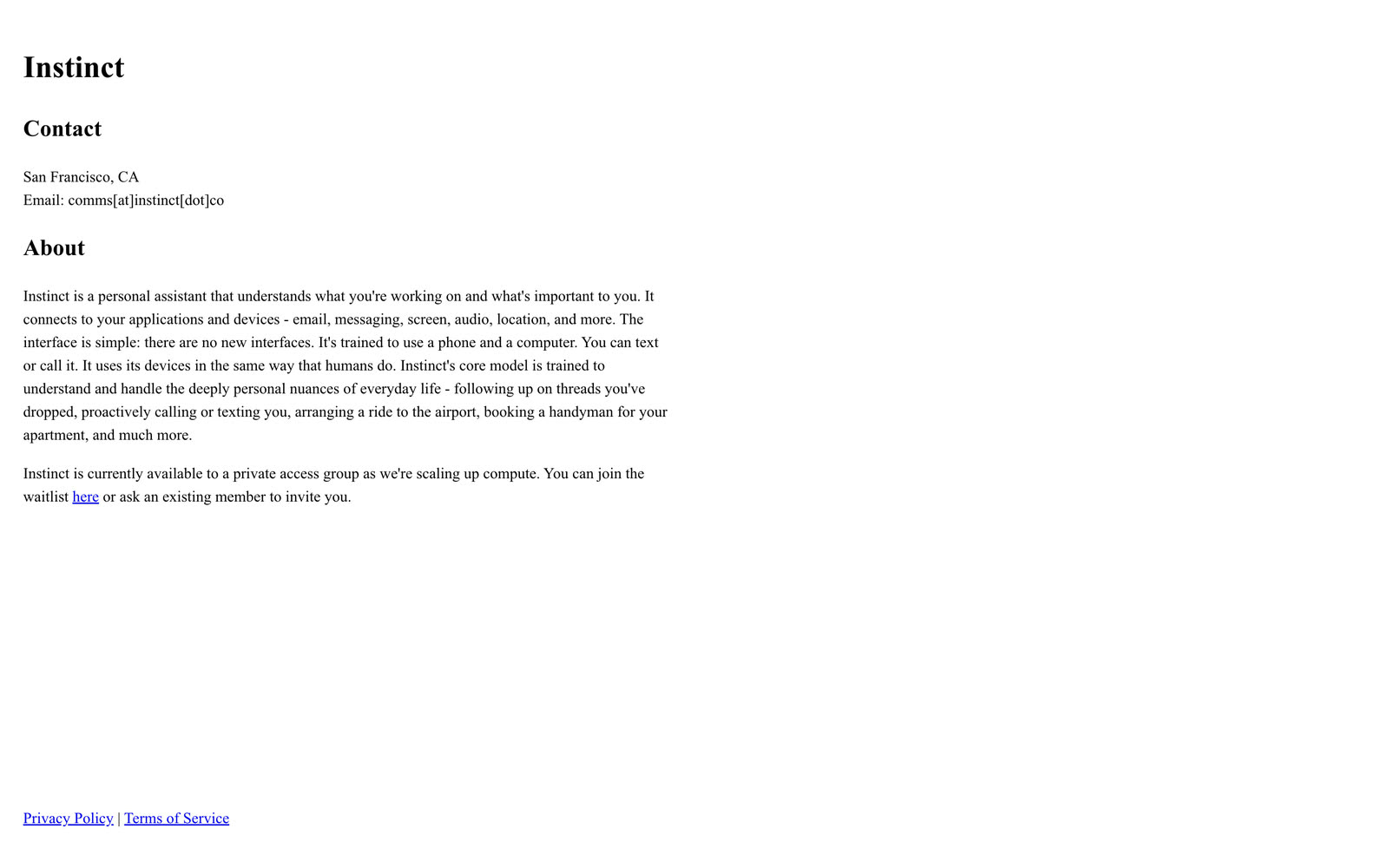
Instinct's official homepage describes connections to email, messaging, screens, audio, and location, along with its private-access status. Image: instinct.co
Founder Noah Shinn said early users have had Instinct plan cross-country trips, do grocery shopping, buy concert tickets, and cancel hundreds of dollars in unwanted subscriptions. One user reportedly had it help plan a wedding. These accounts come from the company and its early users, so they should be treated separately from independently verified results.
Trust arriving later than the capital
Agents like Instinct that take action on a user's behalf need far broader permissions than a chatbot that only generates answers. It's not enough to read an inbox — the agent has to send messages, make bookings, and even move through payment steps. The very access that makes the assistant convenient also widens the surface for security and privacy risks.
Early user reports compiled by METAL LAB on August 25 included cases where email deletion requests weren't honored, and where summaries kept appearing even after a user disconnected their account. The terms of service reported at the time also included language allowing permanent, irrevocable use of user data.
What changed in the August 26 terms
The current terms of service reflect an August 26 revision. That version no longer contains the earlier language about permanent, irrevocable licensing that drew criticism. Instead, it now states that users can opt out of having their data used for AI training through account settings, and that any material stored in Vault won't be used for training. The company hasn't said whether the revision was a direct response to the earlier criticism.
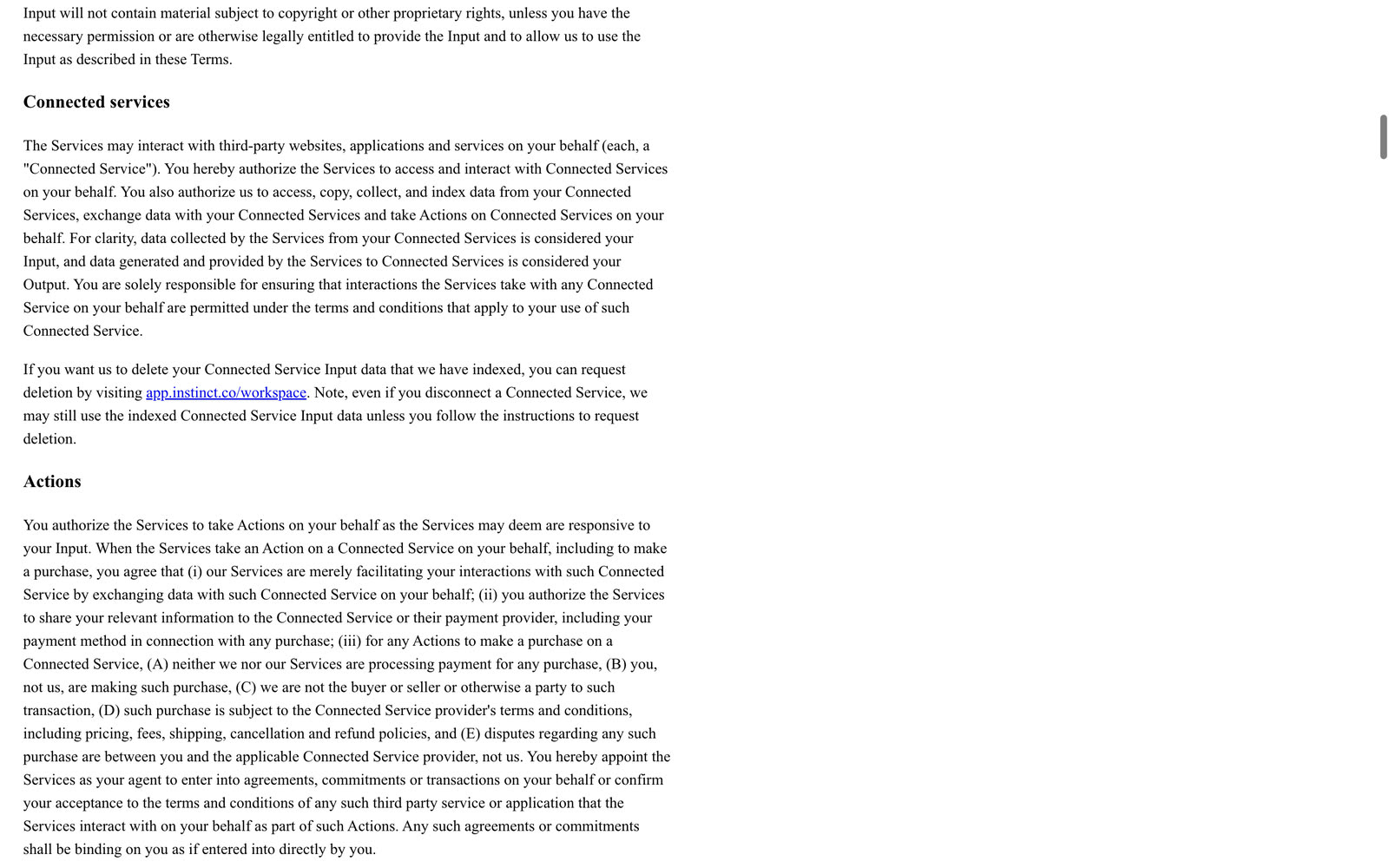
Instinct's August 26, 2026 terms of service state that disconnecting a linked service alone does not delete already-indexed data — a separate deletion request is required. Image: instinct.co
Not every concern has been resolved. Disconnecting a linked service doesn't automatically delete data that's already been indexed — users still have to go through a separate deletion process. Opting out of training only applies going forward; models already improved using earlier data remain in use. The terms also still include a clause allowing Instinct to agree to contracts or transactions on a user's behalf, with the outcome legally binding on the user.
Editor's take
This round is a signal that competition in the personal-agent space is now moving faster than product launches themselves. A fivefold revaluation in three weeks suggests investors see agents that can act across email and devices as the next major point of user contact. That said, which use cases actually drove the investment decision hasn't been disclosed, so it's hard to say for certain what convinced the investors.
Instinct revised its terms and spelled out procedures for deletion requests and opting out of training. At the same time, it kept the core structure intact: disconnecting alone doesn't erase data, and the agent can still take legally binding actions on a user's behalf. This looks less like resolving the controversy and more like redrawing the line around what users now have to handle themselves.
Funding can scale up computing capacity and expand invitations quickly. But the kind of trust needed to hand over an inbox and payment permissions can't be bought at the same speed. Whether that $2.5 billion valuation holds up will depend on whether trust safeguards can be proven as fast as the capital has moved.
Sources
- wsj.com — The Latest Viral AI Assistant Rocketing Across Silicon Valley →
- Techmeme — AI assistant Instinct is raising a $250M Series B co-led by Index Ventures and Benchmark at a $2.5B valuation, bringing its total raised to $350M (Kate Clark/Wall Street Journal) →
- TechCrunch AI — Viral AI startup Instinct has raised $350 million at a $2.5 billion valuation →


Comments