


Summary
- OpenAI published an engineering blog detailing the real-time architecture behind GPT-Live, its third-generation voice system.
- A full-duplex voice model replaces the turn detector, while deep reasoning is offloaded asynchronously to GPT-5.5 to keep conversation flowing.
- Its self-developed WARP protocol cuts WebRTC connection round trips from six to one and is now going through IETF standardization.
"Hey Siri," "Hey Google" — anyone who has talked to a voice assistant knows the frustration well: it cuts in before you finish speaking, or falls into an awkward silence after you're done. In an engineering blog published on August 3 (local time), OpenAI explained where that frustration comes from — and how it spent the past six months tearing the system down to get rid of it.
From walkie-talkie to phone call
Voice AI up to now has worked like a walkie-talkie. With a walkie-talkie, one person has to finish speaking and say "over" before the other can respond. Voice AI worked the same way: a small model called a "turn detector" first had to guess whether the user had finished speaking, and only after that judgment was made would the main model start generating a response. The problem is that this guess is inherently hard to get right. Decide too fast, and you cut the user off; decide too slow, and the response feels sluggish. Machines couldn't keep up with the rhythm of natural human conversation, where turns pass back and forth in fractions of a second.
OpenAI's third-generation voice system, GPT-Live, turns that walkie-talkie into a phone call. The core of this shift is "full-duplex" — a voice model that can listen and speak at the same time. Just as we can say "uh-huh, right" while someone else is talking on a phone call without breaking the flow of conversation, GPT-Live removes the turn detector — the intermediate judgment step — from the audio pathway entirely. Even when speech overlaps or someone interrupts, the conversation keeps flowing.
Separating the talking brain from the thinking brain
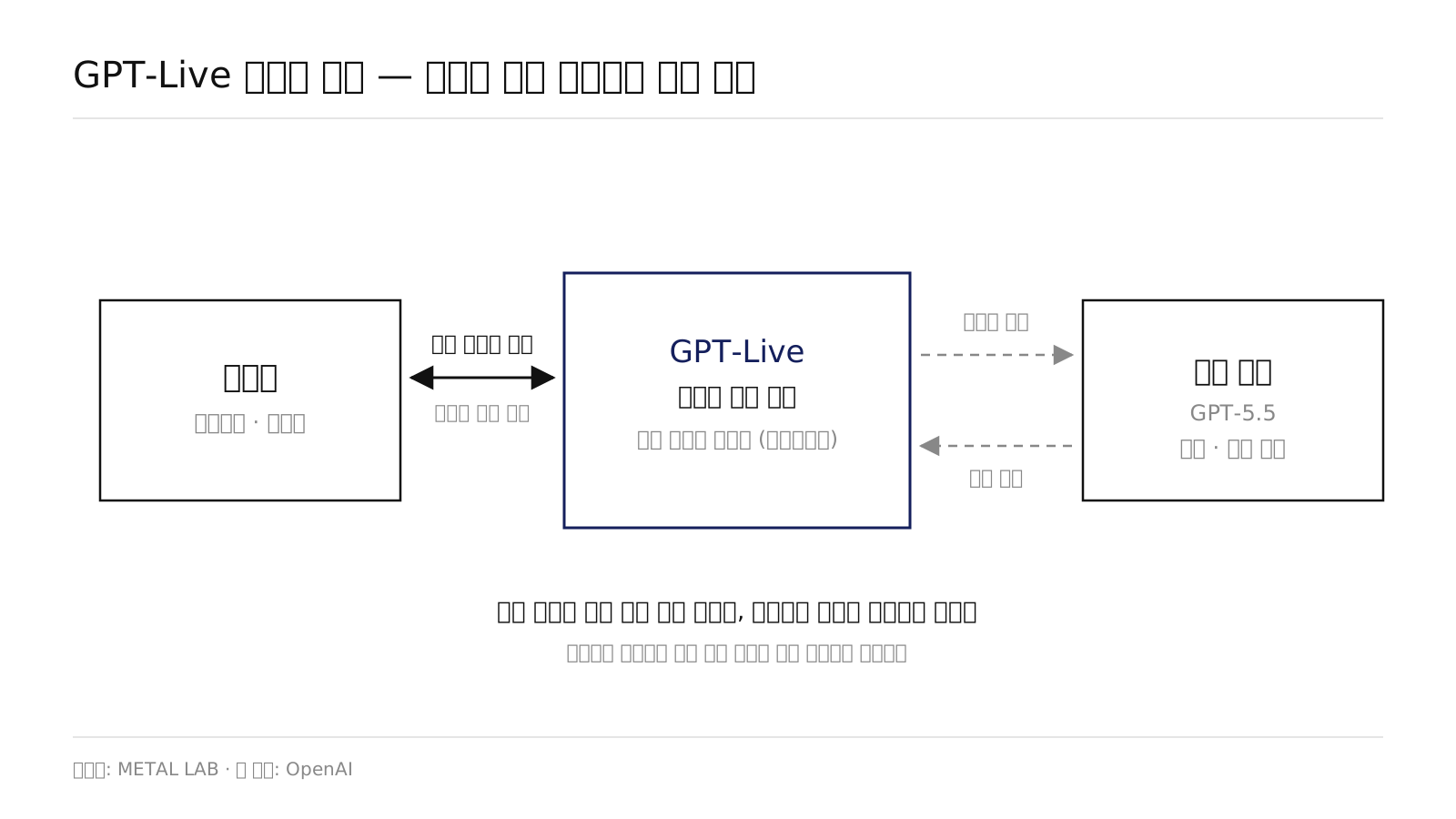
But responding quickly and thinking deeply pull in opposite directions. A model optimized for instant answers tends to go shallow on hard questions. OpenAI's solution resembles division of labor at a call center. The agent who picks up the phone (the voice model) keeps the conversation with the customer going, and when a tough question comes up, passes a note to the specialist sitting in the back (a frontier model like GPT-5.5). While the specialist looks up information and drafts an answer, the agent keeps the conversation alive by saying things like "Sure, let me check that for you."
Technically, this is called "asynchronous delegation." Audio travels only through a dedicated high-speed channel between the client and the voice model, while search, tool calls, and deep reasoning are handled on a separate path. A slow search can delay its own results, but it cannot stop the flow of the voice itself. The original post also includes an actual voice demo (audio) showing GPT-Live keeping the conversation going naturally while GPT-5.5 searches in the background — you can listen to it directly in the original post.
How to swap the wheels on a moving car
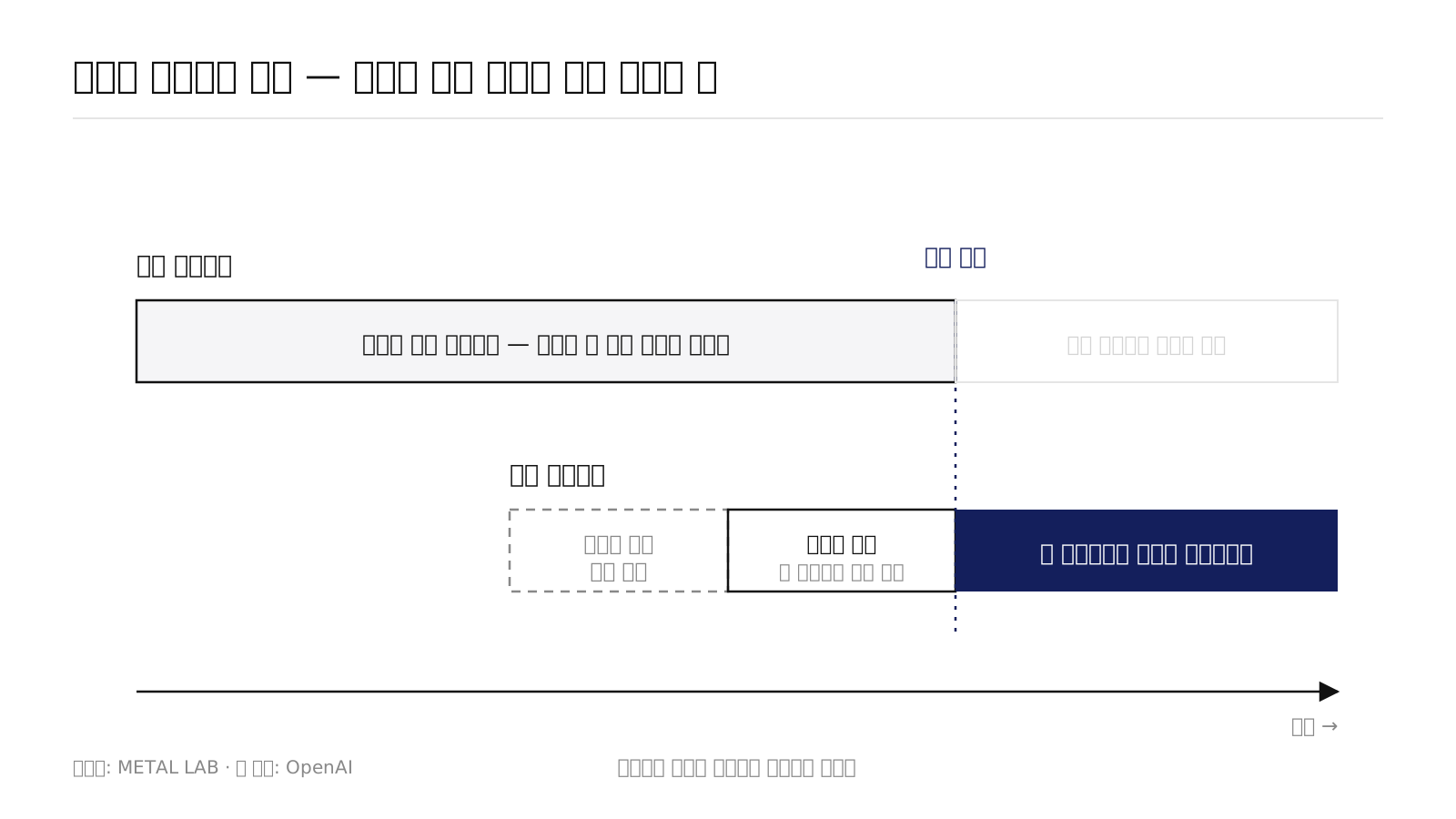
Long calls bring another problem. The longer a conversation runs, the more context the model has to remember, and eventually that context exceeds its limit. Compressing the context solves the overflow, but the conversation can't simply pause while compression happens.
OpenAI's solution is to swap the wheels on a car without stopping it. While the existing model instance keeps the conversation going, a replacement instance loaded with the compressed context is warmed up in the background. The two instances run side by side briefly, and the moment the new one is fully ready, the system switches over silently. The person on the call notices nothing.
There was also a rewrite purely for performance. The media processing code was rewritten from Python to Go, and according to OpenAI, the slowest tail (p95) of the new system now matches the median (p50) of the old system. In other words, what used to be "typical" is now the new "worst case."
Six hotel check-ins become one face-pass entry
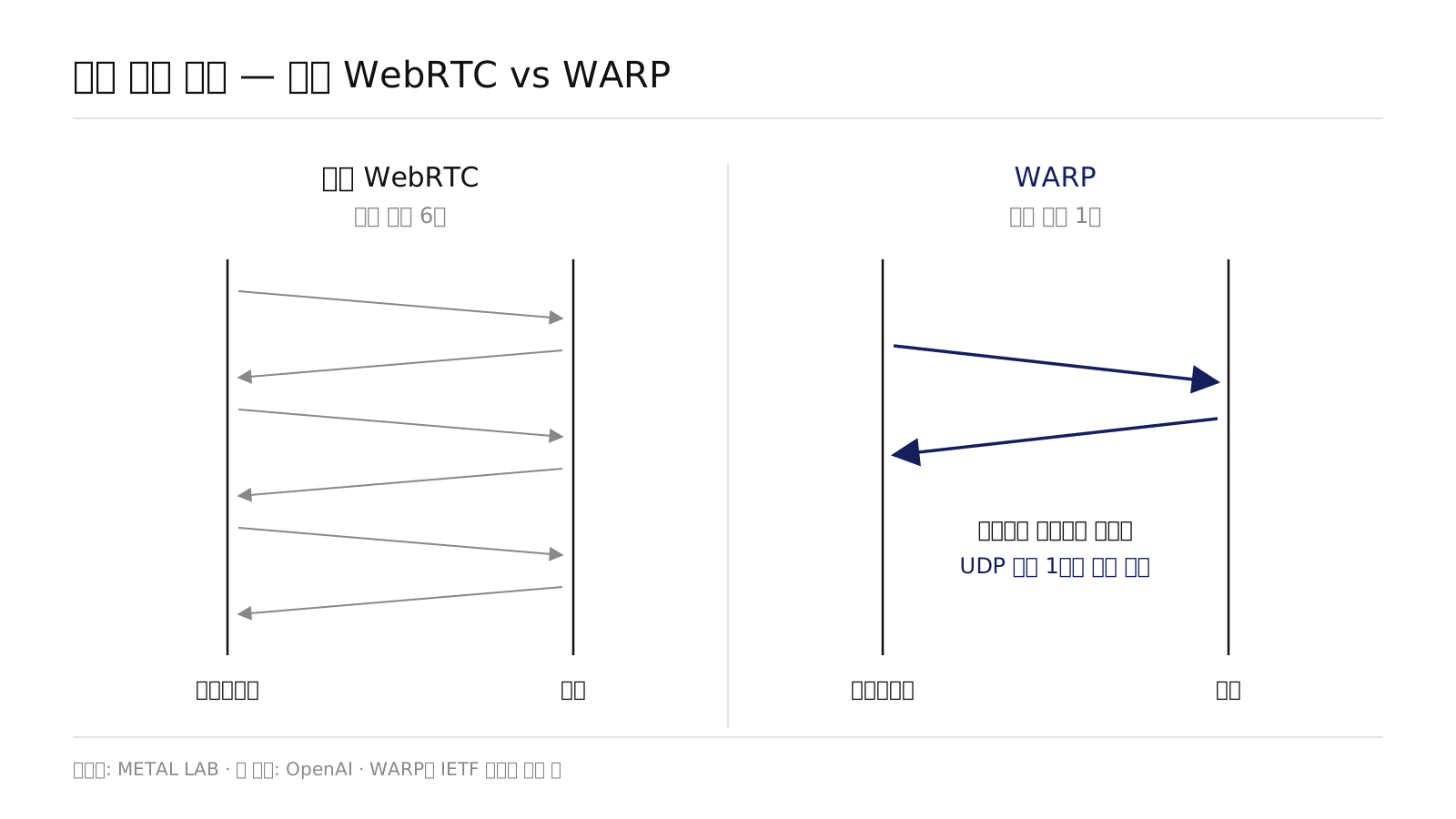
Responsiveness starts the moment you press the call button. WebRTC, the standard technology for voice connections, is reliable but required six round trips between client and server just to start a single session. It's similar to checking your passport, signing paperwork, and registering your card every single time you enter a hotel.
OpenAI took this process apart and built a protocol called WARP (WebRTC Abridged Roundtrip Protocol) that cuts those six round trips down to one. It's the equivalent of a pre-registered face pass that opens the door instantly. Add "Instant Connect," which pre-negotiates connection information in advance, and the client can start a call with a single UDP packet. Notably, OpenAI isn't keeping WARP as a proprietary secret weapon — it designed the protocol as an open specification and is currently pursuing IETF standardization. Support has already been added to open-source implementations libwebrtc and Pion.
A rehearsal the audience never knew about
Before launch, the new system was validated in an unusual way. Portions of real ChatGPT voice users' calls were streamed simultaneously to both the old and new systems, but users only ever heard the old system's voice. It was effectively a backstage rehearsal run on real audience sound before the actual performance.
This "shadow testing" revealed gaps between paper calculations and reality. Capacity bottlenecks turned out to originate first not from GPUs, as expected, but from CPU-side stream processing and network paths, and the physical distance between user and server was confirmed as the primary variable driving latency. The process also caught defects that only surface on long calls — memory pressure over extended conversations, and state-restoration issues after reconnection — the kind of flaws that short load tests would never catch.
Editor's view — three years of hands-on use
Numbers alone won't explain why this announcement matters; personal experience over time does a better job. Since ChatGPT's voice mode first appeared in the fall of 2023, this editor has used every generation of it for making YouTube content and demonstrating AI in lectures.
The first generation (2023) honestly wasn't a conversation at all. Ask a question and you'd sit through 3 to 5 seconds of silence before the answer even began. OpenAI itself has disclosed average latency at the time of 2.8 seconds for GPT-3.5 and 5.4 seconds for GPT-4. Once you understand the architecture, the numbers make sense — every exchange had to pass through three sequential stages: transcribing speech to text, generating a text answer with an LLM, then reading that text aloud. More than once, during a live lecture demo, I had to fill the silence myself by saying "It's thinking right now." It was closer to voice-based search than to conversation.
With the second generation, Advanced Voice Mode (2024, GPT-4o), it felt like a "conversation" for the first time. As the model began understanding audio directly instead of converting speech to text first, average response time dropped to around 0.3 seconds, and the voice carried emotion and intonation. But the more I used it, the more an awkwardness lingered. If I said something like "oh, I see" just to acknowledge what the other person was saying, the AI would mistake it for an interruption and abruptly cut off. Conversely, if I paused briefly to gather my thoughts, it would assume I was done and jump in too soon with an answer. This problem stood out even more clearly when I had it converse with a guest and myself, three-way, during filming — the machine alone couldn't keep pace with the natural back-and-forth rhythm between two humans. It was only after reading this announcement that I understood the root cause lay in the "turn detector" structure itself. The model wasn't slow-witted — under a walkie-talkie architecture, no model, however good, could have behaved any differently.
And the third generation, GPT-Live, abandons that structure entirely. The fact that the flow holds up even when speech overlaps isn't because the model got quicker on the uptake — it's because the underlying plumbing was replaced with one that has no reason to break in the first place. If you compress three years of change into one line: the first generation was a problem of intelligence, the second was a problem of speed, and only with the third has the "structure of conversation" itself finally been solved.
There's a practical lesson in this experience. The gap between the smoothness of a demo video and the reality of actual use almost always comes down to plumbing — latency, dropouts, awkward silences — not model intelligence, as this piece makes clear. It's common to see domestic companies evaluating voice interfaces focus entirely on which model to use while pushing the transport layer aside as a telecom carrier's problem, but this announcement shows that priority is backwards. That's also why a company at OpenAI's level chose to spend six months' worth of disclosure not bragging about its model, but recounting its failures and fixes in plumbing.
One final point on direction. This architecture is already the foundation on which ChatGPT's voice capability is expanding beyond conversation into computer control and agent orchestration, and a GPT-Live API built on the same architecture has been previewed. The picture emerging is one where voice becomes not a secondary input for AI but the primary interface for commanding agents. Conversation as natural as a phone call was the precondition for that. This is why this moment can be read as the gateway to an era of getting work done by speech alone, with no keyboard required.


Comments