


Image: METAL
Summary
- Anthropic's flagship model Fable 5 accounted for just 6% of Anthropic's total token sales and 11.4% of revenue in its first month after launch
- Fable 5 costs $10 per million input tokens and $50 per million output tokens, roughly twice as much as rival models like GPT-5.6 Sol
- According to fintech firm Ramp's data, the growth in US enterprise adoption of both OpenAI and Anthropic is also slowing
The most expensive model is selling the least
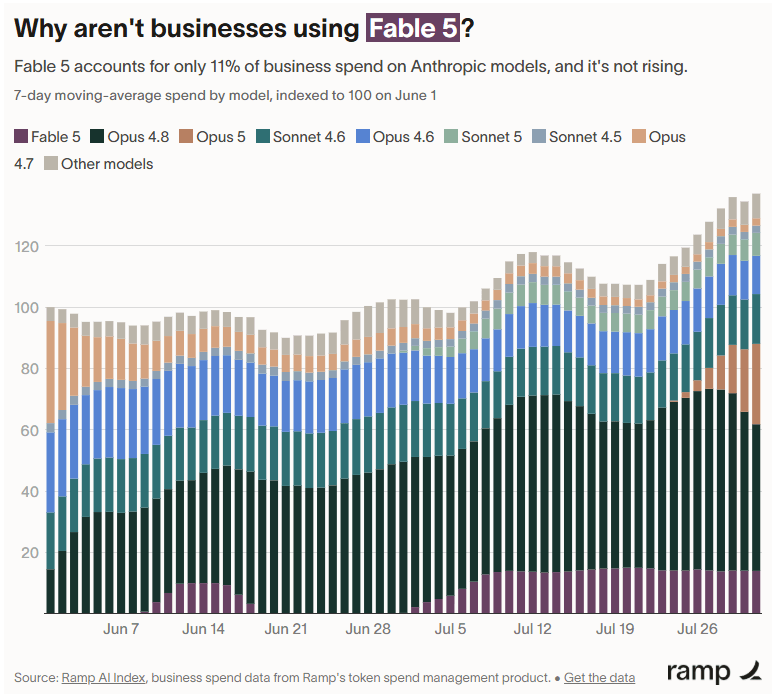
Anthropic's flagship model, Fable 5, is widely regarded as the most powerful AI model on the market. But it turns out US businesses aren't opening their wallets for it. According to spending data compiled by fintech company Ramp, Fable 5 accounted for only about 6% of all tokens Anthropic sold via API in its first month on the market. By revenue, its share was even smaller, at 11.4%.
The comparison point is OpenAI's flagship model, GPT-5.6 Sol, which accounts for 25% of OpenAI's total tokens and 23% of its revenue. Ramp's analysis notes that even though Fable 5 charges a much higher per-token price, revenue tied to the model came in at only about 75% of GPT-5.6 Sol's.
The gap in numbers
| Metric | Fable 5 (Anthropic) | GPT-5.6 Sol (OpenAI) |
|---|---|---|
| Token share | 6% | 25% |
| Revenue share | 11.4% | 23% |
| Input price (per million tokens) | $10 | Relatively lower |
| Output price (per million tokens) | $50 | Relatively lower |
According to Ramp, Fable 5 is priced roughly twice as high as GPT-5.6 Sol or Anthropic's other flagship models. That said, this sample comes from Ramp's own token spend-management product, which skews somewhat toward tech companies. Given that Fable 5 is mostly used for coding tasks, actual adoption could be even lower than these figures suggest.
Why aren't companies buying in?
Ramp economist Ara Karajian attributed Fable 5's weak adoption to pricing, saying "the added performance doesn't justify the added cost." The implication is that a kind of ceiling has formed on how much companies are willing to spend on AI.
But the issue may be more complicated than that. Even if Fable 5 outperforms previous models, companies have little reason to pay a premium if that improvement isn't clearly felt in day-to-day work. Translating generation-over-generation performance gaps into a concrete return-on-investment figure remains an inherently fuzzy exercise. This doesn't mean Fable 5-level pricing represents a hard ceiling on enterprise AI spending — a sufficiently dominant model could still push that ceiling higher.
Growth is slowing at OpenAI and Anthropic too
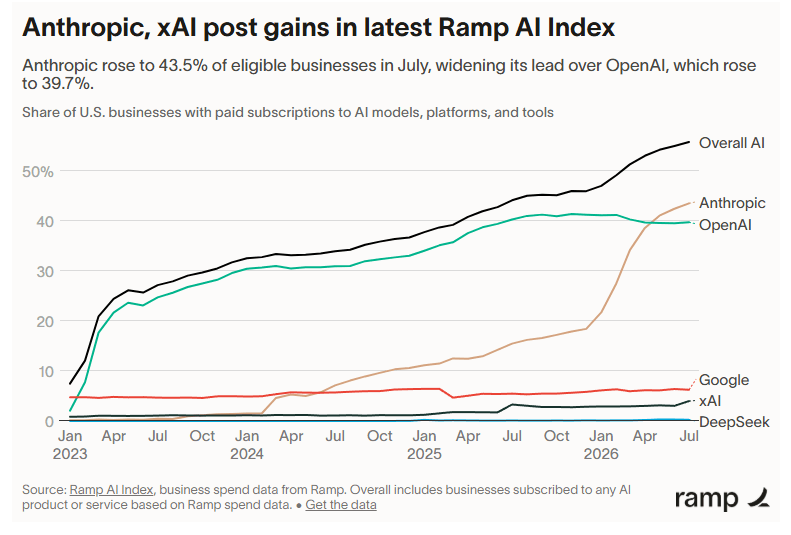
According to Ramp's data, 43.5% of US businesses paid for Anthropic subscriptions or token usage in July, up 1.1 percentage points from the previous month. OpenAI's figure rose to 39.7%, but its increase of just 0.23 percentage points lagged behind overall AI adoption growth. By contrast, xAI grew 0.94 percentage points to reach 4%, its fastest growth pace since July 2025.
New customers are still flowing to US model providers, but the power users who drive the bulk of spending growth are reportedly shifting toward open-source models. According to Ramp, the performance gap between open-source models and top-tier proprietary models has now narrowed to just a few months. That, the firm says, is contributing to the slowdown in growth at both OpenAI and Anthropic.
On August 10, Anthropic announced it would make the introductory pricing for its mid-tier model, Claude Sonnet 5 ($2 per million input tokens, $10 per million output tokens), permanent. For high-volume use cases like coding agents, mid-tier model pricing directly determines operating costs — and the Fable 5 case shows the opposite effect at the high end, where price is acting as a barrier to adoption.
So what does this change?
This data suggests businesses aren't ready to keep increasing AI spending indefinitely. Even when a more capable model arrives, it won't translate into sales unless the improvement shows up as visible value in everyday work. Conversely, as open-source models continue closing the gap with top-tier models on a timescale of just months, companies have growing incentive to switch to cheaper alternatives. This trend also isn't unrelated to concerns, ahead of Anthropic's IPO, about competition from low-cost Chinese models.


Comments